
Fournisseur de Formation Maritime Certifié par DNV  |  CPD Group Provider  |  Depuis 2018

Navigational Audits – From Checklist to Corrective Action

Advanced · Compliance

Navigational Audits – From Checklist to Corrective Action

Online Course

Learn to plan, conduct and report a structured navigational audit — building a defensible, evidence-based audit criteria matrix and driving findings through to verified corrective action, entirely online at your own pace.
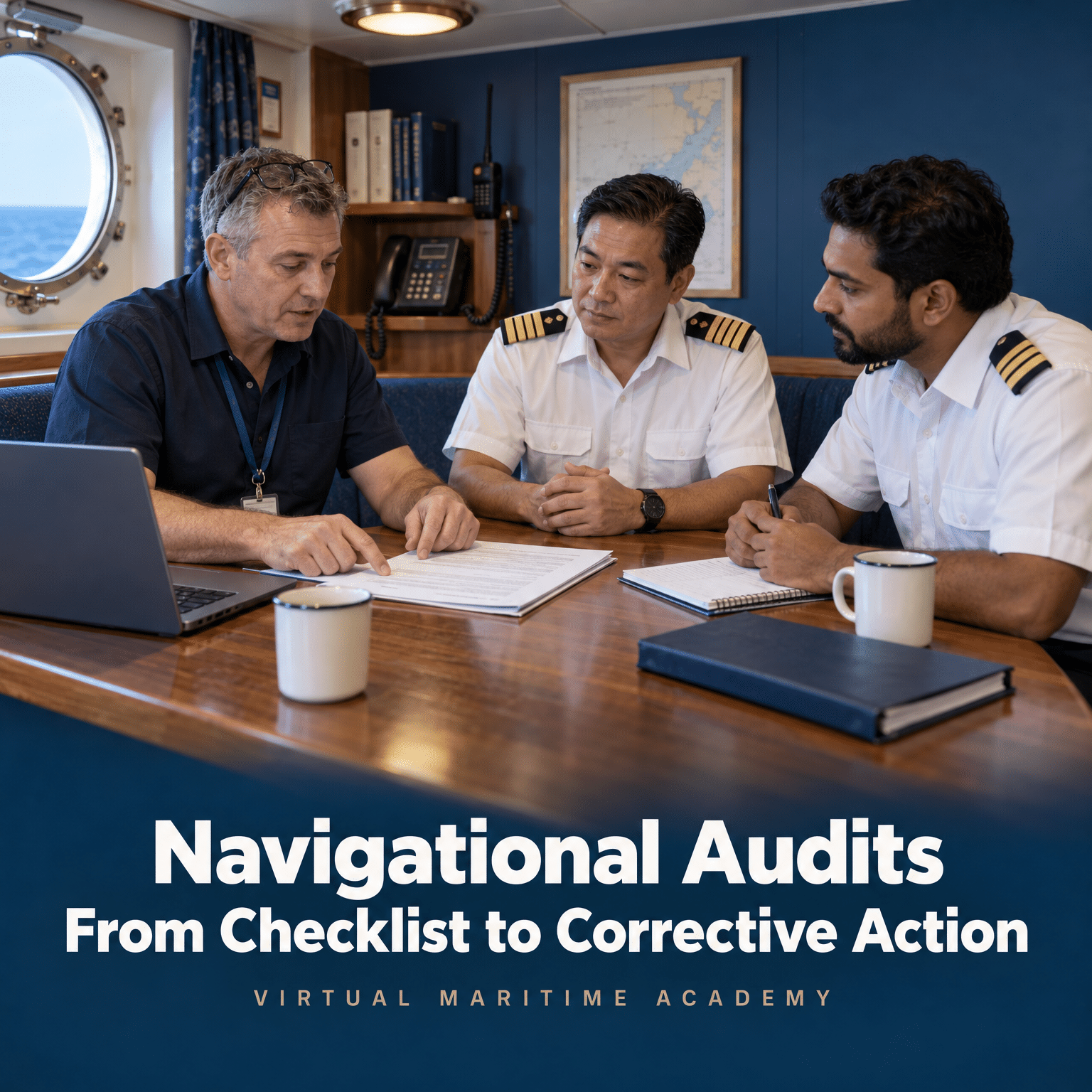
Advanced Level100% OnlineSelf-Paced
Navigational Audits – From Checklist to Corrective Action – course hero
Get Your Navigational Audits – From Checklist to Corrective Action Certificate
16.5 hours · 6 months of access
Navigational Audits – From Checklist to Corrective Action
16.5 hours · 6 months of access
$ 399 USD
Course Overview

From checklist to corrective action

This course is designed to build a navigational auditor's complete skill set: planning and scoping an audit, building a criteria matrix from convention, flag, class, company and industry requirements, and sampling the vessel's own voyages, watches and people to test it.

Across twelve chapters it covers passage planning and voyage execution, bridge operations and watchkeeping, bridge equipment and navigation systems, COLREGs and collision/grounding risk, port approach and pilotage, records and data review, and human factors — before a capstone chapter that works a full audit of a single vessel from brief to closing report.

The course closes on grading findings against objective evidence, writing them to the fact/criterion/risk structure, and driving root-cause corrective action through to verified effectiveness and management review.

Renseignement
Duration16.5 hours
DifficultyAvancé
CategoryCompliance
Delivery100% online, self-paced
Content12 chapters + final assessment
Objectifs d'apprentissage

On successful completion, you will be able to:

These are the learning outcomes established in the course syllabus, Revision 2, 2026.

  • ✓Plan, conduct and report a structured navigational audit that produces defensible, evidence-based findings
  • ✓Build the audit criteria matrix for any vessel from convention, flag, class, company and industry requirements
  • ✓Audit passage planning and voyage execution against the appraisal, planning, execution and monitoring cycle
  • ✓Assess watchkeeping, lookout and bridge resource management as a system rather than as individual error
  • ✓Evaluate the carriage, condition, calibration and operational use of bridge equipment and navigation systems
  • ✓Verify navigational records against recorded data and recognize the red flags that indicate poor record-keeping
  • ✓Grade findings against objective evidence and drive root-cause corrective action through to verified closure
  • ✓Feed navigational audit results into management review so that fleet navigational performance improves measurably
Course Content

Twelve chapters and a final assessment

Each chapter concludes with a short multiple-choice quiz to reinforce key learning objectives. Select a chapter to read what it covers.

—Introduction
How to use this course
Course purpose, scope and the boundary of a navigational audit
Competences, learning outcomes and indicative learner time
Coverage crosswalk to the learning outcomes
Content currency, verification and the limits of this course
01Introduction to Navigational Audits
What a Navigational Audit Is – Definition, Scope and the Boundaries That Keep It Auditable
Why Navigational Audits Matter – Casualty Patterns, Consequences and the Improvement Loop
Types and Approaches – Planned and Targeted, Internal and External, Desktop and On-Board
The Audit Team and Its Roles – Lead Auditor, Auditor, Observer and the Independence Requirement
Reading This Course – Source-Status Labels, Citation Form and the Running Example
02The Regulatory and Industry Framework
The Audit Criteria Hierarchy – Ordering Convention, Flag, Class, Company and Industry Requirements
SOLAS Chapter V – The Core Navigational Criteria and What Each Regulation Actually Requires
STCW Competency and Watchkeeping Requirements – The Benchmark the Auditor Tests Against
The ISM Code – Where the Navigational Audit Legally Lives
COLREGs as Audit Criteria – Turning Rules of the Road into Auditable Evidence
IMO Resolutions and Circulars – Recommendatory Weight and How to Cite It in a Finding
Flag State, Class and Company Requirements – Exemptions, Equivalents and the SMS as Primary Criterion
Industry Standards and Vetting Regimes – ICS, OCIMF TMSA and SIRE as Benchmark, Not Requirement
03Audit Preparation, Planning and the Audit Team
Defining Scope and Objectives – Writing a Scope Statement That Survives Contact With the Ship
The Audit Programme – Frequency, Coverage and Scheduling Against Vessel Operations
Risk-Based Selection – Choosing the Focus From Vessel History, Trade and Previous Findings
The Pre-Audit Desktop Review – Procedures, Previous Findings, Incidents and Port State Records
Building the Audit Checklist – Criteria-Linked, Evidence-Oriented and Not a Scorecard
Sampling Strategy – Selecting Voyages, Ports, Watch Periods and People
Team Assignment, Pre-Briefing and Audit Logistics
The Opening Meeting – Agenda, Tone and Setting Expectations With the Bridge Team
Conducting the Remote and Hybrid Audit – What Presence Adds, and How to Audit Without It
04Auditing Passage Planning and Voyage Management
The Four Elements of Passage Planning – Appraisal, Planning, Execution and Monitoring
Auditing the Planning Process – Who Plans, When, With What Data and Under Whose Approval
The Defect Catalogue – Typical Passage Plan Deficiencies and What Each One Signals
Auditing Voyage Execution – Adherence, Amendment, Re-Planning Triggers and Sign-Off
Voyage Management and Information Flow – Passage Orders, Voyage Data and Communication of Change
Worked Case – The Defective Passage Plan on the MV Kestrel Bay
05Auditing Bridge Operations, Watchkeeping and Bridge Resource Management
Watch Arrangements – Composition, Adequacy and the Manning Decision Behind Them
Lookout – What Rule 5 Requires and What an Auditor Can Actually Verify
Relieving the Watch – The Procedure, Its Failure Points and the Audit Checkpoints at Each Step
Bridge Resource Management – Roles, Task Allocation, Communication and the Duty to Challenge
Navigational Decision-Making – Collision Risk, Safe Speed, Restricted Visibility and the Master's Override
Observing and Interviewing on the Bridge – Method, the Observer Effect and Question Design
06Auditing Bridge Equipment and Navigation Systems
Equipment Inventory and Carriage Requirements – What Must Be Fitted, and the Records That Prove It
ECDIS – Operational Use, Settings, Safety Parameters and the Paperless Decision
ECDIS Alarm Management, Chart Currency and Fallback Arrangements
Radar, ARPA and AIS – Settings, Target Handling and Cross-Checking Discipline
Position Fixing and Monitoring – GNSS, Gyro, Speed Log, Echo Sounder and Under-Keel Clearance
The Voyage Data Recorder – Coverage, Annual Performance Test and Use as Audit Evidence
Maintenance, Defects and Compensating Measures – Auditing the Defective Equipment Procedure
07COLREGs Compliance, Collision and Grounding Risk
COLREGs Compliance as Audit Criteria – Evidence-Based Assessment of Rule Observance
Grounding Risk – Under-Keel Clearance, Squat, Siltation and Tidal Windows
Collision Risk – High-Risk Encounter Geometries and the Decisions That Precede Them
Traffic Separation Schemes and Routeing Measures – Compliance, Deviation and Reporting
The Risk-Based Scenario Analysis Method – Building Scenarios From the Vessel's Own Trade
08Auditing Port Approach, Pilotage and Restricted Waters
Port Approach Procedures – Company Standards, Approach Planning and the Berth-to-Berth Principle
Pilotage – The Pilot Card, the Master and Pilot Exchange and the Limits of the Pilot's Role
Pilot Transfer Arrangements – Carriage, Rigging and the Audit Points That Catch Failures
Restricted Waters, Narrow Channels and Anchorage Practice
Tidal Operations and Weather Windows – Auditing the Decision to Proceed
09Records, Documentation and Data Review
The Deck Log and Bell Book – Required Entries, Completeness and What an Absence Proves
GMDSS and Radio Records – Tests, Distress Traffic and Equipment Status
Voyage Data Recorder Review – Extracting, Interpreting and Reconciling Recorded Data
ECDIS Audit Trails – Route Changes, Alarm History and Setting Changes
Safety Management System Records – Defects, Nonconformities, Near-Misses and Incident Reports
Record Integrity and Red Flags – Recognizing Falsification Without Accusing
10Human Factors, Competency and Familiarisation
Competency Verification – Certificates, Endorsements and the Gap Between Paper and Practice
Familiarisation – Shipboard, Equipment-Specific and After an Incident
Fatigue and Rest Hours – Auditing Records That Are Designed to Comply
Workload, Automation Complacency and Distraction on the Modern Bridge
Safety Culture, Reporting Culture and Leadership – What the Interview Actually Measures
11Findings, Reporting, Corrective Action and Effectiveness
Objective Evidence – What Counts, What Does Not, and How Much Is Enough
Grading Findings – Conformity, Observation, Nonconformity and Major Nonconformity
Writing the Finding – The Fact, Criterion and Risk Structure
Common Finding-Writing Errors and How to Correct Them
The Closing Meeting and the Audit Report – Structure, Tone and Distribution
Root Cause Analysis and Corrective Action Planning
Verifying Effectiveness and Feeding the Management Review
12The Capstone Audit of the MV Kestrel Bay
The Capstone Brief – Vessel, Company, Trade and the Trigger for the Audit
The Capstone Document Pack – SMS Extracts, Passage Plan, Logbook, Recorded Data and Certificates
Working the Audit – Scope, Sampling, Checklist and Evidence Collection
The Model Findings Register – Twelve Findings Graded and Justified
The Model Audit Report and Corrective Action Plan
Closing the Course – What a Navigational Auditor Actually Carries Forward
FAL'examen Final
Online final assessment
Minimum passing score of 70%
Student identity verification

Download the course syllabus here — Revision 2, 2026.

Globally recognized & industry approved

Our courses are developed by experienced maritime professionals and designed to provide practical, competency-based learning that meets internationally recognized standards for training excellence.
CPD Approved ProviderCPD Approved Provider #783378
+5,000
Professionals trained
50+
Countries represented
100+
Companies served
Normes, règlements et lignes directrices couverts

The instruments this course draws on

This course is built on the following conventions, codes and guidance.

SOLAS 1974 as amended, Chapter V, Safety of Navigation
SOLAS Chapter IX and the ISM Code, 2018 Edition, Clauses 8, 9, 11, 12 and 13
STCW Convention and Code, 2010 Manila Amendments, Chapter VIII and Tables A-II/1 and A-II/2
COLREGs 1972 as amended, Rules 5 to 10, 19 and 34
IMO Resolution A.893(21), Guidelines for Voyage Planning
MSC.1/Circ.1503/Rev.1, ECDIS – Guidance for Good Practice
MLC 2006, Regulation 2.3 and Standard A2.3, hours of work and hours of rest
ICS Bridge Procedures Guide, OCIMF TMSA and SIRE 2.0 vetting criteria
Get Certified

From checklist to corrective action

A navigational audit is only as good as the evidence behind it and the corrective action that follows. This course builds that discipline from the ground up: scoping and sampling, auditing the bridge and its equipment against real criteria, and writing findings that survive challenge.

Completed entirely online, in approximately 16.5 hours, at your own pace.

Checklist · Criteria · Evidence · Corrective Action
Course at a Glance
LevelAvancé
Duration16.5 hours
Access6 months
ÉvaluationProctored, 70% to pass
$ 399 USD
Inscription

Revision 2, 2026.

Scroll to Top