Advanced Maritime Cybersecurity
Afloat
Operational cyber risk management for the modern ship — from governance and asset visibility to incident response and recovery, taught through a single running vessel scenario.
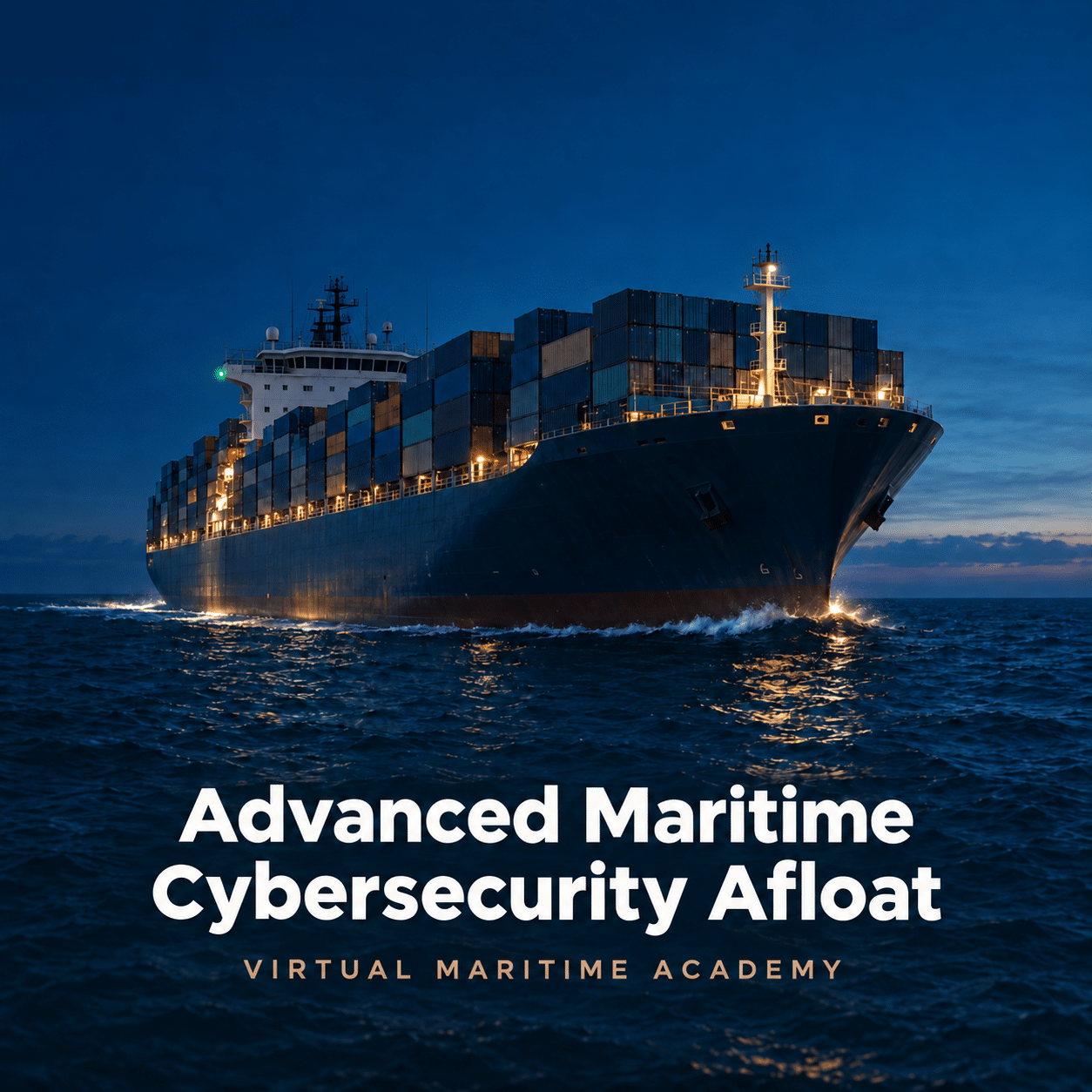
Manage shipboard cyber risk as an operational-safety matter
This course treats cyber risk aboard ship as an operational-safety and continuity issue, not an IT problem bolted onto the vessel. It builds a working, defensible picture of the ship's digital and operational-technology systems, the risks that follow from them, and the controls that actually hold up under audit, vetting and inspection.
Navigation, communications and machinery systems each get dedicated treatment, so officers can recognise anomalies in their own area of responsibility and respond without compromising safety of life or the vessel.
The course closes on incident response, continuity and recovery — preserving evidence, sustaining operations through an event, and converting what happened into corrective action and stronger controls.
Developed by experienced maritime professionals
Our courses are developed by experienced maritime professionals and are designed to provide practical knowledge and competency-based learning for today's maritime industry. On successful completion, participants receive a certificate issued by the Virtual Maritime Academy.
A digital certificate is delivered by email on successful completion.
On successful completion, you will be able to:
These are the learning outcomes established in the course syllabus, Revision 1, 2026.
- ✓Manage shipboard cyber risk as an operational-safety and continuity risk rather than an IT problem
- ✓Satisfy flag, class, charterer and port-State expectations by aligning shipboard practice with IMO and industry cyber guidance
- ✓Produce a defensible asset, dependency and risk picture for any vessel in the fleet
- ✓Select, verify and evidence protective controls that withstand audit, vetting and inspection
- ✓Recognise navigation, communications and machinery anomalies and respond without compromising safety
- ✓Preserve evidence and investigate shipboard cyber events to a standard that survives later scrutiny
- ✓Sustain operations through a cyber incident and recover with validated system integrity
- ✓Strengthen fleet resilience by converting incidents into corrective action and improved controls
Ten chapters and a final assessment
Each chapter closes with a short quiz drawn from its own content. Select a chapter to see what it covers.
—Introduction
01Orientation – Operating Safely in a Cyber Course
02Maritime Cyber Risk, Governance, and the Human Element
03Shipboard Digital Systems, IT/OT, and Asset Identification
04Threats, Vulnerabilities, Attack Paths, and Risk Assessment
05Protecting the Ship – Preventive and Resilience Controls
06Navigation and Communications Cyber Resilience
07Machinery, Power, Cargo, and OT Cyber Resilience
08Detecting, Triaging, and Investigating Shipboard Cyber Events
09Incident Response, Continuity, and Recovery
10Integrated Shipboard Cyber Capstone
FAL'examen Final
Course syllabus: Revision 1, 2026.
This course is designed for shipboard officers and personnel responsible for cyber risk, incident response and continuity aboard any vessel.
A proctored final assessment with a minimum score of 70%
Each chapter closes with a short quiz drawn from its own content. The course ends with a proctored final assessment requiring a minimum score of 70% to pass, delivered entirely online.
Students must submit official photo identification before starting the course.
Grounded in the instruments that govern shipboard cyber risk
This course addresses the instruments that inform maritime cyber risk management, governance and incident-response obligations.
Build a defensible, ship-specific cyber risk practice
Good shipboard cyber risk management is deliberate, not improvised. That means an honest asset picture, controls that survive audit, and a crew that recognises trouble and responds without making it worse.
This course builds that competence — completed entirely online, in approximately 20 hours, at your own pace.
Revision 1, 2026. Digital certificate delivered by email on successful completion.