
Port Security · Careers
How to Become a Port Facility Security Officer (PFSO): Complete Career Guide
Virtual Maritime Academy · November 6, 2026
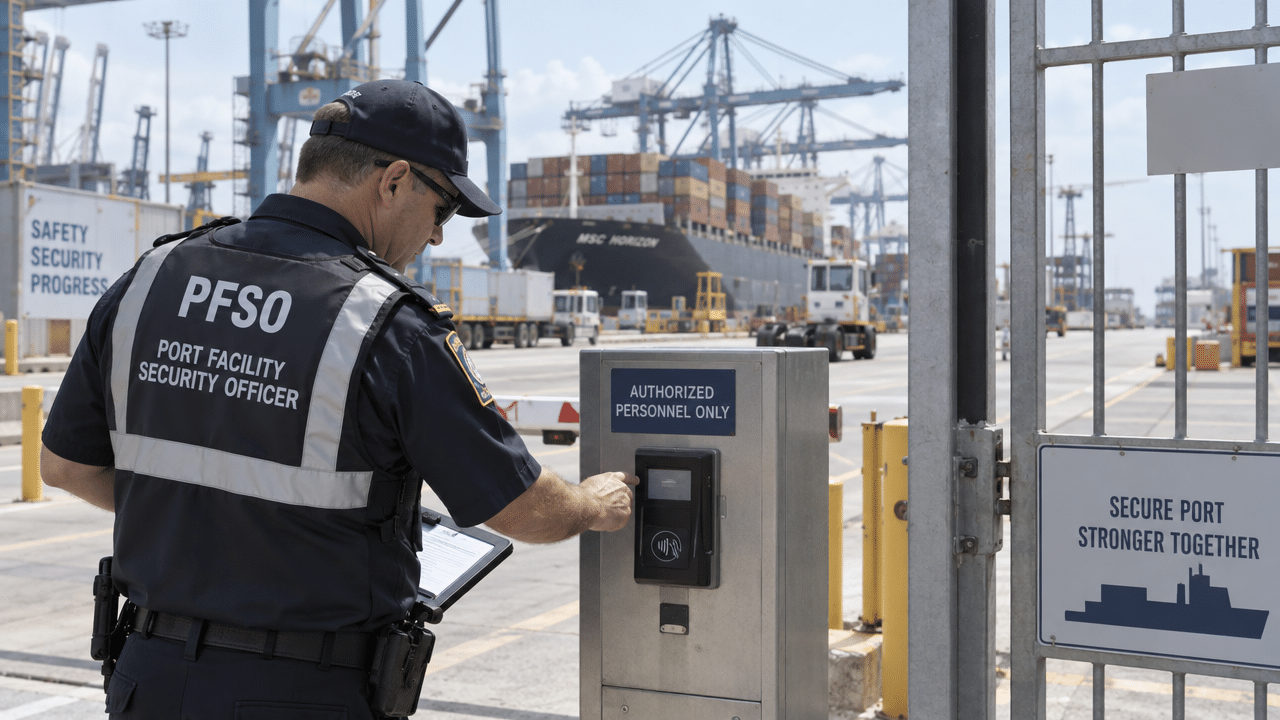
If you are asking how to become a port facility security officer, the honest answer is that there is no single on-ramp. PFSOs come from deck departments, from corporate security teams, and from terminal operations offices, and each path arrives at the same certification requirement by a different route. This guide walks through the entry points that actually lead somewhere, the training and DNV-recognized certification you need, and the qualification gaps that quietly disqualify otherwise capable candidates.
What the PFSO Role Actually Covers Under the ISPS Code
The ISPS Code, introduced in 2004 after global maritime security thinking shifted hard toward prevention, requires every port facility that services SOLAS vessels to appoint a security officer with real authority over day-to-day operations. That person is the PFSO. The role carries legal responsibility for the facility’s Port Facility Security Plan, for running drills and exercises, for setting and adjusting MARSEC levels in coordination with the relevant government authority, and for being the first call when a ship’s security officer flags a concern during berthing.
A PFSO also owns the facility’s relationship with visiting ships’ SSOs and with the Company Security Officers who oversee fleet-wide compliance. When a port authority hires for this seat, they are hiring someone who can read a vessel’s security plan, cross-reference it against the facility’s own plan, and make a defensible decision under time pressure, often during an overnight shift with limited backup on site.
Three Realistic Entry Paths Into the Role
Most working PFSOs did not plan this career from day one. They moved into security responsibilities from one of three adjacent roles, and recognizing which route matches your background makes the rest of the planning much easier.
- Port operations staff, such as terminal superintendents and stevedoring supervisors, who already know the cargo flow and the physical layout of the facility.
- Security background candidates, including former military police, customs officers, and corporate security managers, who bring investigative and incident-response experience.
- Facility management professionals, including health and safety managers and operations managers, who inherit security oversight informally before pursuing formal certification.
Port operations staff tend to move fastest once certified, because they already understand vessel scheduling and the facility’s physical constraints. Security background candidates usually need deliberate exposure to cargo operations and ISPS documentation before a port authority will trust them with the seat, even if their investigative instincts are strong. Facility management professionals often formalize a role they are already performing in practice, which can make certification feel like a catch-up step rather than a new direction.
Certification Requirements: The PFSO/MFSO Course and DNV Recognition
The PFSO/MFSO course is the recognized entry credential, and most hiring port authorities will not consider a candidate without it. The course covers the structure of the ISPS Code, the content and approval process for a Port Facility Security Plan, risk assessment methodology specific to port facilities, drill and exercise design, and the legal authority a PFSO holds to restrict access or deny entry.
Completing the course through a DNV-certified provider matters for a practical reason. DNV certification signals to port authorities, flag states, and auditors that the training met a recognized third-party standard rather than an in-house briefing. During a port state control inspection or a certification body audit, the facility needs to produce evidence that its PFSO holds a credential an external body recognizes, and that evidence carries far more weight when it traces back to accredited training rather than a photocopy of attendance.
How to Become a Port Facility Security Officer: A Step-by-Step Career Path
Strip away the variation in starting points and the path looks fairly consistent across the ports that hire for this role.
- Build two to three years of hands-on experience in port operations, facility security, or a related enforcement role, so you understand how a terminal runs before you are asked to secure one.
- Complete the PFSO/MFSO course through a DNV-certified training provider, and keep the certificate, attendance record, and course outline on file, since hiring committees often ask for all three.
- Shadow or assist an existing PFSO through at least one full security drill and one real MARSEC level change, if your current employer allows it, so your first decision under pressure is not also your first exposure to the process.
- Apply specifically for PFSO, deputy PFSO, or port security coordinator postings rather than general operations roles, since the title itself filters out candidates without the certification.
- Maintain the certification through refresher training, and stay current on amendments to the facility’s approved security plan, because most port authorities audit this annually.
Deputy PFSO and port security coordinator postings are worth targeting directly, because they let you build drill and incident-response experience that full PFSO roles expect, without yet carrying sole legal responsibility for the plan.
Common Qualification Gaps That Hold Candidates Back
Hiring managers reject qualified-looking resumes more often than you would expect, and the reasons tend to repeat across interviews.
- No documented experience running or participating in a security drill or exercise, even a tabletop version.
- Certification that covers general maritime security awareness rather than the specific PFSO/MFSO curriculum a port authority requires.
- No familiarity with the facility’s own approved Port Facility Security Plan format, which varies by port authority and flag state.
- Weak written reporting, since PFSOs file incident reports and liaise with government agencies in writing as often as they do in person.
- No prior exposure to coordinating with customs, coast guard, or police during an actual security escalation.
Closing these gaps before you apply costs far less time than closing them after a port authority passes on your application. A few hours observing a drill, a direct conversation with a current PFSO about their reporting workflow, or a refresher module focused specifically on plan documentation can move a candidate from borderline to clearly qualified.
Ready to start building the qualifications a PFSO appointment needs? Explore the PFSO/MFSO Course at Virtual Maritime Academy.
Explore the full range of maritime courses at Académie Maritime Virtuelle (VMA).
À Propos de Nous
Virtual Maritime Academy is a global leader in online maritime education and training, offering courses designed to meet the evolving needs of the shipping industry. As a DNV Certified Maritime Training Provider with CPD accreditation, we deliver cutting-edge programs that prepare seafarers and maritime professionals for today’s and tomorrow’s challenges. 🌊⚓