
ISM Code · Training
ISM Code Training Online: Who Needs It and Why?
Virtual Maritime Academy · November 16, 2026
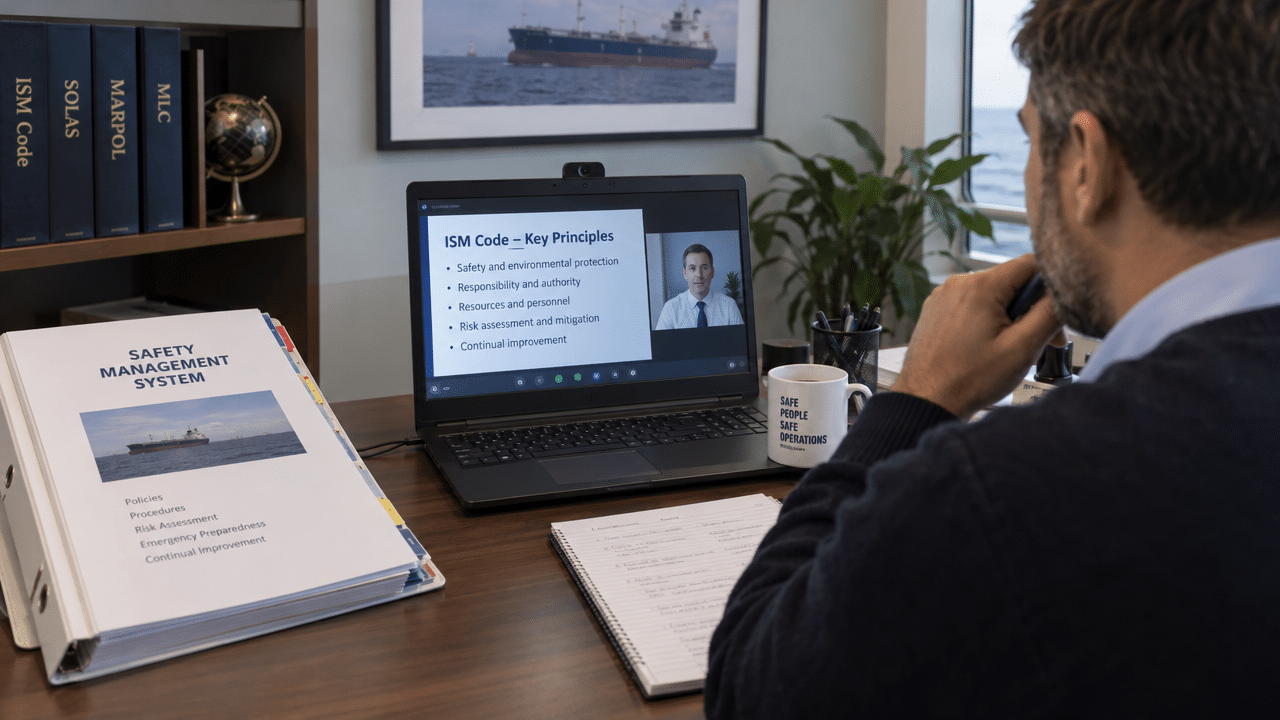
If you have spent any time around a ship management office, you already know the International Safety Management (ISM) Code is more than a binder of procedures gathering dust in the master’s cabin. It sets out how a company organizes, documents, and verifies the way it manages safety and pollution prevention across its fleet. That requirement is exactly why so many DPAs, masters, and auditors are now looking for ISM Code training online instead of waiting for a seat to open in a classroom course three months from now. A well built remote course covers the same depth a flag state or class society expects, without pulling a seafarer off a vessel or a shore manager out of the office for a week.
What the ISM Code Actually Asks of a Company
The Code itself is short, which is part of the problem. It tells a company to establish a safety management system, assign a Designated Person Ashore, define responsibilities for the master, and build in processes for reporting non-conformities, handling emergencies, and reviewing performance. It does not tell anyone exactly how to write a shipboard procedure, how to run an internal audit that actually finds something useful, or how to close out a finding so it does not reappear at the next external audit. That gap between what the Code requires and how a company actually operationalizes it is where most ISM-related headaches come from, and it is also where training earns its keep.
Companies that treat the Code as a one-time compliance exercise tend to end up with paperwork that looks fine on a shelf but falls apart the moment an auditor asks a follow-up question. The people who keep the system alive year after year are the ones who understand the intent behind each clause, not just the clause number.
Who Needs ISM Code Training Online
Formal ISM Code training is not reserved for a single job title. A handful of roles carry direct, named responsibility under the Code, and each one needs a slightly different depth of understanding.
- Designated Persons Ashore. The DPA is the link between the ship and top management, and the Code expects this person to have direct access to senior leadership and enough authority to act on safety concerns. Training here needs to cover escalation procedures, non-conformity trending, and how to keep that access to top management meaningful rather than symbolic.
- Masters and senior officers. A master signs off on the shipboard safety management system in practice every single day, through drills, meetings, and the countless small decisions that either support the system or quietly route around it. Training for masters should connect the written procedures to the judgment calls they make on watch.
- Internal and external auditors. Auditing the ISM Code well requires more than a checklist. An auditor needs to know how to gather objective evidence, how to word a finding so it is defensible, and how to distinguish a genuine non-conformity from a minor documentation slip.
- QHSE managers and superintendents. This group usually writes the procedures everyone else has to follow, which means they need the clearest grasp of how the whole system fits together, including how ISM interacts with the ISPS Code, the MLC, and a company’s own flag state requirements.
Why Training Matters Beyond Just Reading the Code Text
Reading the Code gives you the words. It does not give you the pattern recognition that comes from seeing how real audits unfold, how real non-conformities get raised, or how a real emergency drill exposes a gap nobody had written down. Training built around actual cases and real audit scenarios does something a static read-through cannot: it shows you what a weak objective statement looks like next to a strong one, or how a near miss report that gets buried quietly turns into a serious incident eighteen months later.
There is also a practical certification angle. Flag states, port state control, and class societies increasingly want to see evidence that key personnel have completed structured ISM training, not just a signature on an induction form. A documented course with assessments and a certificate gives a company something concrete to point to during an audit, and it gives the individual something to point to when moving between employers.
Beyond the paperwork benefit, there is a cultural one. Crews and shore staff who understand why a procedure exists tend to follow it more consistently than those who were simply handed a document and told to sign it. That difference shows up in drill performance, in how quickly a near miss gets reported, and in whether a safety meeting produces real discussion or a quick round of signatures.
What a Good ISM Code Course Actually Covers
Not every course labeled “ISM training” covers the same ground, so it helps to know what a genuinely useful one includes before you enroll or enroll your team.
- A walkthrough of the Code’s clauses paired with real examples of how each one shows up in day-to-day ship operations, rather than a line-by-line reading of the regulation.
- The structure and purpose of a safety management system, including how manuals, procedures, forms, and records connect to each other and to the company’s actual risk profile.
- The DPA’s role, authority, and reporting lines, with enough detail that a new DPA understands what the position legally requires on day one.
- Non-conformity management: how to raise one, grade it, investigate root cause, and verify that a corrective action actually worked rather than just closing the paperwork.
- Internal audit technique, including interview skills, sampling, and how to write findings that hold up under scrutiny from a flag state or recognized organization.
- Management review: what top management is expected to examine, how often, and what evidence demonstrates that the review was substantive rather than a formality.
A course that skips straight to definitions and skips the case material tends to produce people who can quote the Code but struggle the first time they sit in front of an auditor.
How to Get Started
The most practical first step is matching the course to the role rather than picking a generic one-size-fits-all package. A DPA and a junior QHSE officer do not need identical depth on every module, even though both benefit from the same foundational understanding of the Code.
- Confirm the certificate is recognized. Check that the training provider is accredited or affiliated with a body your flag state and class society will accept, so the certificate actually counts toward compliance rather than just professional development.
- Check the format fits your operation. Self-paced online delivery lets a master complete modules between watches and lets shore staff fit a course around an already packed schedule, instead of blocking out a full week for travel and classroom time.
- Look for assessment, not just attendance. A course that ends with a quiz or practical exercise gives you a better read on whether the material actually landed than one that simply issues a certificate for watching videos to the end.
- Plan for refreshers. The Code gets amended, interpretations shift, and port state control priorities change from year to year, so treat the first course as a foundation rather than a one-time box to tick.
Once you have identified who on the team needs what level of training, enrolling is usually the easy part. The harder part, and the part that actually protects the company, is choosing a course substantial enough that the people holding ISM responsibilities walk away genuinely prepared for the job rather than just holding a certificate.
Ready to get trained on the ISM Code in practice? Explore the ISM Code in Practice Course at Virtual Maritime Academy.
Explore the full range of maritime courses at Académie Maritime Virtuelle (VMA).
À Propos de Nous
Virtual Maritime Academy is a global leader in online maritime education and training, offering courses designed to meet the evolving needs of the shipping industry. As a DNV Certified Maritime Training Provider with CPD accreditation, we deliver cutting-edge programs that prepare seafarers and maritime professionals for today’s and tomorrow’s challenges. 🌊⚓