
Compliance · Training
Maritime Lead Auditor Training Online: ISM, ISPS and MLC Explained
Virtual Maritime Academy · November 17, 2026
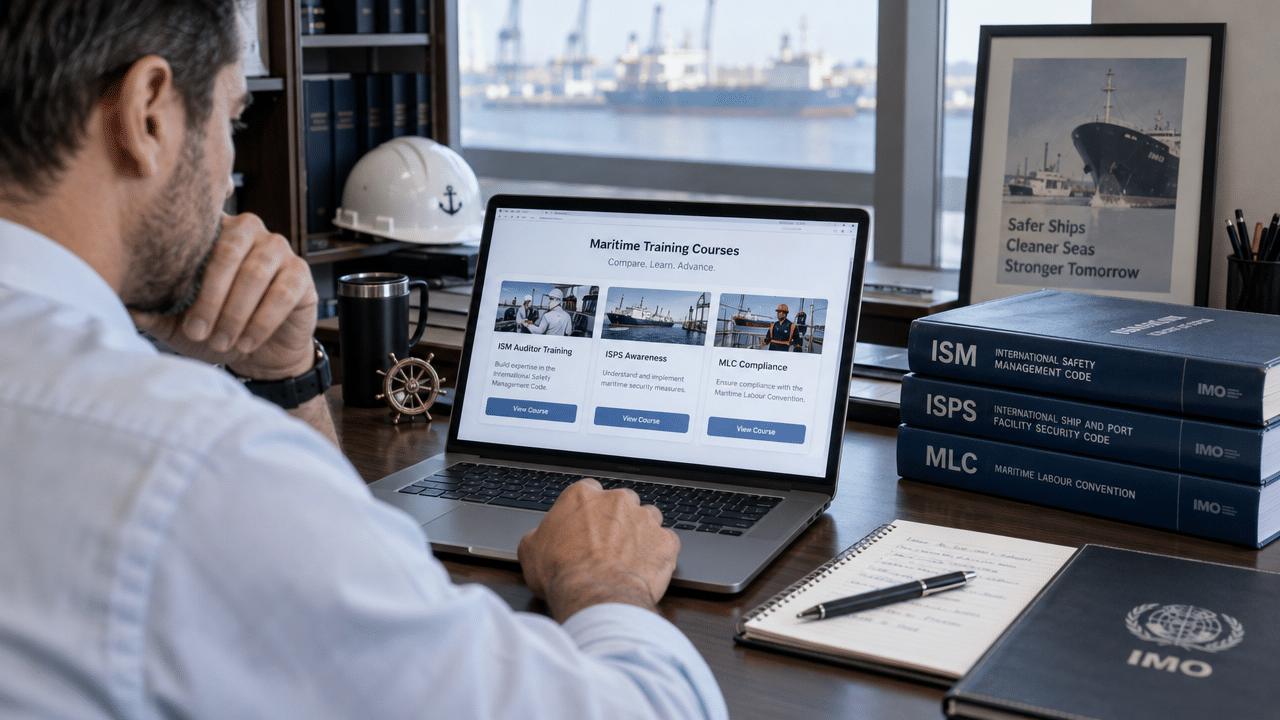
When you search for maritime lead auditor training online, you’ll find a long list of providers and an even longer list of course names: ISM Lead Auditor, ISPS Lead Auditor, MLC Lead Auditor, and various combined ISM-ISPS-MLC packages. The sheer variety makes a fairly simple decision feel complicated. This guide works through the actual decision points, not another pitch for why auditing matters, so you can walk away knowing which course fits your role, your company’s management system, and the certification body expectations you’re working against.
Why maritime lead auditor training online isn’t a single-course answer
Ask five different seafarers or DPAs which lead auditor course they took and you’ll likely get five different answers, because the question of which course to take doesn’t have one correct response. Some companies operate a single integrated management system covering safety, security, and labour conditions together, and for them a combined course mirrors how their actual audits run. Others keep ISM, ISPS, and MLC administered separately, with different lead auditors assigned to each, and a single-code course matches that structure much better.
The split exists because ISM, ISPS, and MLC are three different codes with three different legal bases, three different sets of required records, and in many companies three different responsible departments. ISM sits under the ISM Code and SOLAS, ISPS under the ISPS Code and SOLAS Chapter XI-2, and MLC under the Maritime Labour Convention, which deals with seafarer welfare, hours of work and rest, and living conditions rather than ship or port security. Auditing all three well means understanding each code’s own structure, even though the audit methodology itself (planning, evidence gathering, findings, reporting) stays consistent across all of them.
When a single-code course makes more sense
A single-code course is the right call more often than course marketing suggests. If your job is to audit only one management system, for example you’re the designated person ashore for ISM alone, or you sit on the port facility security side and only ever audit ISPS, a combined course teaches you two codes you’ll rarely if ever use in practice.
Here is when single-code training tends to be the better fit:
- You already hold a parallel qualification. If you were certified as ISM lead auditor years ago and your company has now asked you to also cover MLC audits, an MLC-only course fills the actual gap instead of making you repeat ISM and ISPS material you already know.
- Your company separates responsibilities by code. Many fleets assign ISPS auditing to the company security officer function and keep ISM auditing with the safety management team. If that is your structure, training matched to your actual assignment is more useful than one broad certificate.
- You need a certificate quickly for one specific audit. A single-code course is shorter, and if you have an upcoming MLC inspection or internal audit already scheduled, narrowing your study time to that one code gets you ready faster.
- Budget or time is tightly constrained. One code at a time, spread across separate enrolments, is often easier to justify against a training budget than a single larger combined fee.
The tradeoff is that you will need a fresh enrolment if your responsibilities expand later, and most flag states and certification bodies will still expect each code’s audit competence documented on its own terms regardless of how you got there.
When the combined ISM-ISPS-MLC Lead Auditor course makes more sense
The combined course earns its place when your actual audit work treats the three codes as one exercise rather than three separate ones. If you audit a vessel’s full management system in a single visit and your findings report covers safety, security, and labour conditions together, training that teaches the overlap and the differences at the same time fits your real workflow far better than three disconnected single-code certificates.
Combined training tends to be the stronger choice when:
- You are a DPA, superintendent, or internal auditor responsible for the whole management system, not one slice of it.
- Your company runs integrated audits where one auditor or audit team covers ISM, ISPS, and MLC in the same visit, which is increasingly common on smaller fleets and with third-party audit firms.
- You are building a career as an external or internal lead auditor and want one certificate that signals competence across all three codes rather than assembling three separate ones over time.
- You have never held any lead auditor qualification before, in which case learning the three codes together, with the shared audit methodology taught once instead of three times, is usually more efficient than three separate courses.
Taken as a whole, the combined route also tends to work out cheaper and faster than three single-code enrolments if you already know you will need all three eventually, since you are not paying for the shared methodology content three separate times.
What ISO 19011:2026 means in this context and why the format matters
Whichever path you choose, the audit methodology itself comes from ISO 19011, the international guideline for auditing management systems, and the 2026 edition is the version lead auditor courses should now be built around. ISO 19011:2026 refines how audit evidence, auditor competence, and remote or blended audit techniques are described compared with the previous edition, and it is the reference auditors and certification bodies increasingly expect to see reflected in training.
Here is why that matters for your course choice: the ISO 19011 methodology, not the code-specific content, is actually what makes a course a lead auditor course rather than a general awareness course. A course built on an outdated version of ISO 19011 may still teach ISM, ISPS, or MLC requirements accurately, but it can leave gaps in how it frames audit planning, competence criteria, and evidence grading, which are exactly the skills a certification body or flag state inspector probes when they ask how you reached a finding. When comparing providers of maritime lead auditor training online, checking which ISO 19011 edition the course is built on is worth doing before checking price or course length.
A simple framework for picking the right course for your role
If you are still unsure, work through these questions in order rather than starting from which course looks more comprehensive on paper:
- What does your job actually require you to audit? If you audit one code only, start there. If your role already spans all three in practice, the combined course saves you time.
- How does your company structure its audits? One combined visit per ship favours combined training. Separate audit programmes per code favour single-code training matched to each.
- What do you already hold? Do not repeat content you have already been certified on. Fill the specific gap instead.
- What is your timeline? An upcoming audit with a fixed date often settles the question in favour of the single code you need right away.
- Where do you want your career to go? If you are aiming to work as an independent or third-party lead auditor, the combined certificate is generally the stronger long-term credential.
None of these questions has a universally right answer, which is exactly why a blanket recommendation, always take the combined course, or always start with ISM alone, tends to serve a training catalogue more than it serves you. Match the course to the audit you will actually be asked to perform, confirm it is built on the current ISO 19011 edition, and the rest of the decision falls into place on its own.
Ready to pick the right auditor training path? Explore the ISM-ISPS-MLC Lead Auditor Course at Virtual Maritime Academy.
Explore the full range of maritime courses at Académie Maritime Virtuelle (VMA).
À Propos de Nous
Virtual Maritime Academy is a global leader in online maritime education and training, offering courses designed to meet the evolving needs of the shipping industry. As a DNV Certified Maritime Training Provider with CPD accreditation, we deliver cutting-edge programs that prepare seafarers and maritime professionals for today’s and tomorrow’s challenges. 🌊⚓