Canadian Regulations · Deck Officers
Canadian Maritime Regulations: Essential Guide for Deck Officers
Virtual Maritime Academy · November 11, 2026
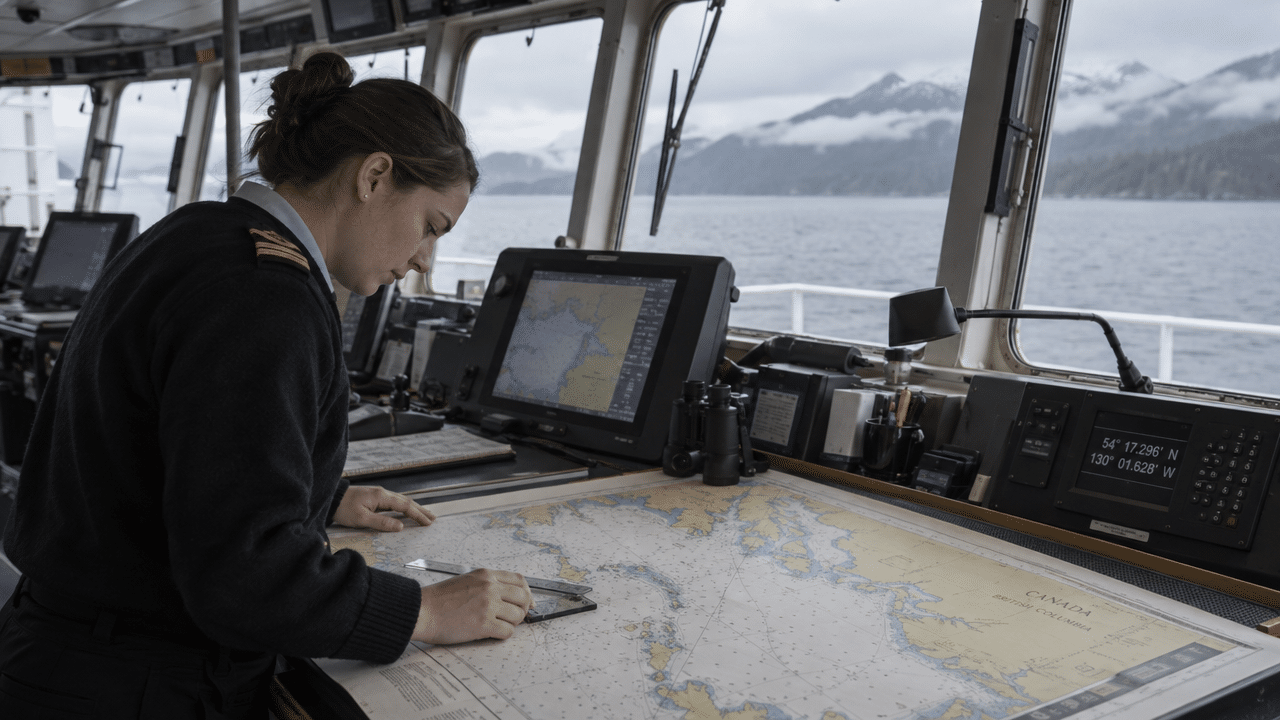
If you’re sailing Canadian waters, or planning to, you already know that international conventions only tell part of the story. Canadian maritime regulations for deck officers add a second layer of rules on top of the IMO framework, covering everything from crewing levels to local waterway procedures, and if you don’t know where the two overlap and where they part ways, you can find yourself technically compliant with SOLAS and still out of step with Transport Canada’s expectations. This guide walks through what makes Canada’s approach distinct, who enforces it, and how to get ready for the training and exams that prove you know it.
Why Canada Layers Its Own Rules Onto International Requirements
The IMO conventions give every flag state a common baseline for safety, training, and certification, and Canada ratifies most of them in full. But Canada’s coastline runs past Arctic ice, through the Great Lakes and Seaway, along fishing grounds, and into dozens of ferry routes that see nothing like the open-ocean traffic SOLAS was built around. Transport Canada’s response is to add a domestic layer of regulation on top of the international one, tailored to those conditions. For a deck officer, that means two sets of obligations run in parallel: the STCW-based certificate structure recognized internationally, and the domestic licensing and examination system that Transport Canada Marine Safety and Security administers directly.
The Canada Shipping Act, 2001 and Transport Canada’s Authority
Transport Canada Marine Safety and Security is the federal body responsible for regulating vessels, crews, and marine operations in Canadian waters, and its main legislative authority is the Canada Shipping Act, 2001. The Act replaced decades-old legislation dating back to 1936, consolidating safety, pollution prevention, and personnel requirements into one modern framework. It is enabling legislation, meaning the Act itself sets broad objectives while the detailed rules deck officers actually work under, the Marine Personnel Regulations, the Vessel Safety Regulations, and dozens of others, are made under its authority. The Act also provides the mechanism for Canada to bring its international treaty commitments into domestic law, so when Canada ratifies an IMO instrument, the Canada Shipping Act, 2001 is usually the vehicle that gives it legal force at home.
Canadian Maritime Regulations for Deck Officers: What You Need to Know
For a working deck officer, the Marine Personnel Regulations are the single most important document in this whole structure. They set out the certification required for each position on board, the manning levels a vessel must carry, and the watchkeeping arrangements that apply to Canadian-flagged ships and to foreign vessels operating in Canadian waters. They also introduce voyage classifications, home trade, near coastal, and inland, that do not map directly onto the IMO’s own near-coastal and ocean-going categories, so an officer moving between international and domestic trade needs to understand both systems side by side.
- Certification and manning requirements set out in the Marine Personnel Regulations
- Canadian voyage classifications (home trade, near coastal, inland) and how they affect your certificate’s scope
- Vessel safety requirements covering lifesaving equipment, fire protection, and stability, inspected under the Vessel Safety Regulations
- Pollution prevention duties under the Canada Shipping Act, 2001, including ballast water and discharge reporting
- Ice navigation and Arctic shipping safety rules for officers working north of the treeline
- Incident and casualty reporting obligations owed directly to Transport Canada, separate from any flag-state reporting
Vessel safety requirements round out the picture. Transport Canada inspectors check lifesaving appliances, fire protection systems, hull and machinery condition, and stability data against standards that mirror SOLAS in most respects but add Canadian-specific detail for cold-water survival, ice conditions, and domestic ferry operations. A deck officer who only studies the international convention text will miss some of this detail entirely, since parts of it exist only in Canadian regulation and in Transport Canada’s own ship safety bulletins.
Where Canadian Rules Diverge From International IMO Requirements
The clearest divergence shows up in how voyages and vessels get classified. The IMO’s categories work well for deep-sea trade, but a huge share of Canadian tonnage, ferries, fishing vessels, tugs, and small passenger craft, never leaves coastal or inland waters where those categories barely apply. Canada’s home trade and inland classifications fill that gap, and they come with their own certification and manning scales that have no exact IMO equivalent. An officer holding an STCW certificate earned abroad cannot simply assume it transfers; Transport Canada runs its own equivalency assessment before issuing a Canadian certificate of competency.
Arctic operations show the same pattern from a different angle. Canada implements the Polar Code, but its own Arctic Shipping Safety and Pollution Prevention Regulations go further in places, setting ice navigator requirements and vessel construction standards shaped by decades of experience in the Northwest Passage and Hudson Bay. A deck officer certified for polar waters under the international code still needs to confirm what Canada expects on top of it before taking a vessel north.
Preparing for Canadian Maritime Regulations Training and Exams
Transport Canada’s examinations are notoriously specific about Canadian content, and officers who prepare using only international STCW study material tend to get caught out on exactly the points covered above. Start with the current edition of the Marine Personnel Regulations and read it alongside the Canada Shipping Act, 2001, rather than treating either one in isolation. Add Transport Canada’s Ship Safety Bulletins and current Notices to Mariners to your study list, since examiners draw on recent bulletins more often than candidates expect.
Officers working toward management-level endorsements, Chief Officer and Master certificates in particular, face an extra layer again. Beyond watchkeeping and personal certification, they are expected to understand fleet-level compliance: how vessel safety certificates get issued and renewed, what triggers a Transport Canada inspection, and how incident reporting obligations flow up through the company. That leadership-level knowledge rarely appears on an operational-level syllabus, so it is worth building a separate study plan for it well before the exam date.
- Work through the current Marine Personnel Regulations clause by clause, not just the summary guides
- Cross-reference each certification requirement against the sections of the Canada Shipping Act, 2001 it stems from
- Review recent Ship Safety Bulletins and Notices to Mariners for the trade area you plan to work in
- Practice scenario-style oral exam questions, since Transport Canada examiners focus heavily on applied judgment under pressure
- Keep sea time and training records organized well ahead of your application, since gaps slow Transport Canada’s review
Ready to get up to speed on Canadian maritime regulations? Explore the Canadian Rules & Regulations Course (Leadership Level) at Virtual Maritime Academy.
Explore the full range of maritime courses at Virtual Maritime Academy.
About Virtual Maritime Academy
Virtual Maritime Academy is a global leader in online maritime education and training, offering courses designed to meet the evolving needs of the shipping industry. As a DNV Certified Maritime Training Provider with CPD accreditation, we deliver cutting-edge programs that prepare seafarers and maritime professionals for today’s and tomorrow’s challenges. 🌊⚓