
DNV Certified Maritime Training Provider  |  CPG Group Provider  |  Online since 2018

Intermediate · Operations

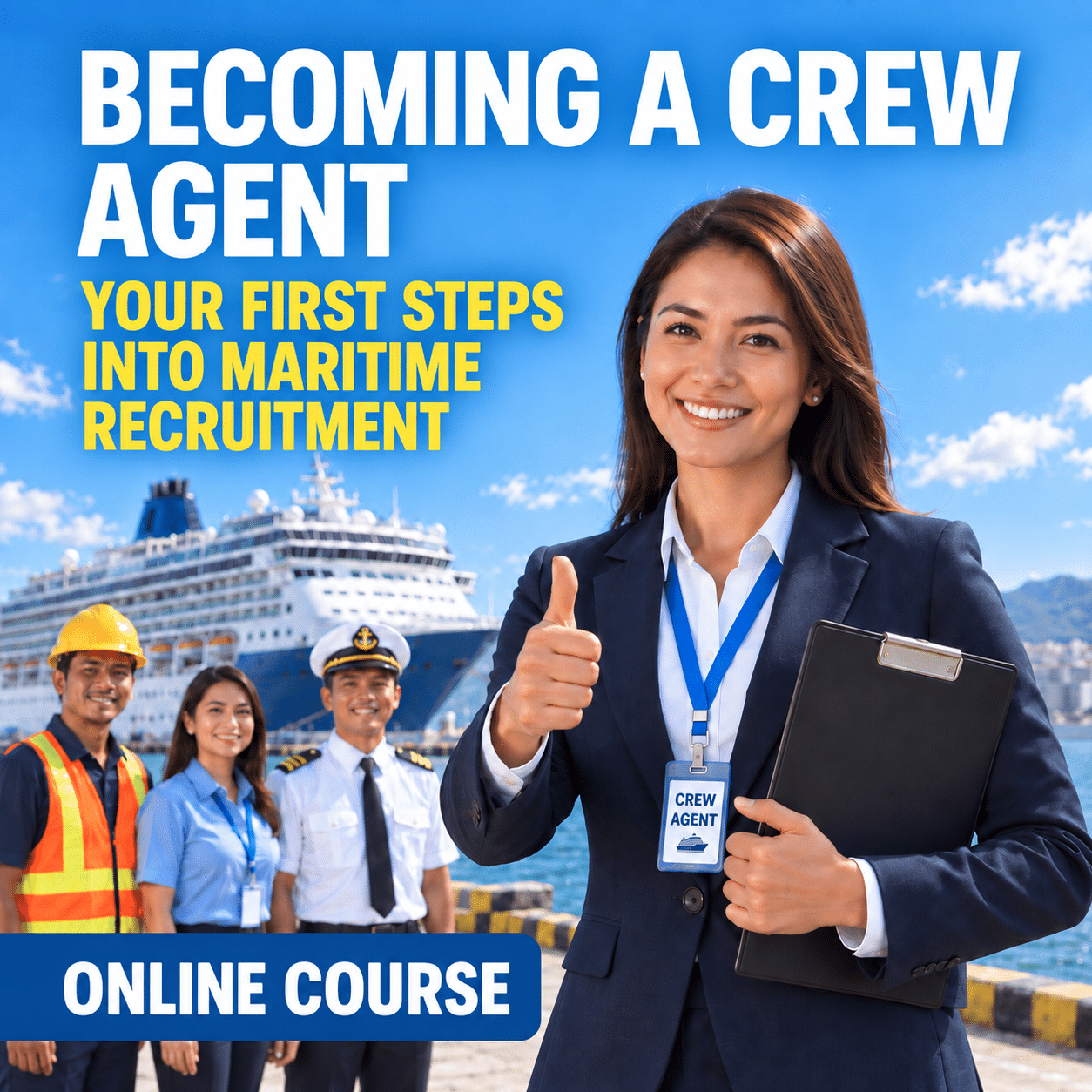
Become a Crew Agent MasterClass

Your first steps into maritime recruitment. A fully online, self-paced MasterClass covering the complete crew lifecycle, from vacancy demand and ethical sourcing to documents, medical fitness, crew changes and repatriation.
MLC, 2006 Reg. 1.4STCW100% OnlineSelf-paced
30
Hours
17
Chapters
70
Lessons
Become a Crew Agent MasterClass, online course
Get Your Crew Agent MasterClass Certificate
CPD Approved Provider · 30 hours · 6 months of access
Limited-time offer
Become a Crew Agent MasterClass — limited-time offer
30 hours · 6 months of access
$ 1000 USD $ 499 USD Save 40%
Course Overview

The complete crewing method, from vacancy demand to record closure

The crew agent sits between a vessel's operational need and a seafarer's livelihood. Every decision you make, how a requisition is written, which certificates you verify, whether a medical restriction is referred, when a visa is confirmed, has consequences for compliance, for the voyage and for the person joining the ship. This MasterClass teaches that work as a controlled process rather than as improvisation under time pressure.

Across seventeen chapters you will build the full crew lifecycle: the crewing ecosystem and your own authority within it, vessel types and manning context, the international regulatory framework governing seafarer employment, recruitment and placement service governance under MLC, 2006, crew planning and requisitions, ethical sourcing, structured interviewing and selection, document and STCW verification, medical fitness controls, the Seafarers' Employment Agreement, visas and crew changes, rotation planning, pre-joining and onboarding, sector-specific crewing, welfare and complaints, data protection and recruitment fraud, and finally agency quality management with an integrated capstone.

Whether you are entering maritime recruitment for the first time or formalizing experience already gained in a crewing department, the course gives you the defensible method, the document discipline and the ethical controls the role demands.

Course Information
Duration30 hours
DifficultyIntermediate
CategoryOperations
PrerequisiteNone, an interest in maritime recruitment is sufficient
Content17 chapters + integrated capstone + final assessment
Why Choose Virtual Maritime Academy

A career entry route that does not depend on being hired first

Crewing is normally learned on the job, in fragments, from whoever happens to be in the office. This MasterClass sets out the whole method in sequence, including the parts that only become visible when something goes wrong: a fraudulent certificate, a refused visa, a last-minute medical hold, an abandonment complaint, a compromised payment instruction.

A hardcopy certificate is posted to your address free of charge on successful completion.

What the course includes
Delivery100% online, self-paced
ScopeFull crew lifecycle, all vessel sectors
Access period6 months to all materials
Support24/7 learner support
CapstoneRecruitment-to-joining simulation
AssessmentProctored online, no classroom
Learning Outcomes

On completion of this course, you will be able to:

These outcomes reflect the formal learning outcomes established in the course syllabus.

  • Protect the company and its seafarers from unlawful or unethical recruitment by applying MLC, 2006 placement controls.
  • Convert a vessel's operational need into a controlled requisition and a defensible, job-related shortlist.
  • Verify identity, competence, certification and medical fitness before any candidate is promised a berth.
  • Deliver crew changes on schedule across visas, immigration, travel, port formalities and vessel interfaces.
  • Adapt crewing judgement across cruise, yacht, cargo, tanker, offshore and specialist operations.
  • Safeguard seafarer welfare, complaints and personal data throughout the recruitment and placement chain.
  • Detect document fraud, recruitment scams and payment compromise before they reach the vessel.
  • Demonstrate agency quality, records, service levels and performance to clients, auditors and regulators.
Course Content

Seventeen chapters, an integrated capstone and a final assessment

Each chapter concludes with multiple-choice questions. Select a chapter to read its lesson list and study time.

01Course Introduction
Course overview and competences to be achieved
How to use this course
The hierarchy of sources: mandatory, guidance and company practice
02The Maritime Crewing Function and the Crew Agent's Role1.25 h
The maritime crewing ecosystem, business models, stakeholders and shore-ship interfaces
The crew lifecycle, from vacancy demand to repatriation and record closure
Authority and escalation, what the crew agent decides and what must be referred
Professional conduct, accuracy, traceability and urgency without shortcuts
03Vessel Types, Shipboard Organization, Ranks and Manning Context1.5 h
Vessel sectors and operating profiles, cargo, tanker, passenger, yacht and specialist trades
Departments, ranks and reporting lines, deck, engine, electro-technical and hotel
Competence and manning concepts, STCW levels, safe manning and company complement
Turning vessel context into recruitment criteria, essential, desirable and red flags
04International Regulatory Framework and Seafarer Employment Rights2.25 h
How maritime regulation applies, sources, applicability and the weight of each instrument
MLC recruitment and placement, Regulation 1.4, Standard A1.4 and Guideline B1.4.1
Connected employment protections, age, medical, qualifications, conditions and complaints
Related IMO and ILO instruments, STCW, SOLAS, FAL, C185, ISM and ISPS
05Recruitment and Placement Service Governance, Licensing and Ethical Controls2.25 h
Agency authorization and the compliance register, jurisdiction, scope and regulatory change
Fee and financial-protection controls, the prohibition on charging seafarers for placement
Operational controls and records, controlled procedures, complaint systems and recordkeeping
Client, supplier and integrity due diligence, principals, sub-agents and corruption risk
06Crew Planning, Vacancy Requisitions and Competency Profiles1.5 h
Manpower demand and relief planning, sources of demand, data needed and priority classification
Building the competency profile, statutory, operational and behavioural criteria
Commercial and employment parameters, contract conditions, approval and change control
Critical-path planning, backward planning, constraints and escalation triggers
07Candidate Sourcing, Ethical Recruitment and Talent Pools1.75 h
Sourcing strategy by role and sector, database, external and sector-specific channels
Vacancy communication, required information, honest claims and inclusive criteria
Talent-pool management, candidate status, refresh cycles and pipeline metrics
Recruitment scams and candidate vulnerability, recognition, response and candidate education
08Screening, Interviewing, Reference Checking and Selection1.75 h
Application screening, evidence-first review, gaps, inconsistencies and screening outcomes
Structured maritime interviews, planning, questioning technique, language and records
References and employment history, authorization, reference questions and conflicting information
Selection and recommendation, comparative decisions, conditional offers and candidate communication
09Seafarer Documents, STCW Certificates and Authenticity Verification2.25 h
Document taxonomy and control, identity, competency, employment and sea-service evidence
The STCW crosswalk for crew agents, certificate categories, recognition and endorsements
Authenticity and fraud indicators, official verification, internal consistency and response
The assignment-specific document matrix, role, flag, vessel, route, expiry and exception control
10Medical Fitness, Health Documentation and Fitness-to-Join Controls1.5 h
Seafarer medical certification, purpose, administrative checks, restrictions and referral
Additional health and travel documentation, assignment controls and time-sensitive change
Medical data privacy and communication, minimization, access control and respectful handling
Fitness-to-join status control, green, hold, refer, last-minute issues and the audit trail
11Seafarers' Employment Agreements, CBAs, Wages and Conditions of Employment2.0 h
The SEA lifecycle and its control, purpose, parties, pre-signing review and execution
Terms and cross-checks, assignment particulars, consistency checks and amendments
CBAs, wages, leave and work/rest context, collective agreements and wage information
Repatriation and employment-protection controls, questionable terms and record integrity
12Visas, Immigration, Travel, Crew Lists, Joining and Repatriation2.0 h
Crew-change planning inputs, the movement map, visa verification and identity facilitation
Travel booking and control, itinerary construction, instruction packs and the confirmation cycle
Crew lists and port/vessel coordination, data quality, FAL context and the port agent interface
Disruption and repatriation, the disruption playbook, decision priorities and closure
13Crew Rotation, Relief Planning and Operational Continuity1.75 h
Rotation planning fundamentals, planning horizon, position criticality, succession and overlap
The relief readiness dashboard, readiness dimensions, traffic-light logic and forward expiry
Contingency and late relief, backup candidates, extension control and port alternatives
Continuity communication, the daily operational picture, escalation triggers and lessons learned
14Pre-Joining, Onboarding, Security Access and Vessel Integration1.25 h
The pre-joining package, administrative content, operational content and information control
Training and familiarization interfaces, pre-joining training, onboard familiarization and evidence
Security and access, ISPS awareness, access credentials and sensitive information
Joining confirmation and closeout, positive confirmation, handover tracking and file transition
15Sector-Specific Crewing, Cruise, Yacht, Cargo, Tanker and Special Operations2.0 h
Cruise and passenger vessels, large mixed departments, guest-facing competence and mass crew changes
Yachts and superyachts, small-team versatility, qualifications, flag context and discretion
Cargo, container, bulk and ro-ro ships, lean manning, trade patterns and role continuity
Tankers and hazardous or specialized trades, competence, consequence and client matrices
Offshore, ferries, tugs and special-purpose operations, non-standard profiles and transferable method
16Seafarer Welfare, Complaints, Safeguarding, Equality and Ethical Response1.5 h
Welfare risk across the crew lifecycle, pre-employment, during assignment and post-assignment
Complaints and grievance routing, receiving concerns, non-retaliation and escalation channels
Safeguarding, equality and respectful recruitment, job-related criteria and abuse indicators
Critical welfare scenarios, abandonment, coercion, exploitation and documentation
17Data Protection, Cybersecurity, Confidentiality and Recruitment Fraud1.5 h
The crewing data lifecycle, data categories, collection purpose, retention and disposal
Secure digital operations, account security, document exchange, remote work and messaging
Recruitment and payment fraud, candidate-facing scams, business email compromise and controls
Incident response, containment, need-to-know communication and corrective action
18Agency Operations, Client Service, Quality Management, KPIs and Integrated Capstone1.75 h
Operating controls and service levels, workflow ownership, indicators and client communication
Quality, records and suppliers, controlled records, supplier control and corrective action
KPIs, analytics and continual improvement, balanced measures, trends and management review
The integrated capstone, recruitment to joining, required decisions and evaluation
19Course Final Assessment1.0 h
Proctored online final assessment
Passing score requirement of 70%
Course feedback
Hardcopy certificate mailed at no additional cost

Total study time is 30 hours, including the final assessment. Revision 2, 2026.

Who Should Take This Course

This MasterClass is for anyone who places seafarers on ships, or who intends to. It suits newcomers entering maritime recruitment as a career and equally those already working in a crewing department who want the complete, defensible method rather than inherited habit.

It is particularly relevant for
Crew agents and crewing coordinators
Recruitment and placement service staff
Crewing and operations managers
Manning agency owners and compliance officers
HR professionals moving into maritime
Seafarers transitioning to a shore-based role

Globally recognized & industry approved

Virtual Maritime Academy is an Approved Provider of The CPD Group, demonstrating our commitment to delivering high-quality maritime education that meets internationally recognized standards for training excellence.

CPD Approved ProviderCPD Approved Provider #783378
MLC, 2006Regulation 1.4 and Standard A1.4, the recruitment and placement basis of this programme
+5,000
Professionals trained
50+
Countries represented
100+
Companies served
Assessment & Certification

Proctored online, with a passing mark of 70%

Each chapter concludes with multiple-choice questions, followed by the integrated capstone and a final assessment. The final assessment is entirely online, with no in-person classroom attendance necessary, and a proctor will monitor you throughout.

As mandated by The CPD Group, you must submit official photo identification before starting the course. A hardcopy certificate is then mailed to your address at no additional cost.

Final Assessment Equipment Requirements
Device — desktop or laptop with webcam and microphone. Not compatible with tablets, cell phones or Chromebooks.
Operating system — Windows 10 or later, Mac OS X 11 or later.
Browser — Google Chrome v39 or later, or Mozilla Firefox v34 or later.
Internet — 3 Mbps or better upload and download.
Hardware — 8 GB RAM or more, microphone, speakers, webcam.
Regulations, Codes and Conventions

Built on the instruments that govern seafarer recruitment

The course teaches the hierarchy of sources explicitly: what is mandatory, what is guidance and what is company practice.

MLC, 2006, as amended, Reg. 1.4 / Std A1.4
STCW Convention and Code, as amended
SOLAS 1974, Ch. V/14 and Ch. XI-2
IMO FAL Convention 1965, as amended
ILO Convention No. 185, Seafarers' Identity Documents
IMO Resolution A.1047(27), Safe Manning
The ISM Code, as amended
National RPS licensing, flag-State and immigration requirements
Get Certified

Place seafarers lawfully, ethically and on schedule

A crew change succeeds or fails weeks before the joining date, in the requisition that was written, the certificate that was verified, the visa that was confirmed and the record that was kept. The crew agent owns all of it.

This MasterClass gives you the method, the document discipline and the ethical controls to carry that responsibility, completed entirely online, in approximately 30 hours, at your own pace.

Source · Verify · Place · Repatriate
Course at a Glance
LevelIntermediate
Duration30 hours
Access6 months
AssessmentProctored, 70% to pass
$ 1000 USD $ 499 USD
Enroll Now

Revision 2, 2026. A hardcopy certificate is mailed to your address at no additional cost.

Scroll to Top