DNV Certified Maritime Training Provider  |  CPD Group Provider  |  Online since 2018

Incident Investigation for Shipboard and Shoreside Teams

Intermediate · Safety

Incident Investigation
for Shipboard and Shoreside Teams

A disciplined, evidence-led method for investigating shipboard incidents, near misses and non-conformities — from first response and evidence preservation through root-cause analysis to corrective action and reporting that withstands scrutiny.
100% OnlineSelf-Paced8 Hours
8
Hours
6
Chapters
6
Months access
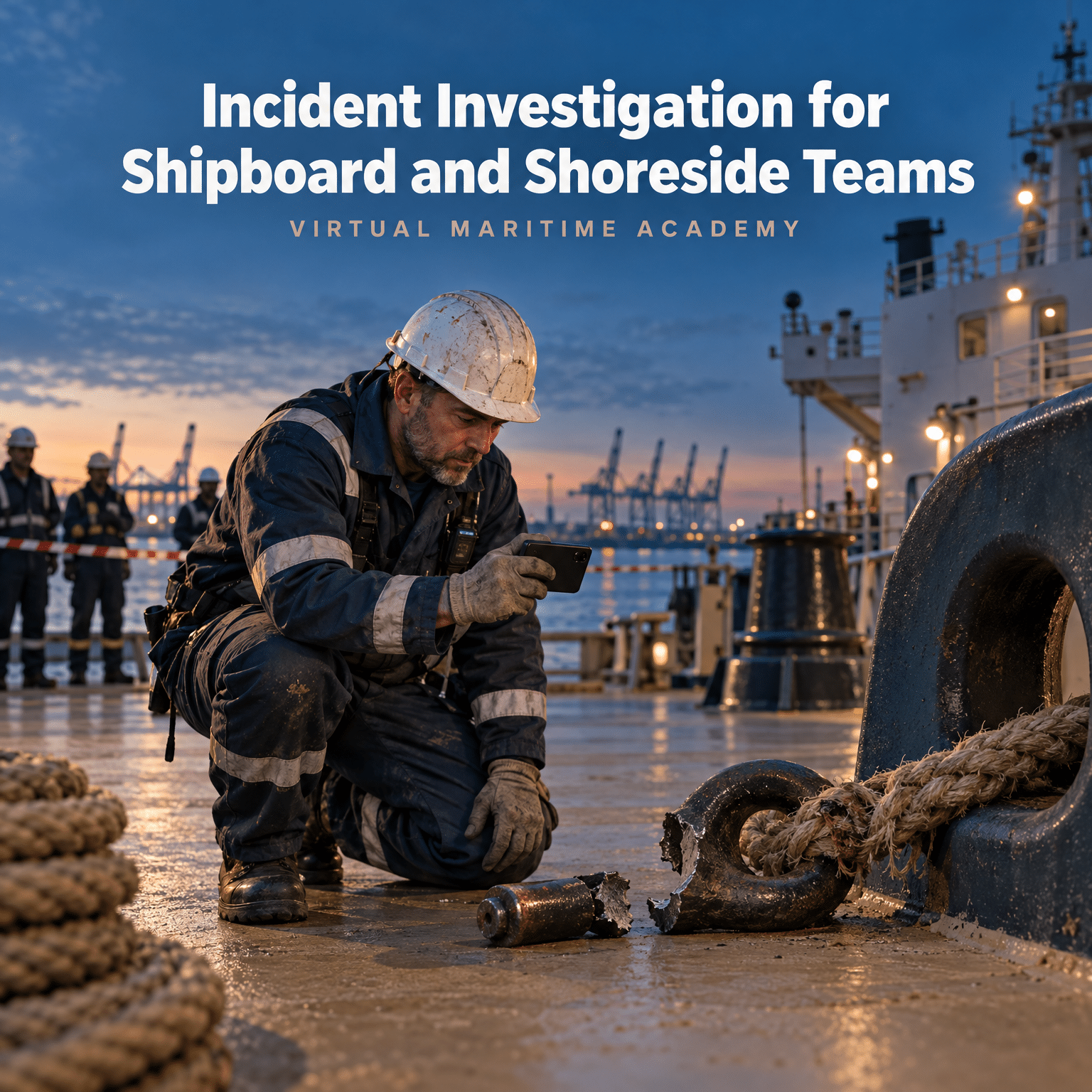
Incident Investigation for Shipboard and Shoreside Teams — online course
Get Your Incident Investigation Certificate
8 hours · 6 months of access
Limited-time offer
Incident Investigation for Shipboard and Shoreside Teams — limited-time offer
8 hours · 6 months of access
$ 400 USD $ 199 USD Sale
Course Overview

A disciplined method for turning incidents into prevention

This course gives shipboard and shoreside teams a consistent, prevention-focused method for investigating accidents, incidents, near misses and non-conformities — one that converts an unwanted event into usable safety information rather than a search for someone to blame.

Working through the full investigation sequence, you will protect life and the scene, preserve physical, documentary, digital and testimonial evidence, build a reliable sequence of events from confirmed fact, and identify the immediate, contributing and underlying causes behind what happened.

The course then covers developing corrective and preventive actions that are assigned, tracked and verified for effectiveness, and writing clear, evidence-linked reports — and draws the line between an internal company investigation and a statutory marine safety investigation.

Course Information
Duration8 hours
DifficultyIntermediate
CategorySafety
Delivery100% online, no classroom attendance
Content6 chapters + final assessment
Why Choose Virtual Maritime Academy

Developed by experienced maritime professionals

Our courses are developed by experienced maritime professionals and are designed to provide practical knowledge and competency-based learning for today's maritime industry. On successful completion, participants receive a certificate issued by the Virtual Maritime Academy, recognized worldwide as evidence of professional development and competency.

A digital certificate is delivered by email on successful completion.

Competencies achieved
Respond to shipboard incidents with a disciplined, prevention-focused investigation method
Preserve physical, documentary, digital and testimonial evidence before it is lost or contaminated
Build a reliable, evidence-led sequence of events that separates confirmed fact from assumption
Identify immediate, contributing and underlying causes without stopping at the first visible error
Develop corrective and preventive actions that are assigned, tracked and verified for effectiveness
Produce clear, evidence-linked investigation reports that withstand scrutiny
Distinguish company investigation from statutory marine safety investigation
Learning Outcomes

On successful completion, you will be able to:

These are the learning outcomes established in the course syllabus, Revision 1, 2026.

  • ✓Respond to shipboard incidents, near misses and non-conformities with a disciplined, prevention-focused investigation method
  • ✓Preserve physical, documentary, digital and testimonial evidence before it is lost, altered or contaminated
  • ✓Build a reliable, evidence-led sequence of events that separates confirmed fact from assumption
  • ✓Identify immediate, contributing and underlying causes without stopping at the first visible error
  • ✓Develop corrective and preventive actions that are assigned, tracked and verified for effectiveness
  • ✓Produce clear, evidence-linked investigation reports that withstand scrutiny
  • ✓Distinguish company and SMS investigation from statutory marine safety investigation, and apply ISM Code reporting and corrective-action requirements with confidence
Course Content

Six chapters and a final assessment

Each chapter concludes with a short multiple-choice quiz to reinforce key learning objectives. Select a chapter to read what it covers.

—Introduction
Course purpose, scope and how to use this course
Competences to be achieved
The boundary between internal investigation and statutory marine safety investigation
01Investigation Purpose, Scope and Mindset
Why Investigate – Prevention, Organizational Learning and the Three Core Questions
Investigation versus Blame Allocation – Learning Culture and Fair Treatment
Accidents, Incidents and Non-Conformities – Defining the Event Types
Near Misses and Hazardous Occurrences – Learning Before Loss Occurs
Roles and Responsibilities – Shipboard and Company Investigation Authority
Internal Investigation versus Statutory Marine Safety Investigation
02Initial Response and Preservation of Evidence
Protecting Life, Environment, Vessel and Property First
Controlling Continuing Hazards and Making Required Notifications
Securing the Scene – Preventing Unnecessary Disturbance
Protecting Perishable Evidence and Managing Access
Physical Evidence, Photographs and Video
Documents, Records and Digital/Electronic Information
Witness Accounts – Identifying Witnesses Early Without Contaminating Memory
03Fact Gathering, Interviews and Event Sequencing
Planning the Fact-Gathering Process – People, Task, Equipment, Environment and Management
Facts, Assumptions and Information Gaps
Relevant Operational Records and Effective Scene Photography
Preserving Originals and Metadata
Interview Preparation and the Open-to-Closed Question Funnel
Neutral Follow-Up and Avoiding Leading, Accusatory and Compound Questions
Recording and Confirming Key Information
Building the Event Sequence – Time Anchors, Corroboration and Missing Information
04Cause Analysis: From Immediate Events to System Factors
From Chronology to Explanation – Event versus Cause
Correlation versus Supported Causal Connection
Levels of Causal Factors – Immediate, Contributing and Underlying/System
Structured Why Questioning and Basic Barrier/Control Analysis
Testing a Causal Statement Against the Evidence
Fatigue, Workload, Communication and Situational Awareness
Procedures, Training, Supervision, Equipment and Organizational Pressure
05Corrective and Preventive Actions
Correction versus Corrective Action – Symptom Treatment versus Cause Control
Eliminating or Reducing Exposure – Engineering and Technical Changes
Procedure and Work-Process Improvements
Training, Briefing and Reminders as Supporting Controls
Action Ownership, Due Dates and Verifiable Completion Criteria
Effectiveness Review and Fleet-Wide Applicability
06Investigation Reports, Follow-Up and Lessons Learned
Report Structure – Event Summary, Scope and Chronology
Analysis, Findings and Corrective Actions in the Report
Report Quality – Factual, Evidence-Linked Language
Separating Fact, Analysis and Conclusion
Avoiding Unsupported Blame Statements
Action Tracking and Verification
Communicating Lessons Learned, Trend Analysis and Feedback to Controls
FAFinal Assessment

Download the course syllabus here — Revision 1, 2026.

Who Should Attend

This course is designed for anyone who may be called on to investigate, or assist in investigating, a shipboard incident, near miss or non-conformity — afloat or ashore.

Prerequisite
There is no prerequisite for this course.
It is particularly relevant for
Deck and engineering officers — build the skills to lead or assist a shipboard investigation from the first response onward
Masters and senior officers — apply a consistent, defensible investigation method across the vessel
Safety officers — strengthen evidence-handling and root-cause analysis skills
DPAs and superintendents — oversee and review investigations conducted aboard managed vessels
Shoreside SMS and HSEQ managers — apply the same disciplined method to shoreside incidents and non-conformities
Anyone new to investigation work — build a solid, evidence-led foundation before leading a first case

Globally recognized & industry approved

Our courses are developed by experienced maritime professionals and designed to provide practical, competency-based learning that meets internationally recognized standards for training excellence.
CPD Approved ProviderCPD Approved Provider #783378
+5,000
Professionals trained
50+
Countries represented
100+
Companies served
Assessment & Certification

A final assessment with a minimum score of 70%

Each chapter concludes with multiple-choice questions, followed by a final assessment with a required passing score of 70%. The final assessment is online, proctored, and has a duration of 1 hour. A computer or tablet with a webcam and a reliable internet connection is required.

Students must submit official photo identification before starting the course, as mandated by DNV and the CPD Group.

A fee may apply for re-attempting the final assessment.

Certificate
On successful completion you receive a Virtual Maritime Academy Certificate of Completion — a digital certificate delivered by email. There is no hardcopy certificate for this course.
Final Assessment Technical Requirements
Device — a computer or tablet with a webcam.
Operating system — Windows 10 or later, macOS 11 or later.
Browser — Google Chrome or Mozilla Firefox, latest version recommended.
Internet — minimum 3 Mbps upload and download speed.
Hardware — minimum 8 GB RAM, functional webcam, microphone and speakers or headset.
Standards, Regulations and Guidance Covered

Grounded in the instruments that govern incident investigation and reporting

Incident investigation does not happen in a regulatory vacuum. This course addresses the instruments that set reporting, investigation and corrective-action requirements for the maritime industry.

ISM Code — International Safety Management Code, Section 9
SOLAS — Safety of Life at Sea, 1974, as amended, Chapter IX
IMO Resolution MSC.255(84) — Casualty Investigation Code
IMO Resolution A.1075(28) — CI Code Implementation Guidelines
MSC-MEPC.7/Circ.7 — Guidance on Near-Miss Reporting
MLC, 2006, as amended — Regulation 4.3 / Standard A4.3
MARPOL, as amended — Pollution-Incident Reporting Provisions
ISO 45001:2018, including Amendment 1:2024
Get Certified

Turn the next incident into a lesson, not a repeat

A good investigation is designed, not improvised. That means protecting the scene and the evidence, building a sequence of events from confirmed fact, tracing causes down to the level that actually changes something, and closing the loop with actions that are verified to work.

This course builds that competence — completed entirely online, in approximately 8 hours, at your own pace.

Preserve · Investigate · Correct · Report
Course at a Glance
LevelIntermediate
Duration8 hours
Access6 months
AssessmentProctored, 70% to pass
$ 400 USD $ 199 USD
Enroll Now

Revision 1, 2026. Digital certificate delivered by email; no hardcopy for this course.

Scroll to Top