DNV Certified Maritime Training Provider  |  CPG Group Provider  |  Online since 2018

Port Agency: A Practical Start for New Agents – Online Course –

Intermediate · Operations

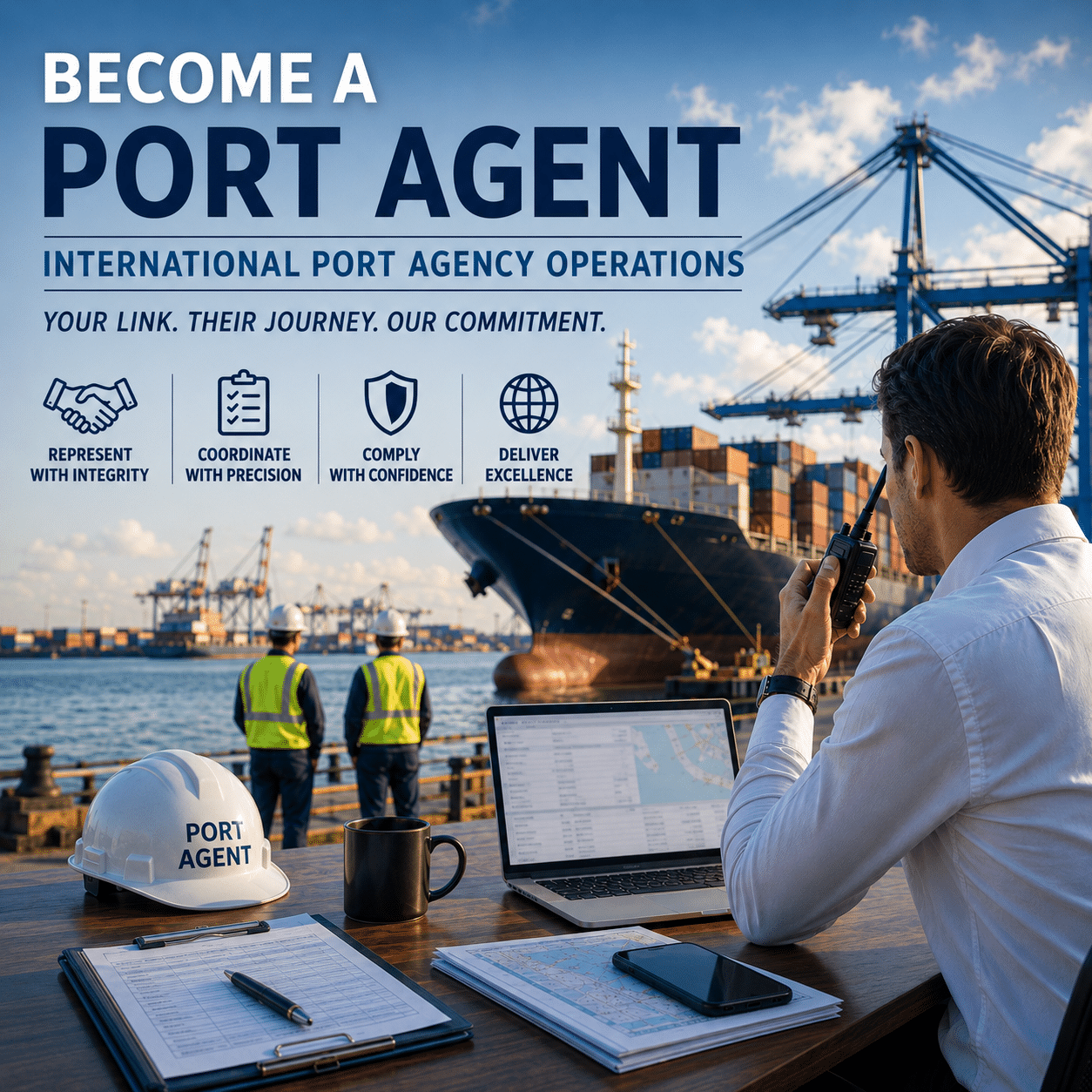
Become a
Port Agent
Online Course

Learn to represent a principal through a complete port call — clearance, cargo, husbandry, laytime, disbursement and compliance — built around one running example from nomination to final disbursement account.
100% OnlineSelf-PacedIntermediate Level
24
Hours
12
Chapters
6
Months access
Become a Port Agent — online course
Get Your Become a Port Agent Certificate
24 hours · 6 months of access
Limited-time offer
Become a Port Agent — limited-time offer
24 hours · 6 months of access
$ 600 USD $ 499 USD Sale
Course Overview

The complete port call, from nomination to final account

Become a Port Agent is designed to equip a new or developing port agent with the professional judgement, documentary discipline and commercial awareness the role actually requires — built against the regulatory architecture a port agent works within every day: the IMO FAL Convention, SOLAS Chapter XI-2 and the ISPS Code, MARPOL and the IMDG Code, the International Health Regulations (2005), UN/CEFACT Recommendation No. 45, and MSC-FAL.1/Circ.3 on maritime cyber risk management.

The course provides an in-depth, practical understanding of the port agent's actual responsibilities: determining who the principal is and the limits of the authority granted, clearing a vessel electronically under the FAL Convention and national Maritime Single Window requirements, coordinating cargo, husbandry and crew services across every stakeholder in the call, protecting the principal's commercial position through disciplined Statement of Facts and laytime practice, and controlling the principal's funds to a defensible standard.

It is well suited to agents new to the role building a solid foundation in the agency relationship, and equally to agents already working who want a structured, auditable framework for the judgement calls the job requires every day.

Course Information
Duration24 hours
DifficultyIntermediate
CategoryOperations
Delivery100% online, no classroom attendance
Content12 chapters + final assessment
Why Choose Virtual Maritime Academy

Developed by experienced maritime professionals

Our courses are developed by experienced maritime professionals and are designed to provide practical knowledge and competency-based learning for today's maritime industry. On successful completion, participants receive a certificate issued by the Virtual Maritime Academy, recognized worldwide as evidence of professional development and competency.

A digital certificate is delivered by email and a hardcopy is mailed worldwide at no additional cost.

Competencies achieved
Distinguish ship, port, husbandry, protective and hub agency, and identify your principal on any appointment
Work within actual, implied, apparent and customary authority and recognise its limits
Deliver compliant electronic clearance under the FAL Convention and Maritime Single Window requirements
Map the port-call stakeholder ecosystem and coordinate cargo, husbandry and crew services without conflict
Apply the professional standard for ethics, neutrality and conflicts of interest
Protect the principal's commercial position through disciplined Statement of Facts and laytime practice
Control principals' funds to the standard of financial soundness expected under UN/CEFACT Recommendation No. 45
Recognise sanctions, fraud and corruption exposure early and escalate it before it becomes a liability
Maintain an auditable record of every decision, instruction and event across a port call
Manage a port call to a measurable, consistently applied service standard
Learning Outcomes

On successful completion, you will be able to:

These are the learning outcomes established in the course syllabus, Revision 1, 2026.

  • ✓Represent a principal's interests through a complete port call while operating strictly within the limits of the authority granted.
  • ✓Deliver compliant electronic clearance under the FAL Convention and national Maritime Single Window requirements.
  • ✓Protect the principal's commercial position through disciplined Statement of Facts, laytime and evidence practice.
  • ✓Control principals' funds to the standard of financial soundness expected under UN/CEFACT Recommendation No. 45.
  • ✓Recognise sanctions, fraud and corruption exposure early and escalate it before it becomes the company's liability.
  • ✓Coordinate cargo, husbandry and crew services across every stakeholder in the call without conflict or omission.
  • ✓Reduce claims and disputes by maintaining an auditable record of every decision, instruction and event.
  • ✓Strengthen client confidence by managing port calls to a measurable, consistently applied service standard.
Course Content

Twelve chapters and a final assessment

Each chapter concludes with a short multiple-choice quiz to reinforce key learning objectives. Select a chapter to read what it covers.

—Virtual Maritime Academy Introduction
How the course works and how progress is tracked
Course notices and important information
Student identity verification
Downloading and using the course notes
01The Port Agent and the Maritime Trade Chain
The Port Agent's Role and the Agency Types – Ship, Port, Husbandry, Protective and Hub Agency
Principals and Appointment – Owners, Charterers and the Instructions That Bind You
Authority and Its Limits – Actual, Implied and Apparent Authority in Agency Practice
The Port-Call Stakeholder Ecosystem – Who Needs What Information, and When
Ethics, Neutrality and Conflicts of Interest – Duty of Care, Confidentiality and Disclosure
The Maritime Trade Chain – Incoterms, Contract Interfaces and Where the Agent Sits
Agency as a Business – Fee Models, Sub-Agency, Delegation and Continuity of Appointment
02Ships, Cargoes, Ports and Maritime Geography
Vessel Types and Their Operational Signatures – What Each Ship Type Demands of an Agent
Principal Dimensions and Tonnage – GT, NT, DWT, LOA, Beam and Draft in Agency Use
Cargo Categories and Handling Requirements – Container, Dry Bulk, Liquid Bulk, Breakbulk, Ro-Ro and Passenger
Terminals, Berths and Port Infrastructure – Matching the Ship to the Facility
Port Restrictions and Berth Feasibility – Draft, Air Draft, LOA, Tidal Windows and Density
Pilotage, Towage and Mooring – The Arrival Services the Agent Coordinates
Trading Geography, Routes and Canals – Distances, Transits and Schedule Realities
Registration, Classification and Statutory Surveys – The Certificates Behind a Port Call
03Agency Law, Charter Parties and Commercial Documents
The Principal–Agent Relationship in Law – Duties, Rights and Personal Liability
Charter Party Types – Voyage, Time and Bareboat, and What Each Means for the Agent
The Contract Chain – Sale Contract, Charter Party and Bill of Lading Interfaces
Notice of Readiness – Tendering, Validity, Acceptance and the Agent's Role
Laytime, Demurrage and Despatch – The Fundamentals Every Agent Must Understand
Bills of Lading – Functions, Types and the Discipline of Signing Authority
Letters of Indemnity, Cargo Claims and P&I – Recognising When to Stop and Escalate
General Average, Surveys and Evidence Preservation – Protecting the Record
04Pre-Arrival Planning and Port-Call Setup
Nomination and Appointment – Accepting the Call and Confirming the Mandate
The Pre-Arrival Information Pack – Voyage Data, ETA, Questionnaires and Certificates
Berth Prospects and Arrival Sequencing – Reading the Port's Congestion Picture
Ordering the Arrival Services – Pilots, Tugs, Linesmen and Terminal Readiness
Crew, Husbandry and Vendor Bookings – Building the Service-Order Schedule
The Proforma Disbursement Account – Estimating the Call Before It Happens
The Communication Plan and Just-in-Time Arrival – Managing ETA and Expectation
05Clearance, FAL Formalities and Maritime Single Windows
The FAL Convention – Scope, Standards, Recommended Practices and the Agent's Obligations
The Standardised FAL Declarations – General, Cargo, Stores, Crew Effects, Crew List, Passenger List and Dangerous Goods
The Maritime Declaration of Health – What the Agent Transmits, and When
Certificates and Electronic Certificates – Verifying the Ship's Statutory Documentation
Maritime Single Windows – Mandatory Electronic Exchange Since January 2024
The IMO Compendium and Harmonised Data – Why Data Structure Determines Data Quality
Port Community Systems and Authority Interfaces – Customs, Immigration, Health and Security
Amendments, Corrections and the Submission Audit Trail – Getting It Wrong Safely
06Vessel Attendance, Husbandry and Crew Services
Arrival Attendance and Boarding – Access Protocol, Safety and the First Hour Onboard
The Master–Agent Briefing – Establishing the Working Relationship of the Call
Crew Changes and Shore Leave – Immigration, Documentation and the Sign-On/Sign-Off Chain
Medical Assistance and Public-Health Events – Recognition, Escalation and the Agent's Limits
Stores, Spares, Bunkers and Fresh Water – Ordering, Delivery and Customs Control
Cash to Master and Financial Handling Aboard – Controls That Protect Everyone
Transport, Accommodation, Surveyors and Technicians – Coordinating the Visitor Programme
The Port-Call Log – Building a Contemporaneous, Auditable Record
07Cargo Operations and Cargo Documentation
Manifest and Bill of Lading Data – The Documentary Spine of the Cargo
Loading and Discharge Documentation – Mate's Receipts, Tally and Terminal Records
Cargo Release and Delivery Controls – No Release Without Documented Authority
Container Operations – Bookings, Weights, VGM and Box Documentation
Dry Bulk and Liquid Bulk Operations – Draft Surveys, Ullage and Quantity Disputes
Breakbulk, Project Cargo and Ro-Ro – Lifts, Lashing and Special Handling
Cargo Condition, Damage and Letters of Protest – Recording Facts Without Conceding Liability
Dangerous Goods and the IMDG Code – Declarations, Segregation and the Agent's Checks
08Statement of Facts, Laytime and Operational Control
From Notice of Readiness to Commencement – The Event Chain the SOF Records
Constructing the Statement of Facts – Sources, Sequence and Timestamp Discipline
Event Coding and Laytime Exceptions – Weather, Shifting, Stoppages and Congestion
Timesheets and Laytime Calculation – Working the Numbers the Principal Will Rely On
Fact Versus Interpretation – The Line That Protects the Agent and the Principal
Stakeholder Reporting – Status, Exception and Escalation Communication
Operational Control and Corrective Action – Recovering a Call Without Losing the Evidence
09Safety, Security, Environment and Public Health
The SOLAS Chapter XI-2 and ISPS Interface – What the Agent Handles and What the Agent Never Handles
Port Facility Security, Access Control and Advance Security Information
MARPOL and Port Reception Facilities – Waste Delivery, Receipts and GISIS
Ballast Water Management – Records, Reporting and Port-State Requirements
Pollution and Incident Escalation – The First Thirty Minutes and the Notification Chain
Ship Sanitation, the IHR and Public-Health Events – Certificates, Declarations and Free Pratique
Supporting Port State Control, Class and Statutory Surveys – Facilitating Without Overstepping
Emergency Contacts and the Agent's Personal Safety – Fatigue, Lone Working and Terminal Hazards
10Disbursement Accounting, Sanctions, Ethics and Compliance
From Proforma to Final Disbursement Account – The Financial Lifecycle of a Call
Port Tariffs, Dues and Vendor Quotations – Knowing What a Charge Should Be
Purchase Authorisation and Invoice Validation – Controlling Spend on Someone Else's Money
Principals' Funds – Segregation, Custody and the Standard of Financial Soundness
Currency, Tax and Cross-Border Payment Treatment
KYC, Counterparty Screening and Sanctions Compliance – Lists, Red Flags and Deceptive Shipping Practices
Bribery, Facilitation Payments and Corrupt Demands – Responding Without Authorising
Fraud Controls, Professional Indemnity and the Financial Audit Trail
11Digital Agency Operations, Cybersecurity and Service Quality
Agency Systems and the Digital Port Call – ERP, MSW and PCS Interfaces
Electronic Document Control – Versioning, Authentication and Retention
Cyber Risk in Agency Work – Phishing, Business Email Compromise and Payment Diversion
Secure Vendor and Bank-Detail Changes – The Control That Prevents the Largest Losses
Structured Operational Messaging and Shift Handover – Continuity Across People and Time
Service Quality, KPIs, Complaints and Root-Cause Analysis – Improving What You Measure
12Integrated Port-Call Capstone and Professional Readiness
The Complete Port Call End to End – Nomination to Final Disbursement Account
Working Under Disruption – Injects, Competing Priorities and Decision Sequencing
The Closing Report and After-Action Review – Learning From a Call That Is Already Over
Professional Development and Qualification Pathways – Where a Port Agent Goes Next
Closing the Course – What a Port Agent Actually Carries Forward
FAFinal Assessment
Online final assessment
Minimum passing score of 70%
Student identity verification
Digital certificate delivered by email, hardcopy mailed at no additional cost

Revision 1, 2026.

Who Should Attend

This course is designed for anyone performing or preparing to perform port agency work — ship, port, husbandry, protective or hub agency — on behalf of a principal.

Prerequisite
There is no prerequisite for this course.
It is particularly relevant for
New or developing port agents — build the professional judgement and documentary discipline the role requires from the ground up
Agents taking on a new agency type — ship, port, husbandry, protective or hub agency work, each with its own obligations
Operations staff supporting a port call — understand how clearance, cargo, husbandry and disbursement fit together across a single call
Agency owners and managers — set a consistent, auditable service standard across a team
Principals' representatives — understand what to expect from an appointed agent and where authority actually sits
Anyone preparing for agency work — gain a structured framework before taking on a first live port call

Globally recognized & industry approved

Our courses are developed by experienced maritime professionals and designed to provide practical, competency-based learning that meets internationally recognized standards for training excellence.
CPD Approved ProviderCPD Approved Provider #783378
+5,000
Professionals trained
50+
Countries represented
100+
Companies served
Assessment & Certification

A final assessment with a minimum score of 70%

Each chapter concludes with a short multiple-choice quiz, followed by a final assessment of 45 questions with a required passing score of 70%. The final assessment is entirely online and proctored, and asks for a proctor password before it begins. A computer or tablet with a webcam and a reliable internet connection is required.

Students must verify their identity before beginning the course, as required by Virtual Maritime Academy.

Certificate
On successful completion you receive a Virtual Maritime Academy Certificate of Completion. A digital certificate is delivered by email and a hardcopy is mailed worldwide at no additional cost.
Final Assessment Technical Requirements
Device — a computer or tablet with a webcam.
Operating system — Windows 10 or later, macOS 11 or later.
Browser — Google Chrome or Mozilla Firefox, latest version recommended.
Internet — minimum 3 Mbps upload and download speed.
Hardware — minimum 8 GB RAM, functional webcam, microphone and speakers or headset.
Standards, Regulations and Guidance Covered

Grounded in the instruments that govern port agency work

Port agency work does not sit outside the regulatory framework. This course addresses the instruments that set clearance, security, environmental and financial-conduct requirements for a port call.

UN/CEFACT Recommendation No. 45 — Minimum Standards for Ship Agents and Ship Brokers
IMO FAL Convention — Convention on Facilitation of International Maritime Traffic, as amended
FAL.5/Circ.56 — IMO Compendium on Facilitation and Electronic Business (2026)
SOLAS Chapter XI-2 and the ISPS Code
IMDG Code 2024 Edition (Amendment 42-24)
MARPOL Annexes I–VI and the BWM Convention
International Health Regulations (2005), as amended
MSC-FAL.1/Circ.3/Rev.4 — Maritime Cyber Risk Management
Get Certified

Become the port agent your principals trust

A port call is judged on the calls that go wrong, not the ones that go smoothly. That means knowing where your authority ends, keeping an auditable record of every decision, and protecting your principal's commercial position when the paperwork and the reality diverge.

This course builds that competence — completed entirely online, in 24 hours, at your own pace.

Clear · Coordinate · Protect · Account
Course at a Glance
LevelIntermediate
Duration24 hours
Access6 months
AssessmentProctored, 70% to pass
$ 600 USD $ 499 USD
Enroll Now

Revision 1, 2026. Hardcopy certificate mailed to your address at no additional cost.

Scroll to Top