
DNV Certified Maritime Training Provider  |  CPD Group Provider  |  Online since 2018

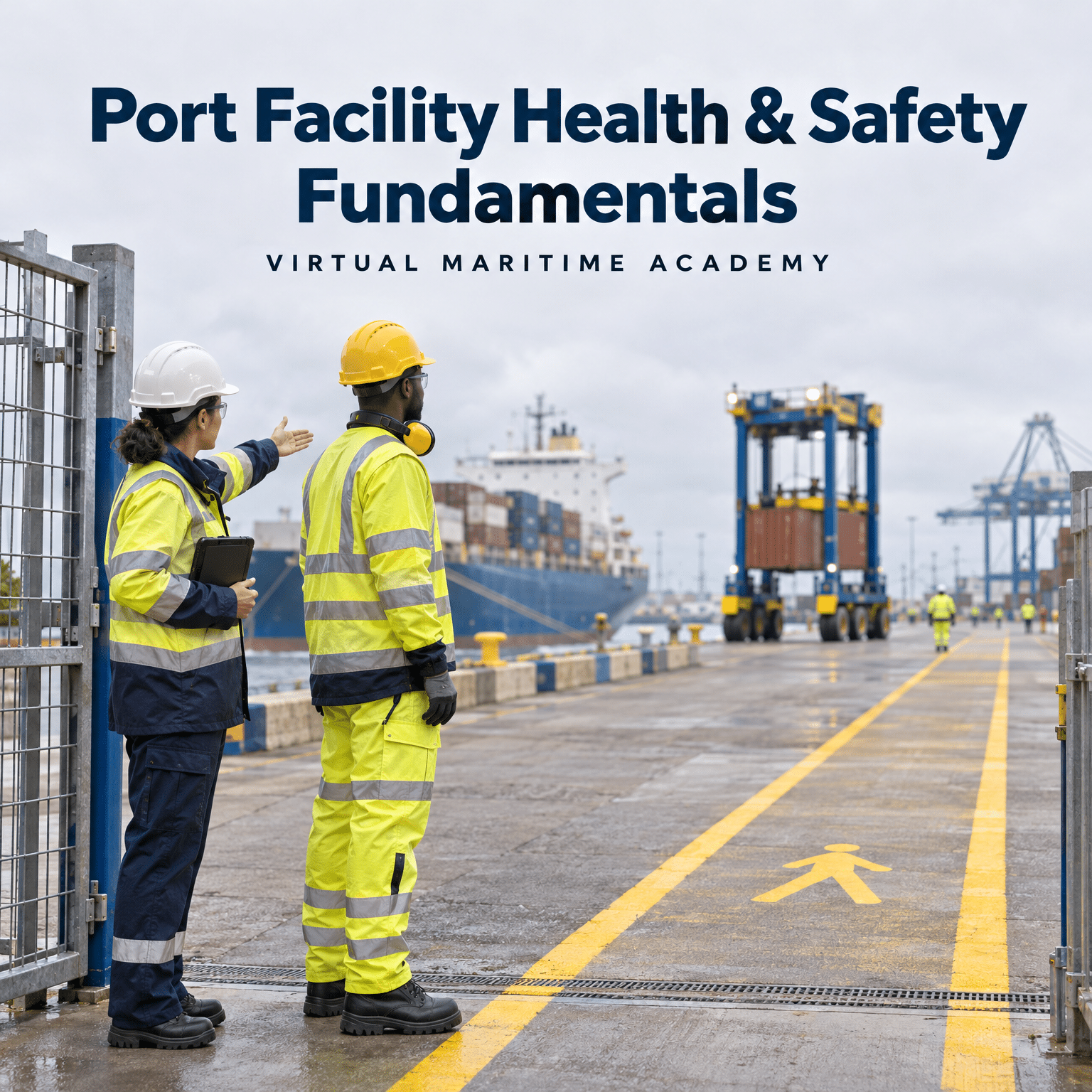
Port Facility Health & Safety Fundamentals

Beginner · Safety

Port Facility Health & Safety Fundamentals

Recognize and control the hazards that cause most port injuries — before they happen. A foundational, self-paced course for anyone who works, supervises, contracts or visits inside a port facility.
100% OnlineSelf-PacedAvailable in English and French
14
Hours
16
Chapters
6
Months Access
Port Facility Health & Safety Fundamentals — online course
Get Your Port Facility Health & Safety Fundamentals Certificate
14 hours · 6 months of access
Limited-time offer
Port Facility Health & Safety Fundamentals — limited-time offer
14 hours · 6 months of access
$ 250 USD $ 199 USD Sale
Course Overview

The hazard awareness every port facility depends on

Port Facility Health & Safety Fundamentals gives every person who works inside a port facility — employee, supervisor, contractor or visitor — a working knowledge of the hazards most likely to cause injury, and the controls that actually stop them.

The course moves from the general rules every facility runs on, through the specific hazards of cargo handling, vehicles, falls, hazardous substances and confined spaces, into risk assessment, personal protective equipment, safe lifting operations, incident reporting and investigation, and the inspection and training disciplines that keep a safety culture alive.

Ten real-world case studies anchor the material in how incidents actually happen, before the course closes with the inspection checklists and corrective-action process a facility uses to catch the next one before it does.

Course Information
Duration14 hours
DifficultyBeginner
CategorySafety
Delivery100% online, no classroom attendance
Content16 chapters + final assessment
Why Choose Virtual Maritime Academy

Developed by experienced maritime professionals

Our courses are developed by experienced maritime professionals and are designed to provide practical knowledge and competency-based learning for today's maritime industry. On successful completion, participants receive a certificate issued by the Virtual Maritime Academy, recognized worldwide as evidence of professional development and competency.

A digital certificate is delivered by email; a hardcopy certificate can also be mailed for a $20 fee.

Competencies achieved
Recognize and control the common hazards of cargo, vehicle and pedestrian operations
Apply the facility's essential safe-working rules on access, PPE and stop-work authority
Identify hazardous substances, electrical, confined-space, fire and environmental risks
Carry out hazard identification and risk assessment using a hierarchy-of-controls approach
Select, use, store and maintain personal protective equipment correctly
Plan and support safe cargo-handling and lifting operations
Coordinate contractor and visitor safety, including site induction and permits
Report unsafe conditions and near misses, and investigate incidents to prevent recurrence
Carry out structured workplace inspections and internal audits
Apply corrective and preventive actions that close out a finding, not just log it
Learning Outcomes

On successful completion, you will be able to:

These are the learning outcomes established in the course syllabus, Revision 1, 2026.

  • ✓Reduce workplace injuries and incidents by recognizing and controlling common port facility hazards
  • ✓Apply fundamental safe working rules and practices across cargo, vehicle, and pedestrian operations
  • ✓Conduct hazard identification and risk assessment using a structured, hierarchy-of-controls approach
  • ✓Select, use and maintain personal protective equipment appropriate to the task and hazard
  • ✓Plan and support safe cargo-handling and lifting operations, including contractor and visitor safety
  • ✓Strengthen the facility's safety culture by reporting unsafe conditions, near misses and incidents promptly
  • ✓Carry out structured workplace inspections and internal audits using practical safety checklists
  • ✓Investigate workplace incidents and implement corrective and preventive actions that prevent recurrence
Course Content

Sixteen chapters and a final assessment

Each chapter concludes with a short quiz to reinforce key learning objectives. Select a chapter to read what it covers.

—Introduction
Course overview and how to use this course
Learning outcomes and course structure
Assessment and certification requirements
How to use the included safety checklists
01Introduction to Port Facility Safety
The Importance of Occupational Health and Safety in Port Operations
Safety Responsibilities Within a Port Facility
Management Commitment and Safety Culture – Building Employee Participation
Hazard Identification and Risk Assessment – A First Look
Safe Systems of Work, Site-Specific Procedures and Contractor Management
Communication, Emergency Preparedness and Continuous Improvement
02Essential Rules of Port Facility Safety
Port Induction and Familiarization
Following Terminal and Facility Rules – Access Control and Restricted Areas
Pedestrian Safety – Designated Walkways and Vehicle Traffic
Mandatory PPE and High-Visibility Clothing
Safe Positioning Around Cargo Operations – Staying Clear of Suspended Loads
Housekeeping, Safe Access and Egress – Avoiding Unsafe Shortcuts
Reporting Hazardous Conditions – Stop-Work Authority and Emergency Alarms
03Cargo, Vehicle, Fall and Equipment Hazards
Cargo-Handling Hazards – Loading, Unloading and Suspended Loads
Vehicle and Traffic Hazards – Blind Spots and Pedestrian Interaction
Slips, Trips and Falls – Surfaces, Housekeeping and Access
Work at Height – Elevated Platforms, Ladders and Fall Prevention
Machinery and Equipment Hazards – Isolation and Lockout/Tagout Principles
04Hazardous Substances, Electrical, Confined Space, Fire and Environmental Hazards
Hazardous Substances – Dangerous Goods, Fuels, Chemicals and Safety Data Sheets
Noise and Vibration – Exposure Duration and Hearing Protection
Electrical Hazards – Damaged Cables, Temporary Installations and Wet Environments
Confined Spaces – Atmospheric Hazards, Permits and Rescue Arrangements
Fire and Explosion Hazards – Ignition Sources and Hot Work
Environmental Conditions – Heat, Cold, Wind and Reduced Visibility
05Risk Assessment and Accident Prevention
Hazard Identification, Likelihood and Severity
Risk Ranking and the Hierarchy of Controls
Elimination, Substitution and Engineering Controls
Administrative Controls, PPE and Safe Operating Procedures
Permit-to-Work Systems, Pre-Job Planning and Toolbox Meetings
Dynamic Risk Assessment, Management of Change and Periodic Review
06Personal Protective Equipment
PPE as One Element of a Broader Risk-Control System
Head, Foot and High-Visibility Protection
Hand, Eye, Face and Hearing Protection
Respiratory Protection and Fall-Protection Equipment
Selection, Correct Use and Inspection of PPE
Storage, Maintenance, Replacement and Limitations of PPE
07Safe Cargo and Lifting Operations
Planning Lifting Operations and Safe Working Loads
Lifting Accessories and Equipment Inspection
Exclusion Zones and Suspended Loads
Communication and Signaling – The Role of Banksmen
Container Handling and Cargo Securing
Unsafe Lifting Practices and Personnel Coordination
08Contractor and Visitor Safety
Contractor Induction and Verification of Competency
Site Familiarization and Communication of Hazards
Permit Requirements and Supervision
Access Restrictions, PPE Requirements and Emergency Procedures
Coordination of Simultaneous Operations and Monitoring Performance
09Reporting Unsafe Conditions and Near Misses
Hazard Reporting – Unsafe Acts and Unsafe Conditions
Near-Miss Reporting and Stop-Work Situations
Reporting Channels and Anonymous Reporting
Management Follow-Up and Corrective Actions
Safety Observations, Lessons Learned and Feedback to Employees
10Reporting and Investigation of Work-Related Injuries
Immediate Response – Providing Assistance and Securing the Scene
Notification Requirements and Preserving Evidence
Collecting Information – Witness Interviews, Photographs and Records
Determining Immediate Causes
Identifying Underlying and Root Causes – Human and Organizational Factors
Corrective and Preventive Actions – Tracking and Sharing Lessons Learned
11Case Studies
Pedestrian and Vehicle Incidents – Struck-By and Collision Events
Cargo-Handling and Lifting Incidents – Falling Cargo and Container Injuries
Slips, Falls and PPE-Related Incidents
Chemical, Fire and Confined-Space Incidents
Unsafe Contractor Activity – Identifying Failed Controls
12Purpose of Safety Inspections
Planned Workplace Inspections and Informal Safety Observations
Internal Audits and Supervisor Inspections
Pre-Use Equipment Checks and Contractor Inspections
Follow-Up Inspections, Documentation and Recordkeeping
13Port Facility Safety Checklist Areas
General Facility Safety – Housekeeping, Walkways and Restricted Areas
Traffic Management – Routes, Speed Limits and Reversing Controls
Cargo Operations – Lifting Equipment, Exclusion Zones and Securing
PPE – Availability, Suitability, Condition and Replacement
Fire Safety – Extinguishers, Escape Routes and Hot-Work Controls
Electrical Safety – Equipment, Cables and Isolation Controls
Hazardous Materials – Labels, Storage and Spill-Control Equipment
Emergency Preparedness – Alarms, Muster Areas and First Aid
14Conducting an Internal Safety Inspection
Defining Scope and Reviewing Previous Findings
Identifying Applicable Procedures and Conducting the Physical Inspection
Speaking With Personnel and Observing Work Practices
Recording Conditions and Evaluating the Level of Risk
Assigning Corrective Actions, Responsibilities and Verifying Effectiveness
15Corrective and Preventive Actions
Immediate Corrective Action and Temporary Risk Controls
Root-Cause Correction and Assignment of Responsibility
Risk-Based Prioritization and Target Completion Dates
Documentation, Verification and Close-Out
Trend Analysis, Lessons Learned and Preventing Recurrence
16Training and Safety Awareness
Initial Safety Induction and Job-Specific Training
Refresher Training, Toolbox Talks and Emergency Drills
Equipment Familiarization and Contractor Training
Training After Incidents and Following Procedural Changes
Technological Innovation and Verification of Understanding
FAFinal Assessment

Download the course syllabus here — Revision 1, 2026.

Who Should Attend

This course is designed for anyone who works, supervises, contracts or visits inside a port facility, and for the people who train and audit them.

Prerequisite
There is no prerequisite for this course.
It is particularly relevant for
Port facility employees and terminal personnel — build the hazard awareness that prevents the injuries most common on site
Supervisors and managers — reinforce safety accountability at every level they lead
HSE/QHSE officers — align floor-level awareness with the facility's own safety management system
Contractors, maintenance and cargo-handling personnel — meet the facility's induction and safe-working standard before starting work
Trainers — use this course as the awareness-level foundation for an in-house program
Auditors and inspectors — see the facility through the same hazard lens frontline workers are trained on
Superintendents — set the safety expectation the site holds every worker to
Shore-based maritime staff — build the same hazard literacy as facility-based colleagues
Assessment & Certification

A proctored final assessment with a minimum score of 70%

Each chapter concludes with a short quiz, followed by a final assessment with a required passing score of 70%. The final assessment is proctored and completed online, on a desktop or laptop computer with a webcam; tablets, smartphones and Chromebooks are not supported.

Students must submit official photo identification before starting the course, as required under DNV and the CPD Group's student verification standard.

Certificate
On successful completion you receive a Virtual Maritime Academy Certificate of Completion. A digital certificate is delivered by email; a hardcopy certificate can also be mailed for a $20 fee.
Important Note
A fee may apply for re-attempting the final assessment.
Final Assessment Technical Requirements
Device — desktop or laptop computer with webcam and microphone. Tablets, smartphones and Chromebooks are not supported.
Operating system — Windows 10 or later, macOS 11 or later.
Browser — Google Chrome or Mozilla Firefox, latest version recommended.
Internet — minimum 3 Mbps upload and download speed.
Hardware — minimum 8 GB RAM, functional webcam, microphone and speakers or headset.
Standards, Regulations and Guidance Covered

Grounded in the instruments that govern port facility safety

Port facility safety does not sit outside the regulatory framework. This course addresses the instruments that set the standard for occupational health and safety at port facilities.

Regulation (EU) 2017/352
ILO Code of Practice – Safety and Health in Ports (2016)
ISO 45001:2018 – Occupational Health and Safety Management Systems
IMO/ILO/UNECE Code of Practice for Packing of Cargo Transport Units (CTU Code)
Get Certified

Build the hazard awareness your facility depends on

Most port injuries come from a short list of recurring hazards — cargo in transition, vehicles and pedestrians sharing space, falls, hazardous substances, and work that looks routine until the one time it isn't.

This course builds the awareness and the habits that catch those hazards before they become incidents — completed entirely online, in approximately 14 hours, at your own pace.

Recognize · Control · Report · Prevent
Course at a Glance
LevelBeginner
Duration14 hours
Access6 months
AssessmentProctored, 70% to pass
$ 250 USD $ 199 USD
Enroll Now

Revision 1, 2026. Hardcopy certificate available for a $20 fee.

Scroll to Top