
Designated Person Ashore · Training
Designated Person Ashore (DPA) Training Online: Everything You Need to Know
Virtual Maritime Academy · November 14, 2026
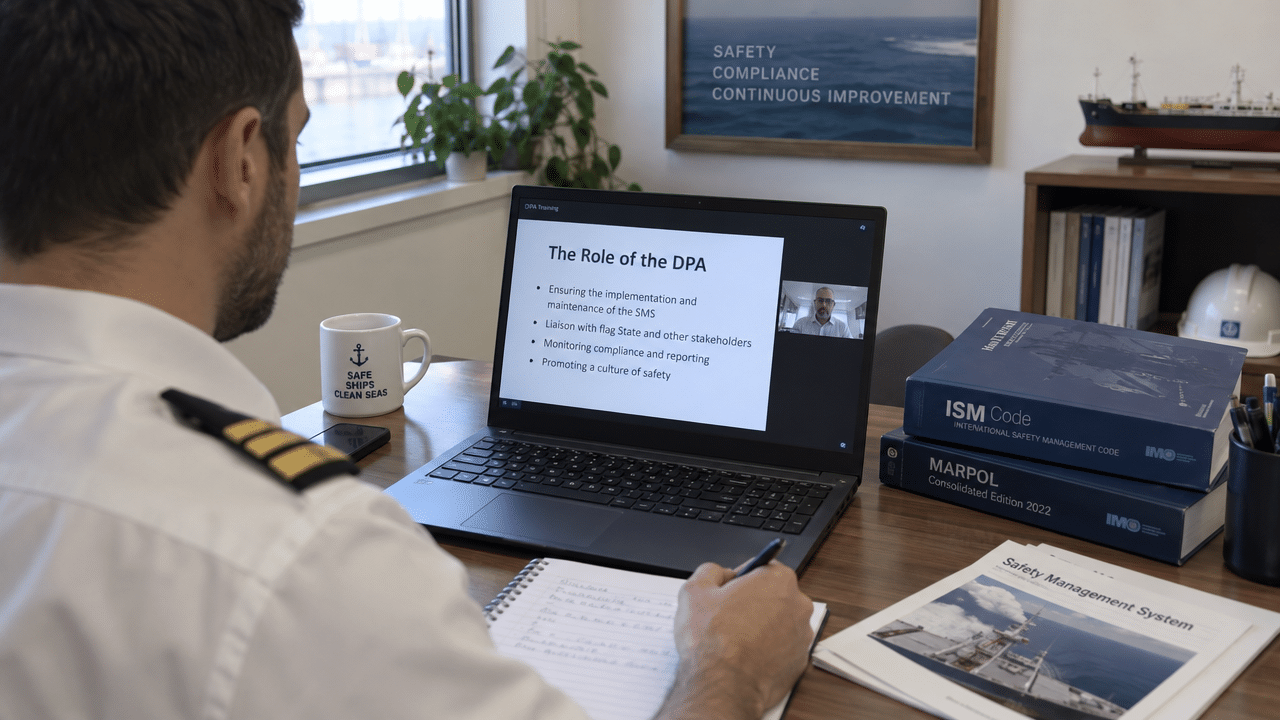
If you work in a shore-based safety or compliance role in shipping, you have probably been asked at some point whether you are considering DPA training online. The Designated Person Ashore is one of the few roles in the ISM Code that exists specifically to connect the people running a ship with the people responsible for it on land, and the training that prepares someone for that role is more technical than most newcomers expect. This guide walks through what the course actually contains, how it is delivered when taken online, who it is really built for, what you walk away with, and how to tell a serious provider from a padded certificate mill.
What DPA Training Online Actually Covers
The backbone of the course is the ISM Code itself, specifically the sections that define the DPA function under Element 4 and the reporting obligations that flow from it. Expect a detailed read-through of the Code’s requirements for monitoring the safety and pollution-prevention aspects of ship operation, and for making sure adequate resources and shore-based support are available to each vessel in the fleet. This is not a surface-level summary; a properly built course walks through the actual clause language and discusses how auditors interpret it in practice.
From there, the content moves into the Safety Management System itself. You will cover how an SMS is structured, how procedures get written and controlled, how non-conformities are raised and closed out, and where the DPA sits in that loop as the person who has to notice when the system is drifting from what it says on paper. A good module spends real time on the direct reporting line between ship and the highest level of management, since that reporting channel is the single most scrutinized part of the DPA function during external audits.
Audits themselves get their own dedicated section. You will look at internal audits, external audits by class societies and flag states, and the corrective action process that follows a finding. Case studies of real findings, near-misses, and incident investigations are common here, because the DPA role is judged less on paperwork and more on how someone actually responds when something goes wrong on board.
How the Course Is Structured and Delivered Online
Most online DPA courses are built as a sequence of chapters, each pairing a short lecture or narrated slide deck with reading material pulled directly from the ISM Code and IMO guidance. Chapters usually run anywhere from thirty minutes to an hour, which keeps the course workable for someone fitting it around a full-time job in operations, marine HR, or technical management.
Delivery is almost always asynchronous, meaning there is no fixed class time to attend. You log in, work through the material at your own pace, and the system tracks your progress chapter by chapter. Each chapter typically ends with a short quiz, and the full course closes with a final assessment that has to be passed before a certificate is issued. Some providers include supplementary material such as sample audit checklists, example non-conformity reports, or recorded scenario discussions, which give the training more texture than a plain reading assignment would.
Total course length varies by provider, but a thorough program generally runs somewhere between eight and fifteen hours of actual study time, spread over however many days or weeks the learner needs. Because the course sits entirely online, there is no travel, no classroom booking, and no need to coordinate with a group, which is part of why companies increasingly send shore staff through this route instead of a one-off in-person seminar.
Who Should Take This Course
The most obvious audience is anyone being appointed or considered for the DPA role itself, but the course is useful well beyond that narrow group. Several categories of professionals tend to enroll.
- Newly appointed DPAs. Companies often require formal training as soon as someone is named to the role, even if that person already has years of shipboard or technical experience.
- Deputy or alternate DPAs. Most SMS manuals name a backup to cover absences, and that backup needs the same grounding in ISM obligations as the primary appointee.
- QHSE and technical superintendents. Even staff who will never formally hold the title benefit from understanding how the role interacts with audits, inspections, and incident reporting.
- Office-based safety officers at manning agencies or ship management companies. These are often the people fielding the day-to-day calls from vessels and need to know what falls under the DPA’s remit versus other departments.
There are no formal academic prerequisites to enroll. The ISM Code does not specify a minimum qualification for the DPA position itself, only that the person must have direct access to the highest level of management and the independence to raise safety concerns without being overruled by commercial pressure. That said, learners get far more out of the material if they already have some exposure to shipboard operations, a safety management system, or port state control inspections, since the course assumes a working familiarity with how shipping companies are structured.
What Completion Actually Gives You
On finishing the course and passing the final assessment, you receive a certificate of completion documenting the training hours and the topics covered. This certificate is typically used in three ways within a shipping company’s own compliance records.
- It serves as documentary evidence during ISM external audits and flag state inspections, where auditors frequently ask to see proof that the appointed DPA has received formal training in the role.
- It supports the company’s own internal competence matrix, since many management systems require named evidence that shore staff in safety-critical roles have completed relevant training before being signed off.
- It gives the individual a portable record of qualification that travels with them if they move between ship management companies, since the underlying ISM requirements and DPA duties are consistent across operators.
One point worth being clear about: completion of a DPA training course is not itself a license or a statutory certificate of competency the way a deck officer’s certificate is. There is no single global standard that mandates a specific course length or content list for DPA training the way STCW does for seafarer certificates. What the certificate demonstrates is that the holder has been through a structured program covering the ISM Code, SMS operation, and audit response, which is exactly what flag states and classification societies expect to see documented when they ask the question.
How to Choose a Training Provider
With so many options available for DPA training online, a few checks go a long way toward separating a solid course from a thin one.
- Check the content against the actual ISM Code clauses. A good syllabus will reference specific sections of the Code rather than offering vague summaries of “safety culture.”
- Look for recognition or alignment with classification society expectations. Courses built with input from, or aligned to, a recognized classification society carry more weight when documentation is reviewed during an audit.
- Ask how the assessment works. A course with no meaningful final test, or one that can be passed without engaging with the material, will not hold up well as documented evidence of competence.
- Confirm what the certificate actually states. It should name the course content, the training hours, and the date of completion clearly enough to satisfy an auditor’s questions.
- Consider how the provider supports learners afterward. Access to updated material when the ISM Code or related guidance changes is a sign the provider treats the course as a living reference rather than a one-time product.
Price matters too, but it should not be the deciding factor on its own. A DPA sits at the point where a shipping company’s shore management meets its legal exposure under the ISM Code, and the training behind that role is one place where it pays to choose carefully rather than cheaply.
Ready to get the full DPA training record in place? Explore the ISM Proficiency as Designated Person Ashore (DPA) Course at Virtual Maritime Academy.
Explore the full range of maritime courses at Virtual Maritime Academy.
About Virtual Maritime Academy
Virtual Maritime Academy is a global leader in online maritime education and training, offering courses designed to meet the evolving needs of the shipping industry. As a DNV Certified Maritime Training Provider with CPD accreditation, we deliver cutting-edge programs that prepare seafarers and maritime professionals for today’s and tomorrow’s challenges. 🌊⚓