
Compliance · Careers
How to Become a Maritime Internal Auditor: Training, Skills and Career Opportunities
Virtual Maritime Academy · November 8, 2026
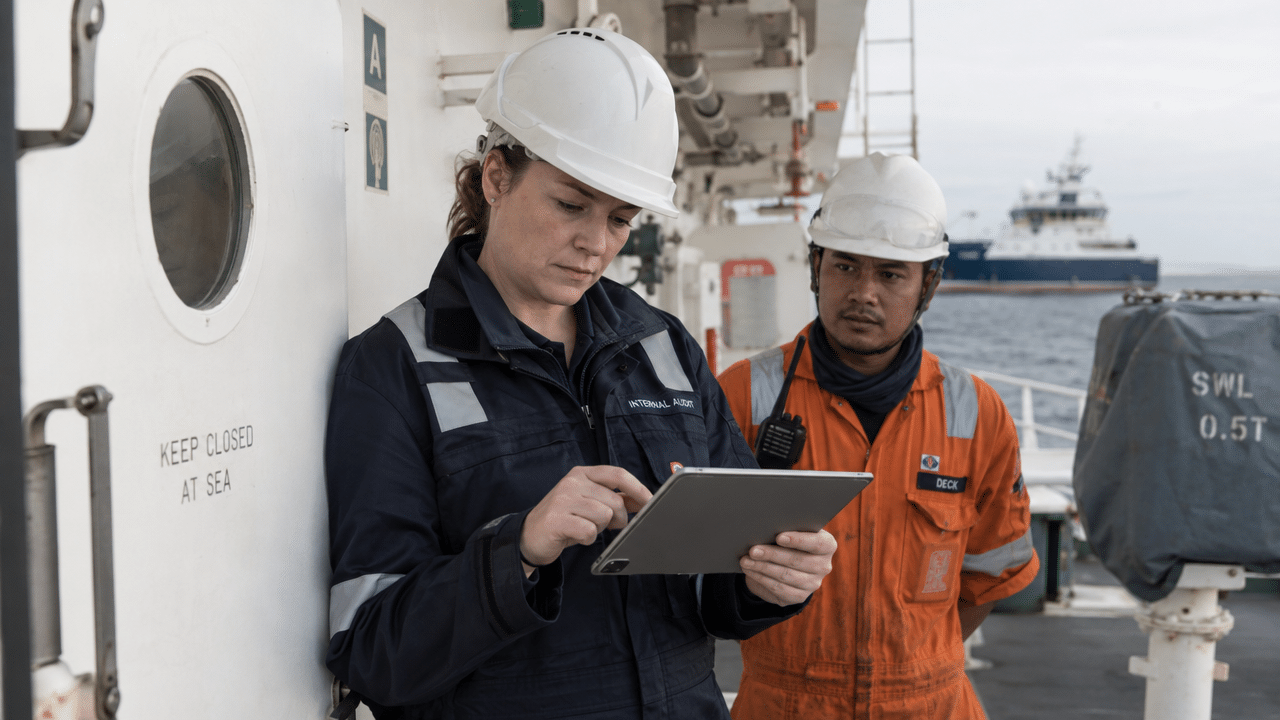
If you have spent any time on a ship or in a shore-based safety office, you have probably crossed paths with an internal auditor without necessarily knowing that it is a career path in its own right. Maritime internal auditor training opens up one of the more transferable skill sets in the industry: the ability to look at how a vessel or a company actually operates, compare it against what the procedures say should happen, and write up the gap in a way that leads to real change. The role sits at the intersection of operations and compliance, and for officers or managers thinking about their next move, it helps to understand what the work really involves before committing time and money to a course.
What a maritime internal auditor actually does day to day
Most people picture an audit as someone walking around with a clipboard checking boxes, and that image is only a small part of the job. A working internal auditor spends a good share of their time preparing before they ever step on deck: reading the vessel’s previous audit history, reviewing recent incident reports, and building a checklist that targets the areas most likely to need attention rather than ticking through a generic form. Once the audit starts, the work shifts to interviews and observation. That means talking to the chief engineer about maintenance records, watching a fire drill unfold, and comparing what crew members say happens in an emergency against what the safety management system actually tells them to do.
The second half of the job is documentation. Every observation needs to be written down with enough detail that someone who was not on the vessel can understand it, and every nonconformity has to be classified correctly, tied to a specific procedure, and followed through to a corrective action that is tracked until it is closed. A good auditor is also the person who flags a trend across several ships before it turns into an incident, which is part of why companies value the role so highly once an auditor has a few cycles of experience behind them.
Skills and experience that transfer well into the role
Sea time is the obvious starting point, and it matters more than people expect. An auditor who has actually stood a watch, run a drill, or managed a bridge team understands which procedures are realistic and which ones look fine on paper but fall apart under pressure. Officers who have served as safety officers, drill instructors, or document controllers onboard usually find the transition easier because they already have a feel for how a safety management system is supposed to function in daily use.
Beyond sea experience, a few habits carry a surprising amount of weight. Attention to detail is the most obvious one, but it needs to be paired with judgment, since an auditor who treats every minor slip as a major finding loses the trust of the crew they are supposed to be working with. Clear writing matters just as much, because a finding that cannot be understood by the office or by the next auditor is close to useless. Finally, the ability to ask questions without putting people on the defensive is a skill that experienced inspectors and surveyors tend to develop naturally, and it is one that training courses spend real time building.
Maritime internal auditor training: ISM, ISPS, MLC and combined Lead Auditor courses
Formal training is usually organized around the code or convention being audited, and it is worth understanding the differences before signing up for a course. ISM internal auditor training covers the Safety Management System required by the International Safety Management Code and focuses on how operational procedures, maintenance, and emergency preparedness are documented and verified. ISPS training shifts the focus to the Ship Security Plan, access control, and how a vessel responds to a changing security level. MLC training is different again: instead of safety or security, it centers on seafarer welfare, including hours of rest, accommodation standards, repatriation, and the handling of complaints, since the Maritime Labour Convention treats crew welfare as a compliance matter in its own right.
Many professionals choose to take these three subjects together through a combined internal auditor course, and there is a good practical reason for that: the underlying auditing method taught under ISO 19011 is the same across all three. Once someone understands how to plan an audit, gather objective evidence, and classify a finding under that framework, applying it to safety, security, or labour standards is mostly a matter of knowing which questions to ask and which regulation to cite. A combined Lead Auditor course built around ISO 19011 principles also tends to carry more weight with employers, since it signals that the auditor can run a full audit program rather than check a single code in isolation.
Career opportunities the role opens up
Internal auditing rarely stays a side responsibility for long once someone shows aptitude for it. Within a shipping company, it is a natural step toward becoming a Designated Person Ashore, a fleet superintendent, or a QHSE manager, all of which rely on the same mix of document review, interviewing, and corrective action tracking that an internal auditor practices constantly. Classification societies and flag state administrations also look for candidates with this background when hiring surveyors, since the day-to-day work overlaps heavily with what an internal auditor already does onboard.
The shore-side compliance route deserves particular attention because it is often overlooked by seafarers who assume their only options are sailing or leaving the industry altogether. Port state control familiarity, class society work, P&I club loss prevention teams, and independent auditing or consultancy firms all hire people whose main qualification is a solid internal auditing background paired with sea experience. For someone who wants to step off the ship without stepping away from the industry, this combination of credentials and hands-on knowledge is one of the more reliable ways to make that move.
How to get started
Getting started is more straightforward than many people assume, and it does not require years of extra study on top of a seafaring career. The practical path looks something like this:
- Build a baseline of sea time in a role that gives exposure to the safety management system, such as a watchkeeping officer or a safety committee member.
- Take an ISM internal auditor course first, since it introduces the auditing method you will reuse everywhere else.
- Add ISPS and MLC internal auditor training, either separately or through a combined course, to cover security and welfare compliance alongside safety.
- Look for opportunities to shadow or assist on a real internal audit onboard before leading one, since nothing replaces watching an experienced auditor handle an interview or a disputed finding.
- Keep a record of every audit you participate in, including the findings raised and how they were closed, since this record becomes the evidence of experience that employers and certification bodies ask for later.
None of this has to happen all at once. Many officers complete their first internal auditor course on leave between contracts and build up the rest of their qualifications over a year or two, gaining practical audit experience onboard in parallel. What matters most is treating the training as the start of a skill rather than a one-time certificate, since the auditors who end up with real career options are the ones who keep practicing the method long after the course ends.
Ready to build the credentials a maritime auditor role needs? Explore the ISM-ISPS-MLC Lead Auditor Course at Virtual Maritime Academy.
Explore the full range of maritime courses at Virtual Maritime Academy.
About Virtual Maritime Academy
Virtual Maritime Academy is a global leader in online maritime education and training, offering courses designed to meet the evolving needs of the shipping industry. As a DNV Certified Maritime Training Provider with CPD accreditation, we deliver cutting-edge programs that prepare seafarers and maritime professionals for today’s and tomorrow’s challenges. 🌊⚓