
ISM Code · Implementation
How to Implement the ISM Code in a Shipping Company
Virtual Maritime Academy · November 26, 2026
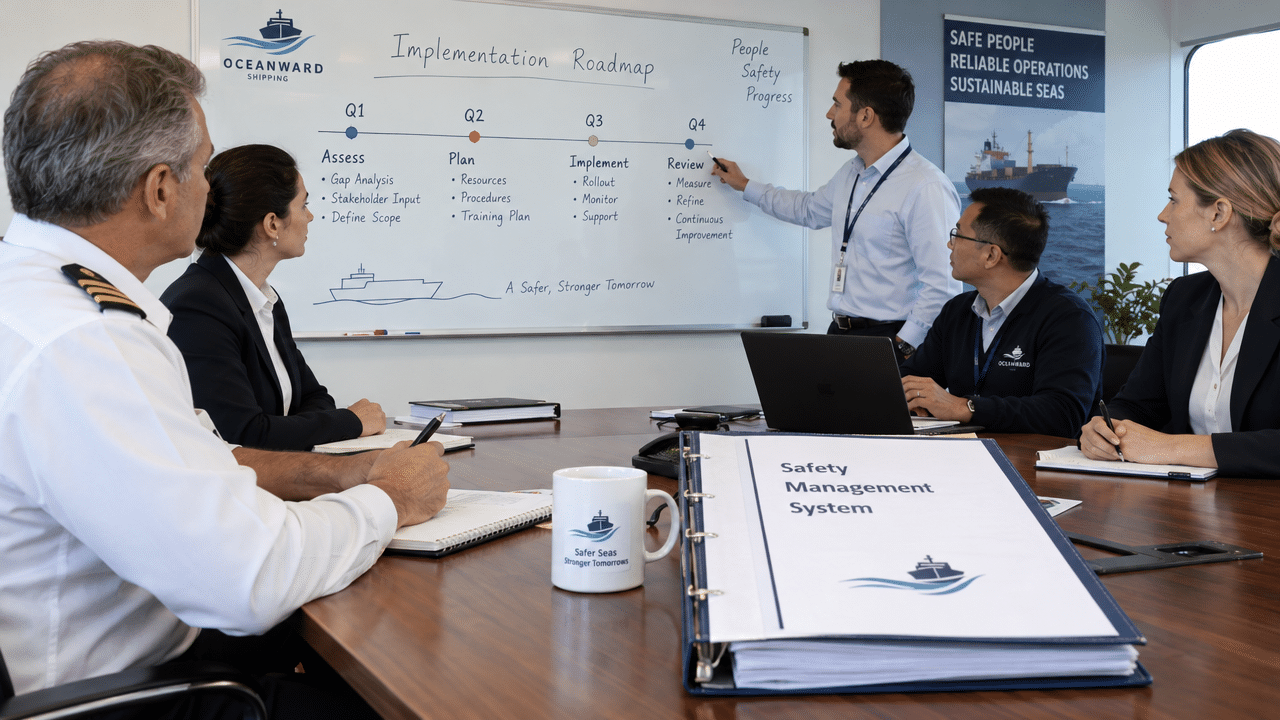
Every operator eventually reaches the point where reading about the Code is not enough and the real work begins. Whether you are bringing a new company under the ISM umbrella for the first time or rebuilding a system that has drifted away from how the ships actually work, you need a sequence you can follow, with milestones you can defend to an auditor. This guide sets out exactly that: a phased, practical path to implement the ISM Code in a shipping company, starting from where your operation stands today and finishing with a Document of Compliance in hand. We will treat it as a project with a start date, named owners, and checkpoints, rather than as a paperwork exercise bolted onto existing routines.
Step one: a gap analysis against current operations
Before anyone drafts a single procedure, spend real time establishing what already exists and where it falls short of Chapter IX requirements. Pull together the company’s existing manuals, checklists, maintenance records, and incident reports, then sit down with masters, chief engineers, and shore managers to find out what actually happens on board versus what is written down somewhere. Most companies discover that informal practices already cover a surprising share of the Code’s intent; the gap analysis exists to find the parts that are missing, undocumented, or inconsistent from ship to ship.
A useful gap analysis works through each clause of the Code methodically rather than jumping straight to solutions. For each requirement, record three things: whether a documented procedure exists, whether it is actually followed in practice, and who in the company is accountable for it. This produces a punch list rather than a vague sense of unreadiness, and that punch list becomes the backbone of your implementation project plan.
- Map existing documents. Catalogue every manual, form, and checklist currently in circulation, including ones that only live on individual ships.
- Interview the people who do the work. Masters and engineers will tell you where written procedures and shipboard reality diverge faster than any file review will.
- Score each ISM clause. A simple red, amber, green rating against Chapter IX requirements gives management a clear starting picture.
- Set a realistic timeline. Use the scored list to estimate how long drafting, training, and audit preparation will genuinely take, not how long you wish it would take.
Drafting the Safety Management System itself
With the gaps identified, the next phase is writing the Safety Management System document set. Resist the temptation to copy a generic SMS template wholesale from another company or a consultant’s library. An SMS that does not reflect your vessel types, trading pattern, and manning structure will be spotted immediately by an auditor and, worse, ignored by the crew who are supposed to live by it. Build the manual around the operations you actually run: the cargo you carry, the ports you call, the equipment fitted on your ships.
Structure the manual around the required elements: safety and environmental protection policy, company and shipboard responsibilities, the master’s authority, resources and personnel, development of plans for shipboard operations, emergency preparedness, reporting and analysis of non-conformities, maintenance of the ship and equipment, documentation control, and the company’s own verification, review, and evaluation processes. Each section should name a responsible position, not just a department, and should reference the forms and checklists that support it so the manual and the working documents stay connected.
Write procedures at the level of detail someone unfamiliar with the ship could follow, but avoid burying the crew in paperwork that adds no safety value. A thick manual nobody reads is worse than a lean one that gets used every voyage. Circulate drafts to a handful of serving masters and chief engineers before finalising anything; their marginal notes will catch impractical wording long before an external auditor does.
Appointing and training the Designated Person Ashore
The Code requires a Designated Person Ashore, or DPA, who provides a direct line between the ships and the highest level of management, and who has the authority to act when safety or pollution-prevention matters need attention regardless of commercial pressure. Choosing this person is not a box-ticking exercise. Pick someone with genuine operational credibility, enough seniority to be heard in a board meeting, and enough time in the role to actually monitor the fleet rather than treat it as a side duty.
Once appointed, the DPA needs structured preparation, not just a job description. That means formal training on the legal basis of the Code, on root-cause investigation techniques, on how to run and interpret internal audits, and on the reporting lines that let non-conformities reach top management without being filtered out along the way. Many companies send their DPA through a recognised DPA course precisely so the appointment is defensible during flag state and classification society scrutiny, and so the person holding the role is not learning the job for the first time during an actual emergency.
Give the DPA documented access to top management and a mechanism for escalating urgent matters outside the normal reporting cycle. Auditors will ask for evidence of this access, not just a sentence in the manual claiming it exists, so keep records of DPA reports, management responses, and any instances where the DPA intervened directly in an operational decision.
Rolling out training and procedures fleet-wide
A finished manual sitting in a shore office achieves nothing until every ship and every relevant shore employee understands what has changed and why. Plan the rollout as its own project, with a schedule for visiting ships, conducting briefings, and confirming that procedures have actually reached the people who need them. Video conferences and circular letters have their place, but nothing replaces a shore manager or superintendent standing in front of a crew explaining how the new permit-to-work form works and why the reporting threshold for near-misses has changed.
Sequence the rollout so the highest-risk procedures land first. Emergency response plans, permit-to-work systems, and critical equipment maintenance routines should reach every vessel before administrative items like document control numbering. Where possible, pilot the new system on one or two ships, gather feedback on what is unworkable in practice, and adjust before pushing the full set fleet-wide.
- Brief the masters first. They need to understand the reasoning behind each procedure well enough to explain it to their own crew.
- Run onboard familiarisation sessions. Cover the new forms, reporting routes, and emergency drills specific to the revised manual.
- Confirm understanding, not just attendance. A signature on a training record proves presence, not comprehension; short practical checks catch the difference.
- Track completion centrally. Shore management needs a single list showing which ships and which crew members have completed each stage of the rollout.
Running the first internal audit and applying for certification
Once procedures are live across the fleet, the Code requires the company to verify its own system before an outside body does. The first internal audit cycle matters for reasons beyond compliance: it is your genuine test of whether what you wrote matches what happens on board, and it gives you a chance to fix weak points before a certification body finds them. Assign auditors who were not directly involved in writing the procedures they are checking, so the audit retains the independence that makes it useful rather than a formality.
Treat findings from this first round honestly. A clean report after the first internal audit of a brand-new SMS is itself a warning sign, since real implementation almost always surfaces mismatches between the manual and shipboard reality. Document every non-conformity, assign a corrective action with an owner and a deadline, and close the loop by verifying the fix rather than just recording that one was proposed.
With internal audit findings closed out and the management review completed, the company is ready to apply to its flag state or a recognised organisation acting on its behalf for the Document of Compliance, followed by Safety Management Certificates for each ship once the external auditors confirm the system works in practice as well as on paper. Keep the audit trail from the gap analysis through to certification organised and accessible; external auditors routinely ask to see that history, and a company that can show its own learning process tends to earn more confidence than one that simply presents a finished manual with no visible development behind it.
Ready to implement the ISM Code properly? Explore the ISM Code in Practice Course at Virtual Maritime Academy.
Explore the full range of maritime courses at Virtual Maritime Academy.
About Virtual Maritime Academy
Virtual Maritime Academy is a global leader in online maritime education and training, offering courses designed to meet the evolving needs of the shipping industry. As a DNV Certified Maritime Training Provider with CPD accreditation, we deliver cutting-edge programs that prepare seafarers and maritime professionals for today’s and tomorrow’s challenges. 🌊⚓