DNV Certified Maritime Training Provider  |  CPG Group Provider  |  Online since 2018

Become an Enviromental Officer

Advanced · Compliance

Environmental Officer Course
for Cruise Ships

From MARPOL Annexes to audit-ready compliance — the complete course for cruise ship Environmental Officers.
MARPOL I–VI100% OnlineSelf-Paced
50
Hours
18
Chapters
6
Months access
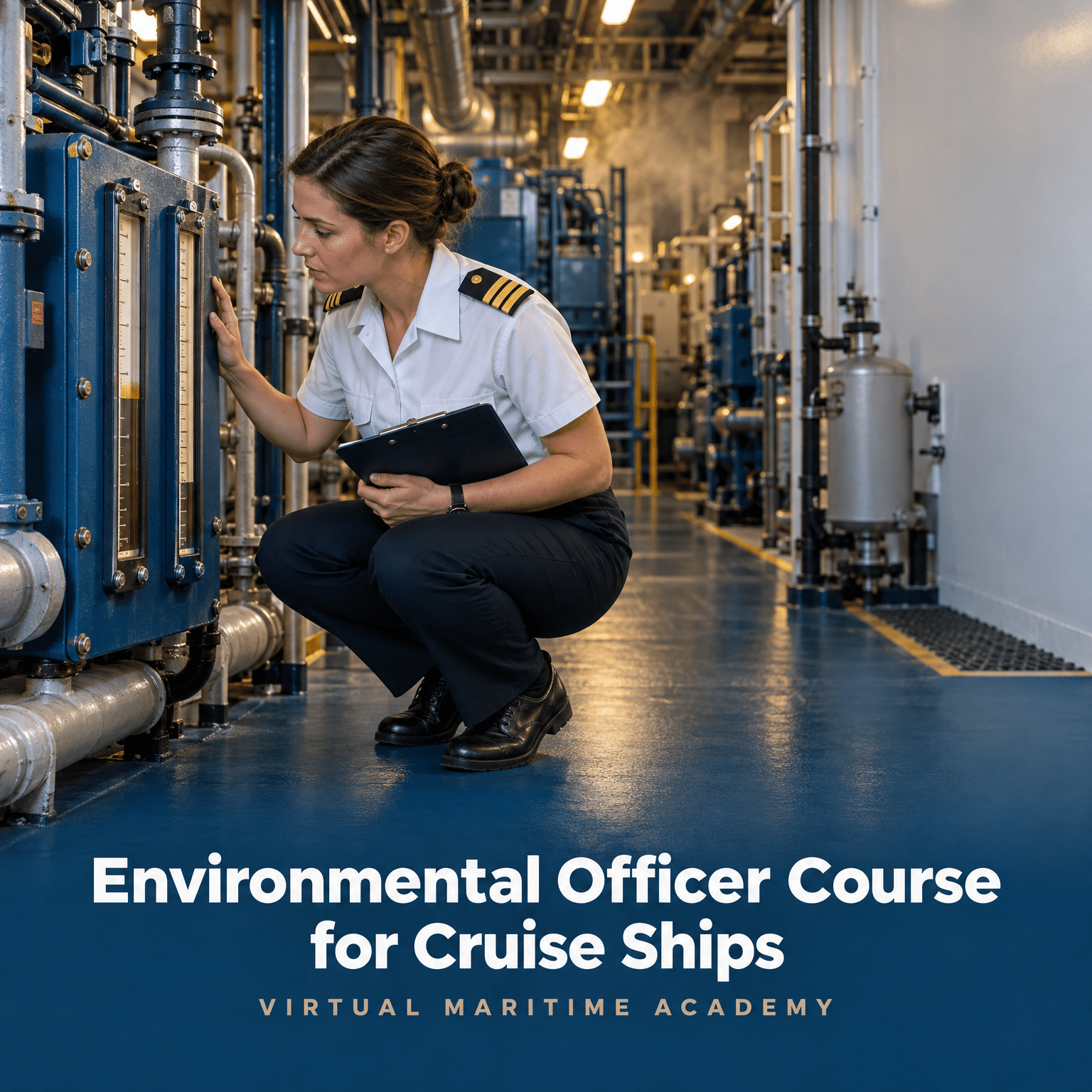
Environmental Officer Course for Cruise Ships — compliance course for cruise ship Environmental Officers
Get Your Environmental Officer Certificate
50 hours · 6 months of access
Limited-time offer
Environmental Officer Course for Cruise Ships — limited-time offer
50 hours · 6 months of access
$ 1000 USD $ 699 USD Sale
Course Overview

Environmental compliance training built around a real cruise ship, voyage and crew

This course gives the Cruise Ship Environmental Officer a complete, practical grounding in the international, regional and company requirements that govern a cruise operation — taught throughout against a single running example: a real cruise ship, her itinerary, her equipment and her crew, so every regulation is learned the way it is actually applied, not as an abstract rule.

It covers MARPOL Annexes I through VI, the Ballast Water Management Convention, environmental management systems, hotel-operations environmental control, pollution-incident response, environmental monitoring and recordkeeping, inspections and audits, and environmental leadership — closing with an integrated capstone chapter that carries one voyage from departure to an audit-ready compliance package.

Delivered entirely online and self-paced, it suits Environmental Officers already serving aboard, officers preparing to take on the role, and shore-side staff responsible for a cruise fleet's environmental compliance.

Course Information
Duration50 hours
DifficultyAdvanced
CategoryCompliance
Delivery100% online, no classroom attendance
Content18 chapters + final assessment
Why Choose Virtual Maritime Academy

Developed by experienced maritime professionals

Our courses are developed by experienced maritime professionals and are designed to provide practical knowledge and competency-based learning for today's maritime industry. On successful completion, participants receive a certificate issued by the Virtual Maritime Academy, recognized worldwide as evidence of professional development and competency.

A digital certificate is delivered by email and a hardcopy is mailed worldwide at no additional cost.

Competencies achieved
Determine which MARPOL Annexes, conventions and regional or local requirements apply to a specific voyage
Operate an Environmental Management System's objectives, controls and continual-improvement cycle
Manage oily-water separator operation, sludge handling and bunkering records under MARPOL Annex I
Operate and troubleshoot an advanced wastewater treatment system under MARPOL Annex IV
Apply MARPOL Annex V garbage segregation, recycling and landing requirements
Manage Emission Control Area fuel changeovers, exhaust-gas cleaning systems and the ship's energy-efficiency framework
Operate a Ballast Water Management System and respond to biofouling and invasive-species requirements
Manage chemical, hazardous-material and hotel-operations environmental risk
Plan a multi-jurisdiction voyage against Special Areas, Emission Control Areas, PSSAs and polar-water restrictions
Lead the first actions, notification and evidence-preservation steps of a pollution-incident response
Build and maintain a defensible environmental monitoring, sampling and recordkeeping programme
Prepare for external inspections and conduct internal environmental audits
Lead environmental culture and crew engagement, and produce an audit-ready compliance package
Learning Outcomes

On successful completion, you will be able to:

These are the learning outcomes established in the course syllabus, Revision 3, 2026.

  • ✓Identify the international, regional, flag, port and company environmental requirements that apply to a cruise operation
  • ✓Coordinate and verify shipboard environmental compliance across technical, hotel and voyage operations
  • ✓Apply MARPOL controls for oil, sewage, garbage, air emissions, ballast water and hazardous materials
  • ✓Interpret environmental monitoring data, records and audit evidence to confirm genuine compliance
  • ✓Respond to pollution incidents with disciplined first actions, escalation and reporting
  • ✓Plan a multi-jurisdiction voyage against Special Areas, ECAs, PSSAs and local restrictions
  • ✓Lead environmental culture, crew engagement and ship-shore coordination under commercial pressure
  • ✓Produce an audit-ready environmental compliance package for a full cruise voyage
Course Content

Eighteen chapters and a final assessment

Each chapter concludes with a short multiple-choice quiz to reinforce key learning objectives. Select a chapter to read what it covers.

—Introduction
Course overview, navigation and assessment rules
Terminology and evidence-based learning approach
Diagnostic knowledge check and role-orientation exercise
01The Cruise Ship Environmental Officer and Environmental Governance
Role Purpose and Company-Defined Authority
Independence, Escalation and Intervention
Shipboard Reporting Relationships
Technical Operations – Environmental Risk Profile
Hotel Operations – Environmental Risk Profile
Multi-Jurisdiction Itineraries
Verification Rather Than Assumption
Environmental Integrity
Recap: Verification, Escalation and the Limits of a Company-Defined Role
02International and Regional Environmental Regulatory Framework
How Maritime Environmental Law Works
MARPOL Architecture
Complementary Conventions
Regional and Local Requirements
Recap: Applicability as the Working Discipline of an Environmental Officer
03Environmental Management Systems, SMS and Compliance Risk
Environmental Policy and Management Systems
Environmental Aspects and Impacts
Operational Controls
Objectives and Improvement
Recap: From Known Rule to Provable, Improving Practice
04Oil Pollution Prevention, Bilge, Sludge and Bunkering
MARPOL Annex I Foundations
Machinery-Space Oily-Water Systems
Sludge and Waste Oil
Bunkering and Transfers
Records and Verification
Recap: Verification That Holds Up Under Pressure
05Sewage, Graywater and Wastewater Management
MARPOL Annex IV
Advanced Wastewater Treatment Systems
Graywater and Other Cruise Streams
Discharge Decision-Making
Monitoring and Failure Response
Recap: Sewage, Graywater and Wastewater Management
06Garbage, Food Waste, Plastics and Recycling
MARPOL Annex V Framework
Waste-Stream Identification and Segregation
Food Waste
Recycling and Waste Minimization
Storage and Landing
Garbage Records and Evidence
Recap: Segregation Discipline and the Garbage Record
07Air Pollution, Fuel, ECAs, Incineration and Refrigerants
MARPOL Annex VI Architecture
Sulphur, Fuel Changeover and ECAs
NOx Awareness
Exhaust-Gas Cleaning Systems
Shipboard Incineration
Ozone-Depleting Substances and Refrigerants
Fuel Documentation and Samples
Recap: Proving Compliance, Not Just Knowing the Limit
08Energy Efficiency, GHG Management and Decarbonization
IMO Energy-Efficiency Framework
DCS, EEXI, CII and SEEMP
Cruise-Ship Energy Consumers
2023 IMO GHG Strategy
Evolving IMO Net-Zero Framework
Regional Carbon Regimes
Recap: Reading a Rating, Not Just a Fuel Bill
09Ballast Water, Biofouling, Anti-Fouling and Invasive Species
BWM Convention
BWMS Operations and Contingencies
Biofouling Management
Anti-Fouling Systems
Local Biosecurity Requirements
Recap: Preventing the Silent Passenger
10Chemicals, Marine Pollutants and Hazardous Materials
Chemical Environmental Risk
Packaged Marine Pollutants
Hotel and Cleaning Chemicals
Paints, Coatings and Solvents
IHM and Ship-Recycling Interface
Recap: Following the Chemical to Where It Actually Goes
11Cruise Hotel Operations and Environmental Control
Galley and Food Service
Laundry and Housekeeping
Pools, Spas and Recreational Water
Potable-Water Production and Residuals
Specialty Drains and Streams
Procurement and Source Reduction
Environmental Rounds
Recap: Tracing the Hotel Function to Its Own Destination
12Port Reception Facilities and Waste-Vendor Management
Reception-Facility Concept
Pre-Arrival Planning
Transfer and Vendor Interface
Receipts and Chain of Custody
Inadequate Facilities
Recap: Planning the Call, Proving the Landing
13Special Areas, Sensitive Waters and Itinerary Planning
MARPOL Special Areas
Emission Control Areas
PSSAs and Route-Specific Protection Measures
Polar Waters
Local Restrictions
Voyage Compliance Matrix
Recap: From Itinerary to Compliance Plan
14Pollution Prevention, Emergency Response and Reporting
Prevention Barriers
SOPEP / SMPEP Interface
Initial Actions
Notifications
Evidence and Sampling
Post-Incident Learning
Recap: Prevention, Response and the Discipline of Reporting
15Monitoring, Sampling, Records and Environmental Data
Monitoring Plan
Sampling Fundamentals
Calibration and Instrument Verification
Environmental Recordkeeping
Data Integrity and Trends
Recap: Monitoring, Sampling and the Discipline of Proof
16Inspections, Audits, Non-Conformities and Corrective Action
External Inspections
Internal Audits
Interviewing and Sampling
Findings and Corrective Action
Effectiveness Verification
Recap: Findings, Evidence and the Discipline of Closing the Loop
17Environmental Leadership, Crew Engagement and Ship-Shore Coordination
Environmental Culture and Human Factors
Departmental Training
Passenger Communication
Shore Management
Ethical Decision-Making
Recap: Leadership, Culture and the People Who Carry Every Earlier Chapter Forward
18Integrated Environmental Compliance Capstone
Voyage Environmental Profile
Pre-Departure Readiness
At-Sea Decisions
Port Arrival and Waste Delivery
Environmental Incident
Audit-Ready Closeout
Recap: Integration, Judgement and What Eighteen Chapters Actually Built
FAFinal Assessment
Online final assessment
Minimum passing score of 70%
Student identity verification
Hardcopy certificate mailed at no additional cost

Revision 3, 2026.

Who Should Attend

Who should attend: Environmental Officers serving aboard cruise ships, or preparing to take on the role; shore-side DPAs and superintendents responsible for a cruise fleet's environmental compliance.

Prerequisite
This is an advanced, operational/management-level course. Prior seagoing or shore-side environmental/compliance experience is recommended, not assumed as a strict requirement.
It is particularly relevant for
Cruise ship Environmental Officers — build complete, defensible command of the role's MARPOL, BWM and company-procedure obligations
Officers preparing to take on the role — develop the full compliance and verification skill set before stepping into it
Deck, engineering and hotel-department officers — with environmental compliance responsibilities, strengthen the technical grounding the role depends on
Shore-side DPAs and superintendents — responsible for a cruise fleet's environmental compliance, align shipboard and shore-side practice
Safety and Environmental Officers — transitioning from cargo or other vessel types into cruise operations
Internal auditors and compliance staff — who review cruise ship environmental records and need to understand what they are checking

Globally recognized & industry approved

Our courses are developed by experienced maritime professionals and designed to provide practical, competency-based learning that meets internationally recognized standards for training excellence.
CPD Approved ProviderCPD Approved Provider #783378
+5,000
Professionals trained
50+
Countries represented
100+
Companies served
Assessment & Certification

A final assessment with a minimum score of 70%

Each chapter concludes with a short multiple-choice quiz. The course closes with a final assessment of 45 questions, completed within a 60-minute time limit, with a required passing score of 70%. The final assessment is proctored.

Students must submit official photo identification before starting the course, as mandated by DNV and the CPD Group.

Certificate
On successful completion you receive a Virtual Maritime Academy Certificate of Completion — a digital certificate delivered by email and a hardcopy mailed worldwide at no additional cost.
Important Note
A fee may apply for re-attempting the final assessment.
Final Assessment Technical Requirements
Device — desktop or laptop computer with webcam and microphone. Tablets, smartphones and Chromebooks are not supported.
Operating system — Windows 10 or later, macOS 11 or later.
Browser — Google Chrome or Mozilla Firefox, latest version recommended.
Internet — minimum 3 Mbps upload and download speed.
Hardware — minimum 8 GB RAM, functional webcam, microphone and speakers or headset.
Standards, Regulations and Guidance Covered

Grounded in the instruments that govern cruise ship environmental compliance

This course addresses the international and class instruments that set environmental compliance requirements for a cruise ship and its Environmental Officer.

MARPOL 73/78 (Annexes I, III, IV, V, VI)
ISM Code (SOLAS Ch. IX)
BWM Convention 2004
ISO 14001:2026
Get Certified

Become the Environmental Officer your fleet depends on

An Environmental Officer's job is not reciting regulations — it is knowing exactly which ones apply, to this ship, on this date, and being able to show the evidence when asked. That discipline runs through every chapter of this course, from MARPOL applicability to an audit-ready compliance package.

This course builds that competence — completed entirely online, in approximately 50 hours, at your own pace.

Prevent · Verify · Respond · Lead
Course at a Glance
LevelAdvanced
Duration50 hours
Access6 months
AssessmentProctored, 70% to pass
$ 1000 USD $ 699 USD
Enroll Now

Revision 3, 2026. Hardcopy certificate mailed to your address at no additional cost.

Scroll to Top