
Maritime Security · Training
Company Security Officer (CSO) Online Training: Complete Guide
Virtual Maritime Academy · November 14, 2026
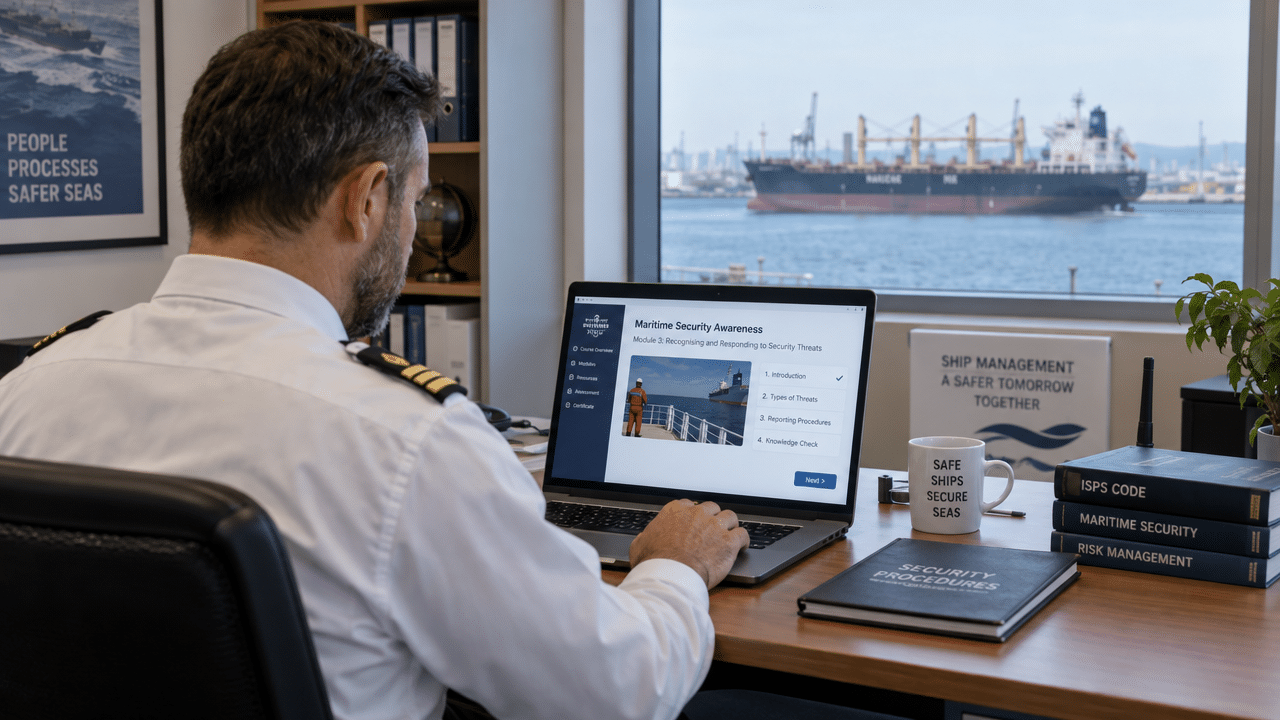
The Company Security Officer sits at the center of a ship operator’s security management system, so getting that appointment right starts with proper training. CSO online training exists because the ISPS Code sets out specific knowledge requirements for anyone designated to this post, and most operators now prefer web-based delivery over a classroom seminar simply because it fits around a busy fleet schedule. Below is a reference guide to what the training actually has to cover, how providers structure the modules and assessments, who typically enrolls, what certification looks like once you finish, and how to judge whether a provider’s program will hold up under a port state control inspection or an internal audit.
ISPS Code Requirements That Shape the Curriculum
The International Ship and Port Facility Security (ISPS) Code, Part A, paragraph 11, and the guidance in Part B lay out the knowledge a Company Security Officer is expected to hold before taking on the role. A compliant course has to work through each of these areas rather than treating them as background reading, because an auditor checking your training records will look for evidence that every one of them was actually taught and tested.
- Security organization. How ship and company security structures relate to port facility security, and where the CSO fits between the Ship Security Officer and company management.
- Ship security assessments. How to carry out and review a Ship Security Assessment (SSA), identify vulnerabilities, and feed the findings into the Ship Security Plan (SSP).
- Security levels. How to recognize and respond to Security Levels 1 through 3, including the additional measures required at each level.
- Security equipment and systems. Working knowledge of access control, surveillance, and communication systems used aboard and at the terminal interface.
- Threat recognition. Techniques for recognizing weapons, dangerous substances, and devices, along with the characteristics of people likely to threaten security.
- Security drills and exercises. How to plan, conduct, and evaluate drills, and how often they need to take place under the SSP.
- Documentation and audit. Maintaining Declarations of Security, incident reports, and training records in a form that survives scrutiny from a flag state or recognized security organization.
None of this is optional content a provider can trim to shorten a course. A certificate missing one of these elements will not satisfy an auditor who knows what the Code actually requires.
How CSO Online Training Is Typically Structured
Most CSO online training programs break the ISPS requirements into a series of self-paced modules, usually somewhere between eight and fourteen, each built around one knowledge area from the Code. A learner moves through recorded lectures, reading material, and short case studies, then answers a knowledge check before the system opens up the next module. Total contact time generally runs between 20 and 30 hours, which is close to what an in-person IMO Model Course 3.20 seminar would take, but spread across days or weeks instead of forced into a single block.
Assessment usually happens at two levels. Short quizzes close out each module to confirm the learner absorbed that specific topic, and a longer final examination covers the whole syllabus, typically multiple choice with scenario-based questions that mirror situations a CSO would actually face, such as responding to a change in security level or drafting part of a Declaration of Security. A passing score is commonly set between 70 and 80 percent, and many providers allow one resit attempt before requiring the learner to repeat the relevant module. Some platforms add identity verification or webcam proctoring on the final exam, which matters if your flag state or company has started asking how remote assessments are secured.
Duration flexibility is the real advantage of the online format. A DPA juggling several vessels can complete two modules on a Monday and the rest later in the week, whereas a classroom course demands the learner be in one room for consecutive days regardless of operational workload.
Who Takes This Course and What Prerequisites Apply
Three groups account for most enrollments. Serving or former deck officers moving into a shore-based security role make up one segment, since their operational background gives them a head start on the ship-side material. Designated Persons Ashore (DPAs) who are also taking on CSO duties, which is common at smaller operators, form a second group. Shore-based security or compliance managers who need ISPS-specific knowledge to supplement a broader security background make up the third.
Unlike many STCW certificates, the ISPS Code does not mandate a fixed amount of sea time or a prior statutory qualification before someone can be appointed CSO. There is no convention requirement tying the role to a seafarer’s certificate of competency. In practice, though, companies tend to look for candidates who already understand vessel operations, the ship’s safety management system, and basic maritime terminology, because the course assumes that baseline rather than teaching it from scratch. A working knowledge of English is also expected, since the documentation, flag state correspondence, and training content are produced in English. Some providers set a minimum age or require proof of employment with a shipping company before granting access.
Certification and How It’s Recognized
On successful completion, the learner receives a certificate of training that names the course, references the ISPS Code sections it covers, and records the completion date and the issuing organization. This is a company-level and industry qualification document rather than an STCW endorsement stamped into a seafarer’s discharge book, which reflects the fact that the CSO role itself sits under the company’s security management obligations rather than under seafarer certification conventions.
What gives the certificate weight is the credibility of the body behind it. Training delivered under a classification society’s recognition, such as a DNV-certified program, carries documented evidence that the course content, assessment method, and quality controls were reviewed against the relevant standard. Flag states, port state control officers, and company auditors generally accept certificates from recognized providers without requiring the CSO to retake an equivalent course elsewhere. Operators should still keep the certificate alongside the appointment letter and any refresher records in the vessel and company security files, since an auditor checking ISPS compliance will ask to see both the qualification and the paperwork that confirms the person actually holds the CSO appointment.
Refresher or update training is not universally mandated by the Code itself, but many companies build a three to five year renewal cycle into their own security management procedures, particularly after amendments to the ISPS Code or a significant change in the threat environment.
Choosing a Training Provider
With the content requirements fixed by the Code, the real differences between providers show up in delivery quality and institutional backing. A few checks will tell you quickly whether a program is worth the enrollment fee.
- Recognized certification. Confirm the provider holds certification or recognition from a classification society or equivalent body, and ask to see the scope of that recognition rather than taking a logo on a webpage at face value.
- Alignment with IMO Model Course 3.20. The syllabus should map clearly onto the IMO’s own model course structure for Company Security Officers, which makes it easier to defend the training during an audit.
- Qualified instructors. Look for instructor backgrounds that combine sea-going or port security experience with an actual training qualification, not just a security consulting background with no maritime context.
- Assessment rigor. A course with no meaningful final exam, or one that lets a learner pass by guessing on a handful of questions, will not satisfy a skeptical port state control officer.
- Documentation support. Check that the provider issues a certificate with enough detail, course code, syllabus reference, validity period, to stand on its own in an audit file without extra correspondence.
- Practical flexibility. Self-paced access, mobile-friendly modules, and a reasonable window to complete the course matter more than marketing claims about speed, since a CSO candidate usually has a full workload already.
Price matters less than it seems to at first glance. A cheaper course that produces a certificate an auditor later questions costs far more in rework than a properly recognized program did in the first place. Start from recognition and content alignment, confirm the assessment is genuinely tested, and treat cost as the last filter rather than the first.
Ready to complete your CSO training online? Explore the ISPS & Company Security Officer (CSO) Course at Virtual Maritime Academy.
Explore the full range of maritime courses at Virtual Maritime Academy.
About Virtual Maritime Academy
Virtual Maritime Academy is a global leader in online maritime education and training, offering courses designed to meet the evolving needs of the shipping industry. As a DNV Certified Maritime Training Provider with CPD accreditation, we deliver cutting-edge programs that prepare seafarers and maritime professionals for today’s and tomorrow’s challenges. 🌊⚓