
DNV Certified Maritime Training Provider  |  CPD Group Provider  |  Online since 2018

Cruise Ship Safety Officer

Advanced · Safety

Cruise Ship
Safety Officer

Lead safety management, risk control and emergency response aboard the modern cruise ship — a comprehensive, self-paced online programme for the shipboard Safety Officer.
STCW-aligned100% OnlineSelf-paced
45
Hours
16
Chapters
6
Months access
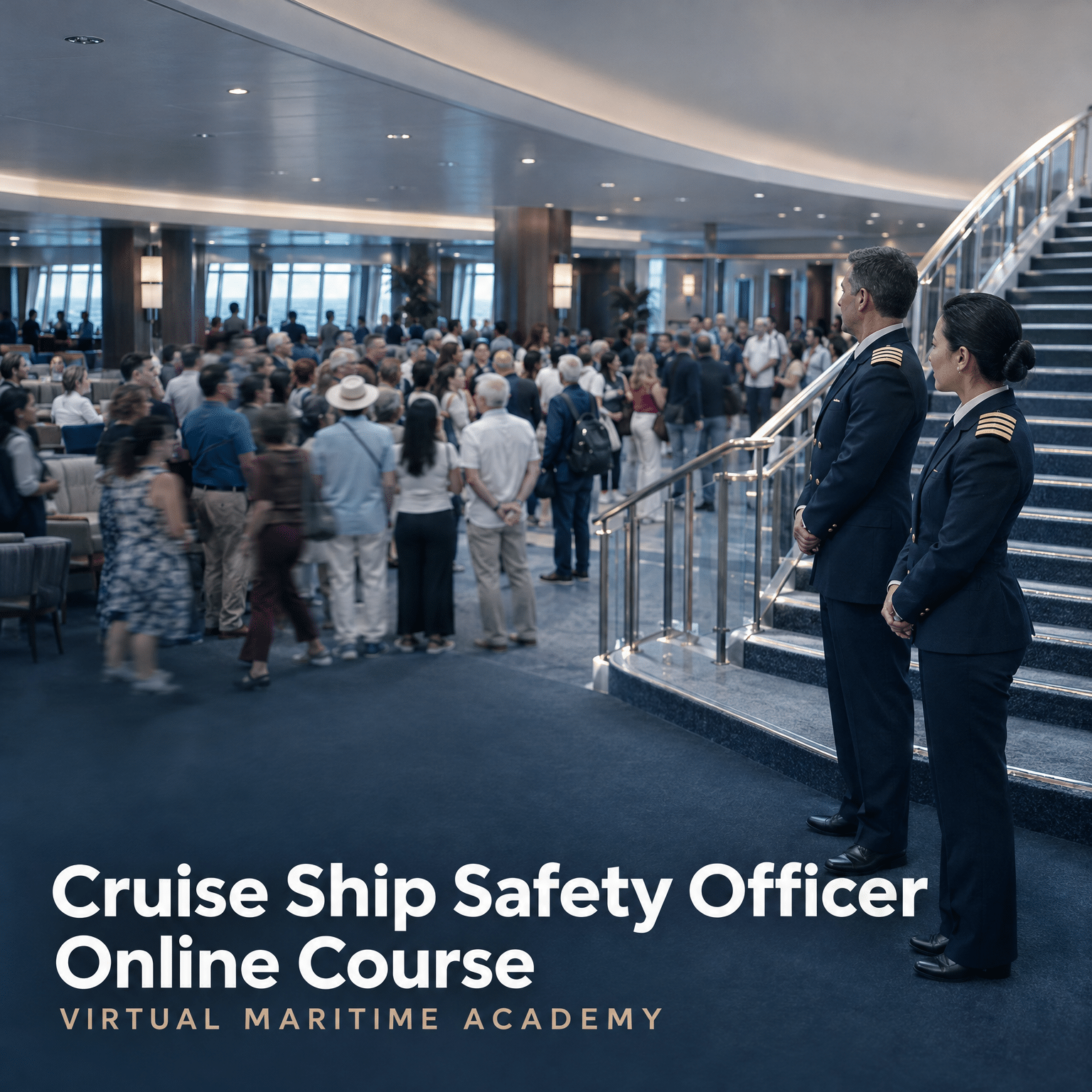
Cruise Ship Safety Officer — Advanced online course
Get Your Cruise Ship Safety Officer Certificate
45 hours · 6 months of access
Cruise Ship Safety Officer
45 hours · 6 months of access
$ 1000 USD $ 495 USD
Course Overview

A complete shipboard safety management programme

This course prepares you to carry out the shipboard Safety Officer function on a cruise ship: understanding the regulatory framework that shapes passenger ship safety, operating the Safety Management System in practice, and running risk assessment, occupational safety, fire safety and life-saving appliance programmes to a verifiable standard.

Beyond day-to-day operations, the course builds the skills to lead muster and drill programmes, manage passenger safety and crowd behaviour, respond to emergencies and investigate incidents — and to prepare the ship, its people and its records for surveys, audits, Port State Control and third-party inspection.

Completed entirely online, at your own pace, the course closes with a review and final examination, and practical guidance on applying what you have learned in your first 90 days back on board.

Course Information
Duration45 hours
DifficultyAdvanced
CategorySafety
Delivery100% online, no classroom attendance
Content16 chapters + final assessment
Why Choose Virtual Maritime Academy

Developed by experienced maritime professionals

Our courses are developed by experienced maritime professionals and are designed to provide practical knowledge and competency-based learning for today's maritime industry. On successful completion, participants receive a certificate issued by the Virtual Maritime Academy, recognized worldwide as evidence of professional development and competency.

A digital certificate is delivered by email and a hardcopy is mailed worldwide at no additional cost.

Competencies achieved
Discharge the shipboard Safety Officer function competently and lawfully, within the limits of its authority
Distinguish mandatory requirements from recognized guidance, industry practice and company policy
Operate the shipboard elements of a Safety Management System as an integrated, evidence-generating cycle
Conduct, document and review risk assessments using the hierarchy of control
Implement and verify safe systems of work, including permit-to-work for the highest-consequence tasks
Verify fire safety, life-saving appliance and evacuation readiness against regulatory, class and company standards
Develop and evaluate drill and onboard training programmes that produce demonstrable competence
Investigate incidents, analyse causal factors and drive corrective action through to verified closure
Prepare the ship, its people and its records for surveys, audits, Port State Control and inspection
Influence safety behaviour and strengthen safety culture across a large multinational crew
Learning Outcomes

On successful completion, you will be able to:

These are the learning outcomes established in the course syllabus, Revision 1, 2026.

  • ✓Discharge the shipboard Safety Officer function competently and lawfully, within a clear understanding of the limits of its authority
  • ✓Distinguish mandatory requirements from recognized guidance, industry practice and company policy
  • ✓Operate the shipboard elements of a Safety Management System as an integrated, evidence-generating cycle
  • ✓Conduct, document and review risk assessments for shipboard tasks, areas and operations using the hierarchy of control
  • ✓Implement and verify safe systems of work, including permit-to-work arrangements for the highest-consequence shipboard tasks
  • ✓Verify fire safety, life-saving appliance and evacuation readiness against regulatory, class and company standards
  • ✓Develop and evaluate drill and onboard training programmes that produce demonstrable competence rather than attendance records
  • ✓Investigate incidents, analyse causal factors and drive corrective action through to verified closure
  • ✓Prepare the ship, its people and its records for surveys, audits, Port State Control and third-party inspection
  • ✓Influence safety behaviour and strengthen safety culture across a large multinational crew
Course Content

Sixteen chapters and a final assessment

Each chapter concludes with a short multiple-choice quiz to reinforce key learning objectives. Select a chapter to read what it covers.

—Introduction
Course overview
Competences to be achieved
01The Cruise Ship Operating Environment and Safety Context
The cruise sector and its vessel types
Why passenger ship safety is different
How the regulatory framework was shaped by casualty
Shipboard organisation and where the safety function sits
The external stakeholder map
02The Regulatory and Legal Framework
How maritime regulation is made and structured
SOLAS for the Safety Officer
STCW and the training obligations the Safety Officer administers
MLC, 2006 and occupational safety law at sea
Adjacent instruments and their boundaries
National law: flag, coastal and port States
Company policy as the operative instrument
Maintaining regulatory currency
03The Safety Officer – Appointment, Authority and Accountability
What a Safety Officer is
Appointment and terms of reference
Authority and its limits
Core duties in the annual cycle
The safety committee
Role boundaries
Planning the work: the annual safety calendar
Professional conduct
04The Safety Management System in Practice
The ISM Code applied to a cruise ship
Documentation architecture
Non-conformities and corrective action
Internal audit
Measuring safety performance
Management of change
Records: what to keep, for how long, and why
05Risk Assessment and Hazard Control
Foundations
Methods and when to use each
Conducting an assessment
The cruise ship risk landscape
Communicating risk
Common failures in shipboard risk assessment
06Occupational Health, Safety and Safe Systems of Work
The occupational safety framework on board
Permit to work
Enclosed space entry and rescue
Hot work
Work at height and over the side
Electrical safety and isolation
Hotel-area occupational hazards
Chemical and biological hazards
Slips, trips and falls
Mooring, tender and gangway operations
Physical agents
Personal protective equipment
Health surveillance and the medical department interface
07Fire Safety Management
Fire behaviour on ships
Structural fire protection
Detection and alarm
Fixed fire-extinguishing systems
Portable and semi-portable appliances and fire main
Fire patrols, plans and organisation
High-risk areas and activities
Hot work control
Inspection, testing and maintenance regimes
Fire drills and training
Fire casualty response concepts
08Life-Saving Appliances and Evacuation Readiness
The LSA outfit of a large passenger ship
Personal life-saving appliances
Launching appliances and release gear
Maintenance, servicing and inspection
Preventing lifeboat accidents
Evacuation concepts and analysis
Evacuation with untrained persons
Man overboard and rescue readiness
Distress and locating equipment
LSA records, defects and readiness reporting
09Muster Lists, Drills and the Onboard Training Programme
The muster list
The shipboard emergency organisation
Crew familiarisation and joining requirements
The passenger muster
The drill programme
Evaluating drills
The onboard training programme
10Passenger Safety and Crowd Management
Human behaviour in emergencies
Crowd management principles
Communicating with passengers
Passengers requiring additional assistance
Everyday passenger safety
Passenger conduct and overboard prevention
The port and shore excursion interface
Public health and its interaction with safety
Passenger safety information: design and delivery
The safety and security interface
11Emergency Response and Crisis Management
The emergency organisation in action
Plans, checklists and supporting documentation
Scenario response principles
Decision-making under pressure
Emergency communications
Mass rescue operations
Accounting for persons
Post-incident management
Exercising the crisis organisation
12Incident Reporting, Investigation and Analysis
Definitions and thresholds
Reporting obligations
Immediate response to an incident
Gathering evidence
Analysis
Corrective and preventive action
Writing the investigation report
Learning at fleet level
Just culture and legal exposure
13Surveys, Audits, Inspections and Port State Control
Statutory certification and surveys
Classification society surveys and conditions of class
Management system audits
Port State Control and equivalent regimes
The self-inspection programme
Managing findings to closure
Third-party inspections
14Safety Culture, Human Factors and Safety Leadership
Safety culture
Human factors that degrade safety performance
The multinational, multi-department crew
Influencing behaviour
The Safety Officer as leader
Personal development plan
15Module 15: Consolidation and Final Examination
Integrated review of the course
Practice examination with feedback
Final examination
16Module 16: Course Conclusion
Applying the course on board: the first 90 days
Maintaining currency and continuing development
Course evaluation and feedback
Certification and record of training
FAFinal Assessment

Download the course syllabus here — Revision 1, 2026.

Who Should Attend

This course is designed for anyone who holds, or is preparing to take on, the shipboard Safety Officer function on a cruise ship.

Prerequisite
There is no prerequisite for this course.
It is particularly relevant for
Shipboard Safety Officers — build a complete, evidence-based grip on the role's duties and authority
Officers moving into the safety function — gain the regulatory and SMS grounding the role demands
Deck and hotel department officers — strengthen safety leadership across their own areas of responsibility
DPAs and shore-side safety managers — see the role as it operates day to day on board
Training and HR managers — understand what the Safety Officer function requires before assigning it
Anyone preparing for survey, audit or Port State Control — learn to prepare the ship, its people and its records

Globally recognized & industry approved

Our courses are developed by experienced maritime professionals and designed to provide practical, competency-based learning that meets internationally recognized standards for training excellence.
CPD Approved ProviderCPD Approved Provider #783378
+5,000
Professionals trained
50+
Countries represented
100+
Companies served
Assessment & Certification

A final assessment with a minimum score of 70%

Each chapter concludes with multiple-choice questions, followed by a final assessment with a required passing score of 70%. The final assessment is entirely online and proctored.

Students must submit official photo identification before starting the course, as mandated by DNV and the CPD Group.

Certificate
On successful completion you receive a Virtual Maritime Academy Certificate of Completion — a digital certificate delivered by email and a hardcopy mailed worldwide at no additional cost.
Important Note
A fee may apply for re-attempting the final assessment.
Final Assessment Technical Requirements
Device — a computer or tablet with a webcam.
Operating system — Windows 10 or later, macOS 11 or later.
Browser — Google Chrome or Mozilla Firefox, latest version recommended.
Internet — minimum 3 Mbps upload and download speed.
Hardware — minimum 8 GB RAM, functional webcam, microphone and speakers or headset.
Standards, Regulations and Guidance Covered

Grounded in the instruments that govern passenger ship safety

Shipboard safety management does not sit outside the regulatory framework. This course addresses the principal instruments that set the Safety Officer's own obligations.

SOLAS 1974, as amended
ISM Code — International Safety Management Code
MLC, 2006
STCW Convention & Code
LSA Code — International Life-Saving Appliance Code
FSS Code — International Code for Fire Safety Systems
Get Certified

Become the Safety Officer your crew relies on

Shipboard safety is not improvised. It is regulation understood, a Safety Management System operated with discipline, risk assessed and controlled, and an emergency organisation that is drilled, not merely documented.

This course builds that competence — completed entirely online, in approximately 45 hours, at your own pace.

Lead · Assess · Respond · Verify
Course at a Glance
LevelAdvanced
Duration45 hours
Access6 months
AssessmentProctored, 70% to pass
$ 1000 USD $ 495 USD
Enroll Now

Revision 1, 2026. Hardcopy certificate mailed to your address at no additional cost.

Scroll to Top