Canadian Regulations · Training
Canadian Rules and Regulations Training Online for Deck Officers
Virtual Maritime Academy · November 20, 2026
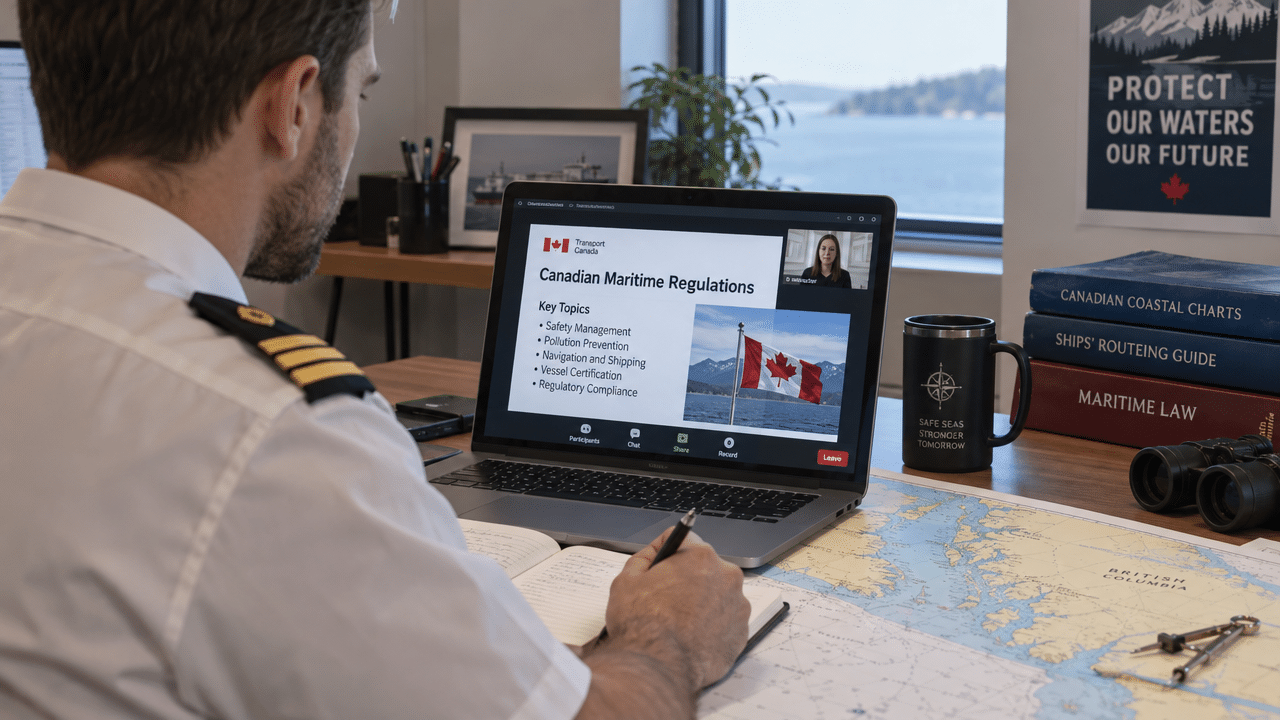
Every deck officer working on a Canadian-flagged vessel eventually runs into a gap that STCW alone doesn’t close: Transport Canada’s own rulebook. The international convention sets the floor for competency, but it was never written with Canadian waters, Canadian reporting requirements, or Canadian enforcement practice in mind. That’s why Canadian maritime regulations training online has become the standard route for officers who need country-specific knowledge without stepping away from a ship or a job search for weeks at a time. It deserves to be understood as its own training track, split by level, built around what an officer actually does on a Canadian deck.
Why Canadian Maritime Regulations Training Online Matters for Deck Officers
STCW gives every officer a shared baseline, but it stops well short of what Transport Canada actually expects once a vessel is operating in Canadian waters. The Canada Shipping Act, the Marine Personnel Regulations, and a long list of Transport Canada Ship Safety Bulletins sit on top of the convention, and they cover ground STCW never touches: domestic reporting obligations, Canadian pilotage requirements, ice regime navigation rules, and the specific paperwork a Transport Canada inspector will ask to see during a port state control visit. An officer who only studied to the international standard can hold a valid certificate and still be unfamiliar with half of what a Canadian inspection actually checks.
This gap matters most at the exact moment nobody wants to discover it: during an inspection, an incident investigation, or a Transport Canada audit. Officers who have never worked through the domestic material tend to treat Canadian-specific rules as local trivia rather than enforceable requirements, and that assumption gets expensive quickly. Dedicated training closes the distance between what STCW certified and what a Canadian-flagged vessel is legally required to do, and it does so through structured study rather than on-the-job guesswork.
Operational Level Versus Leadership Level: Where the Line Actually Falls
Transport Canada draws the line between Operational Level and Leadership Level training along the same axis STCW uses for competency generally: scope of responsibility. Operational Level content is written for officers who carry out watchkeeping duties and execute procedures that someone else has already set. Leadership Level content is written for officers who set those procedures, make the judgment calls when a situation doesn’t fit the manual, and answer for the vessel’s compliance to the company and to Transport Canada directly.
The practical difference shows up in how each course treats the same regulation. An Operational Level module on pollution prevention reporting walks through the steps: what triggers a report, what form it takes, who gets notified, and in what order. A Leadership Level module on the same subject asks the officer to weigh ambiguous situations, decide whether an event even meets the reporting threshold, and carry that call in front of a regulator afterward. Both courses touch the same regulatory material; only the altitude changes.
Inside the Operational Level Course
The Operational Level course is built around the regulations an officer handles directly and routinely, rather than the ones a master or chief officer would be the one called on to interpret. Five areas carry most of the weight:
- Vessel documentation. Canadian registration, certification, and the records an officer is expected to produce on request.
- Manning and certification rules. How the Marine Personnel Regulations determine who can stand which watch.
- Pollution reporting. Thresholds, forms, and notification chains under Canadian environmental rules.
- Domestic safety management. How Canadian requirements layer onto an existing ISM-based system.
- Inspection readiness. What a Transport Canada inspector checks and how to respond to findings.
Each of those topics is treated as something the officer will use directly on watch, not as background reading. The course works through reporting scenarios, documentation examples, and the kind of borderline cases that come up during an actual inspection, so an officer finishes with a procedure they can apply rather than a summary they half remember a month later.
Who Should Enrol, and at What Career Stage
Operational Level training fits officers working toward their first promotion past rating, or those recently promoted into a watchkeeping role on a Canadian-flagged vessel. It also suits officers who trained internationally and are joining a Canadian company for the first time, since nothing in a foreign STCW program prepares them for domestic reporting rules or Transport Canada’s inspection expectations.
Leadership Level fits officers being considered for, or already stepping into, a command or senior officer role where they personally carry accountability for compliance. Masters, chief officers, and officers moving toward those positions need the judgment-based material because they are the ones Transport Canada will hold responsible when a call turns out to be wrong, rather than the officer who simply carried out the procedure.
- New to Canadian flag. Start at Operational Level regardless of prior sea time elsewhere.
- Recently promoted to watchkeeper. Operational Level, timed close to the promotion itself.
- Named for command or chief officer. Leadership Level, completed before or shortly after taking the role.
- Already in command. Leadership Level as a refresher when regulations are updated.
How the Online Format Actually Works
Both courses run asynchronously, which matters for officers trying to fit regulatory training around rotation schedules rather than around a classroom calendar. Coursework is broken into chapters an officer can complete between watches or during time off, with each chapter closing on a short knowledge check before the following chapter becomes available.
A final exam at the end of each course confirms the material was actually absorbed, and a completion certificate from a DNV-certified provider gives officers and their employers something concrete to put in a training record. Because the entire course runs online, officers anywhere in Canada, or on rotation internationally, can complete Operational or Leadership Level training without losing time ashore or coordinating around a fixed start date.
For officers planning their next certification step, matching the course level to the role they actually hold, or the role they are about to take on, keeps the training relevant rather than redundant. Operational Level content builds the procedural foundation, and Leadership Level content builds on top of it once accountability shifts to the officer’s own judgment.
Ready to get trained on Canadian maritime regulations? Explore the Canadian Rules & Regulations Course (Operational Level) at Virtual Maritime Academy.
Explore the full range of maritime courses at Virtual Maritime Academy.
About Virtual Maritime Academy
Virtual Maritime Academy is a global leader in online maritime education and training, offering courses designed to meet the evolving needs of the shipping industry. As a DNV Certified Maritime Training Provider with CPD accreditation, we deliver cutting-edge programs that prepare seafarers and maritime professionals for today’s and tomorrow’s challenges. 🌊⚓