
Company Security Officer · Compliance
CSO Training Requirements Under the ISPS Code Explained
Virtual Maritime Academy · November 24, 2026
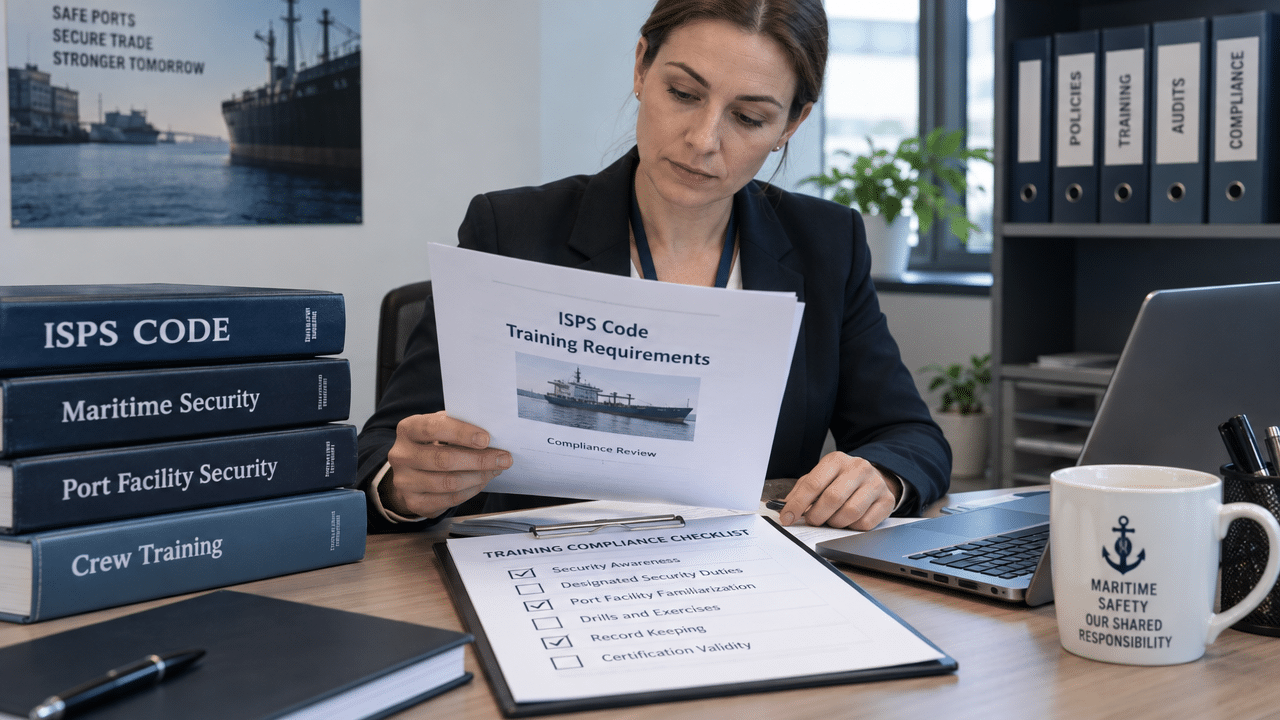
Every Company Security Officer carries a specific burden of knowledge that the ISPS Code expects them to hold, and most companies only discover how thin that knowledge actually is when an auditor starts asking pointed questions. The CSO training requirements ISPS code lays out are not vague professional development goals. They are a defined set of competencies tied to security assessments, security plans, drills, and incident response, and a CSO who cannot demonstrate them on paper is a finding waiting to happen. Getting this right starts with understanding exactly what the Code demands, then building a training record that can prove it.
What the ISPS Code Specifically Mandates a CSO Must Know
SOLAS Chapter XI-2 and Part A of the ISPS Code set out the CSO’s functions in fairly plain terms, but Part B goes further and lists the knowledge areas a CSO is expected to hold before taking on the role. These are not abstract; each one maps to a task the CSO performs on a normal working day, from reviewing a ship security assessment to liaising with a port facility security officer during a call.
- Security organization and policy. The CSO needs working knowledge of maritime and port security organizations, their relevant international instruments, codes, and recommendations, and how national legislation sits on top of them.
- Risk and assessment methods. This covers security assessment methodology, the ship security survey process, and how to identify vulnerabilities in operations, cargo handling, and access control.
- Security equipment and systems. The CSO must understand the capability and limitations of security equipment and systems fitted to the ship or used at the interface with a port facility.
- Drills, exercises, and threat response. Planning and evaluating security drills, recognizing security threats, and knowing how to respond to a change in security level all fall inside the mandate.
- Communication and crowd handling. Techniques for crowd management, handling confidential security information, and communicating clearly during an incident round out the list.
None of this is optional reading. A CSO who has never worked through a security assessment exercise or never practiced evaluating a drill against stated objectives has a gap that a company cannot paper over with a generic security awareness certificate.
CSO Training Requirements ISPS Code Sets Out for Course Content
A well-built CSO course does not just read the Code aloud and ask candidates to nod along. It takes each knowledge area from Part B and turns it into an exercise the candidate has to complete, usually modeled on the structure of IMO Model Course 3.20, which most accredited providers use as their baseline syllabus. That means a candidate should leave the course having actually drafted part of a ship security plan, not just read a sample one.
In practice, strong course content includes a worked security assessment on a sample vessel, a tabletop exercise where candidates respond to a simulated security breach, and a module on drafting and amending a ship security plan so it survives a port state control review. Courses also need to cover the three security levels and how declarations of security are handled between ship and shore, because this is where many new CSOs stumble during their first real incident.
The strongest training also tests judgment, not just recall. A multiple-choice quiz can confirm someone memorized the definition of a restricted area, but it cannot confirm they would correctly escalate an unannounced visitor at the gangway during security level two. Course design that includes scenario-based assessment is what separates a certificate that reflects real competence from one that reflects attendance.
How Companies Verify and Document That Training Requirements Are Met
Verification is where paperwork meets reality, and it needs to happen at two points: when a CSO is first appointed, and periodically afterward as the role continues. A company cannot rely on a candidate’s word that they completed an approved course. The documentation trail has to stand on its own.
- Confirm the training provider’s accreditation status and check that the course content maps to IMO Model Course 3.20 or an equivalent recognized syllabus.
- Collect the original certificate of completion, not a photocopy or a scanned signature page with no course reference number.
- Cross-check the certificate dates against the CSO’s appointment letter so there is no gap between training and the start of duties.
- Record the training in the company’s personnel or safety management system, linked to the specific vessel or fleet the CSO is responsible for.
- Note any conditions attached to the certificate, such as a requirement to complete a practical assessment component separately.
Some companies also ask the training provider for a syllabus outline alongside the certificate. This single document often resolves disputes during an audit, because it shows an assessor exactly which Part B knowledge areas were covered and how they were assessed, rather than leaving the auditor to take the certificate’s wording at face value.
Common Gaps Companies Miss When Checking a CSO’s Training Record
Several patterns show up again and again during ISM and ISPS audits, and almost all of them trace back to a company assuming a box was ticked rather than confirming it.
- Deputy CSOs left untrained. Companies often train the named CSO thoroughly but leave the designated deputy with only informal handover notes, which collapses the moment the primary CSO is unavailable during an incident.
- Generic security courses mistaken for ISPS-specific training. A broad corporate security or anti-piracy awareness course does not satisfy the Part B knowledge requirements, even if it uses similar vocabulary.
- No refresher after Code amendments. When amendments or related IMO circulars update expectations around security levels or declarations of security, companies rarely schedule refresher training to match, leaving the CSO’s knowledge frozen at the date of original certification.
- Training completed before the role existed. A CSO certificate earned years before appointment, with no bridging training tied to the company’s actual fleet and ship security plans, leaves a real gap between generic knowledge and operational readiness.
- No evidence of practical assessment. A certificate that only confirms attendance, with no record of a completed exercise or evaluated drill, gives an auditor grounds to question whether the course met the Code’s intent at all.
Each of these gaps is easy to miss during a routine file check and easy to find during a focused audit, which is exactly why they turn up so often in non-conformity reports.
How to Keep Training Records Audit-Ready
Audit readiness is less about having impressive paperwork and more about being able to produce the right document within minutes of being asked for it. Auditors notice hesitation, and a long search through email archives for a certificate sends a clear signal about how seriously training compliance is actually managed.
- Keep a single, centralized register of CSO and deputy CSO training that lists course provider, completion date, certificate number, and expiry or refresher date in one place.
- Store the certificate, the syllabus outline, and any practical assessment record together as one file, rather than scattered across different systems.
- Set a calendar reminder tied to each Code amendment review cycle so refresher training gets scheduled before a gap opens, not after an auditor points it out.
- Link the training register to the ship security plan’s revision history, so anyone reviewing the file can see that the CSO’s knowledge matches the plan currently in force.
- Run an internal spot check at least once a year, pulling a CSO file at random and confirming it would survive an external audit the same afternoon.
Companies that treat this register as a living document, updated as training happens rather than reconstructed before a visit, tend to sail through the security portion of an audit. The ones that scramble to assemble records after the fact are usually the ones explaining a non-conformity afterward instead of simply pointing to a file.
Ready to meet the ISPS training requirements for your CSO? Explore the ISPS & Company Security Officer (CSO) Course at Virtual Maritime Academy.
Explore the full range of maritime courses at Virtual Maritime Academy.
About Virtual Maritime Academy
Virtual Maritime Academy is a global leader in online maritime education and training, offering courses designed to meet the evolving needs of the shipping industry. As a DNV Certified Maritime Training Provider with CPD accreditation, we deliver cutting-edge programs that prepare seafarers and maritime professionals for today’s and tomorrow’s challenges. 🌊⚓