
Designated Person Ashore · Role
What Is a Designated Person Ashore? Duties and Responsibilities Under the ISM Code
Virtual Maritime Academy · November 23, 2026
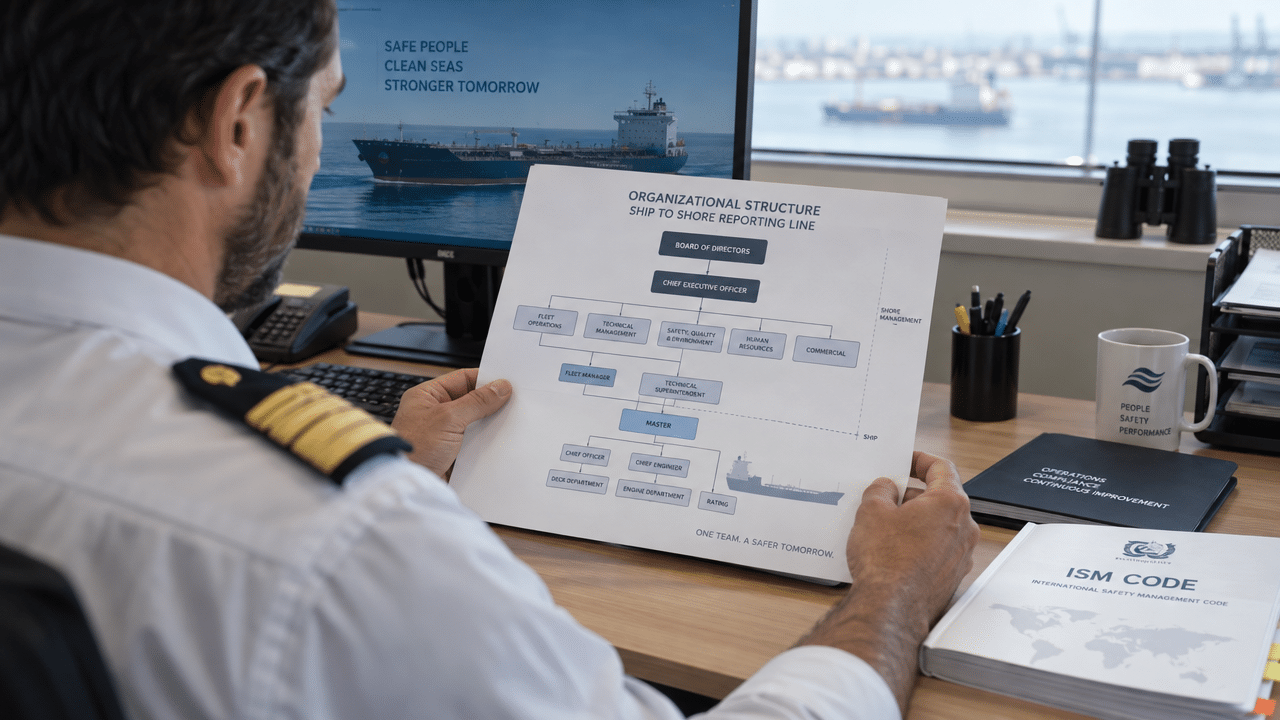
Every certified company operating under the ISM Code has to name someone whose job is to be the link between the ships and the people who run the company, and whose authority does not depend on staying in anyone’s good graces. That person is the designated person ashore, or DPA, and understanding designated person ashore duties and responsibilities is one of the first things a new safety or compliance manager needs to get straight, because the role is written into the Code itself rather than left to company policy.
What the Role Is and Where It Comes From
The DPA requirement sits in Element 4 of the ISM Code, which obliges every company to designate a person or persons ashore having direct access to the highest level of management. The Code does not treat this as an optional good practice item. It is a mandatory element of the safety management system, and a company without a properly functioning DPA cannot hold a valid Document of Compliance. The idea behind the requirement is fairly simple: safety management on paper is worthless if there is no independent channel through which problems on board can reach someone ashore who has the standing to act on them without first clearing it with a commercial manager or a chartering department.
Flag states and classification societies, DNV among them, expect the DPA to be named formally, with a job description, defined authority, and evidence that the person actually performs the function rather than holding the title on paper. Some companies appoint one DPA for the whole fleet, others appoint several for different vessel types or geographic regions, and larger groups sometimes use a small team. Whatever the structure, the Code requires that the function be clearly assigned and that everyone on board and ashore knows who holds it.
Designated Person Ashore Duties and Responsibilities Under Element 4
The Code spells out the core of the job in fairly plain language, and it comes down to two connected tasks. First, the DPA monitors the safety and pollution prevention aspects of the operation of each ship, which in practice means staying close enough to real conditions on board to notice when something is drifting away from the safety management system rather than relying only on reports that have already been filtered and softened on their way up. Second, the DPA has to ensure that adequate resources and shore based support are applied to the ship as required, which is a broader and sometimes harder obligation because it can mean pushing back against budget decisions, staffing plans, or maintenance deferrals that put a vessel at risk.
In day to day terms, this usually involves:
- Reviewing incident and near miss reports. The DPA looks for patterns across the fleet, not just isolated events, and checks that corrective actions are genuinely closed out rather than marked complete on a spreadsheet.
- Tracking audit and inspection findings. Internal audits, flag state inspections, port state control detentions, and vetting results all feed into the DPA’s picture of where the safety management system is weak.
- Following up on crew concerns. Masters and officers need a route to raise safety issues that bypasses operational pressure, and the DPA is that route.
- Checking resourcing decisions. Spare parts budgets, manning levels, and shore technical support all get scrutinized when they start to affect safe operation.
None of this works as a box ticking exercise. Auditors and flag state surveyors who look closely at a DPA file are trying to see evidence of genuine engagement with real operational problems, not a folder of memos written to satisfy a checklist.
The Reporting Line to the Highest Level of Management
What separates the DPA from almost every other shore based safety role is the direct access clause. The Code requires the DPA to have direct access to the highest level of management, meaning the DPA does not have to route concerns through a chain of operational managers before they reach someone with real decision making power. That access has to be real and unblocked, not a theoretical line on an organizational chart that nobody actually uses.
Safety concerns that get softened, delayed, or quietly dropped at each level of a management hierarchy never reach the people who can fix them. A DPA who can walk into the managing director’s office, or pick up the phone to the board, removes that filtering problem. If a vessel is being pushed to sail with an outstanding deficiency because of commercial pressure, the DPA’s job is to make sure that decision gets made by someone at the top with full knowledge of the risk. Companies that genuinely respect this access tend to show it through documented escalation procedures and a track record of the DPA’s concerns actually changing outcomes.
DPA Versus Marine Superintendent or QHSE Manager
Confusion between the DPA and other shore roles comes up often, partly because the same person sometimes holds more than one title. A marine superintendent is generally focused on technical and operational oversight of specific vessels, including surveys, dry dockings, repairs, and day to day fleet management. A QHSE manager usually owns the broader quality, health, safety, and environmental management system, writing procedures, running internal audits, and coordinating certification. Both roles are valuable and both interact constantly with safety matters, but neither carries the statutory independence that the ISM Code assigns specifically to the DPA.
The distinction is about where the authority sits when something goes wrong. A superintendent can be overruled by a commercial or technical director without that being a violation of anything. A QHSE manager’s recommendations can be deprioritized in favor of other business needs without triggering a compliance problem. The DPA’s direct line to top management exists precisely so that this kind of override cannot happen quietly on a safety critical matter. Some companies combine the DPA function with the QHSE manager role for efficiency, and that can work, provided the person still has unobstructed access to senior leadership and the independence to flag issues that might be inconvenient for the department they also sit in.
How DPA Duties Get Verified During Audits
Auditors, whether internal, flag state, or from a recognized organization such as DNV, do not simply ask whether a DPA has been named. They look for evidence that the function operates as the Code intends. A typical audit of the DPA role will include:
- Confirmation that the DPA’s name, contact details, and scope of authority are documented and communicated to every vessel in the fleet, usually posted on board and referenced in the safety management manual.
- A review of records showing the DPA actually receiving and acting on reports, such as non-conformity logs, near miss reports, and master’s monthly reports, with evidence of follow up rather than passive filing.
- Interviews with masters and senior officers to confirm they know who the DPA is and have used, or would feel able to use, the direct reporting channel.
- Evidence of the DPA’s access to top management, such as minutes from management review meetings, direct correspondence with the managing director, or escalation records tied to specific incidents.
- A check that resourcing concerns raised by the DPA, such as under crewing, deferred maintenance, or spare parts shortages, were tracked through to a resolution rather than left open indefinitely.
Where auditors tend to raise findings is when the DPA title exists but the substance does not: no record of real engagement with incidents, no documented path to senior management, or a DPA who is also the person responsible for the commercial decisions they are meant to be checking. Building a DPA function that survives this kind of scrutiny means treating the role as a genuine operational safeguard from the start, with the authority, time, and independence to do the job the Code actually describes.
Ready to get properly trained for the DPA role? Explore the ISM Proficiency as Designated Person Ashore (DPA) Course at Virtual Maritime Academy.
Explore the full range of maritime courses at Virtual Maritime Academy.
About Virtual Maritime Academy
Virtual Maritime Academy is a global leader in online maritime education and training, offering courses designed to meet the evolving needs of the shipping industry. As a DNV Certified Maritime Training Provider with CPD accreditation, we deliver cutting-edge programs that prepare seafarers and maritime professionals for today’s and tomorrow’s challenges. 🌊⚓