
Cybersecurity · Regulations
IMO Maritime Cyber Risk Management: Requirements and Best Practices
Virtual Maritime Academy · November 22, 2026
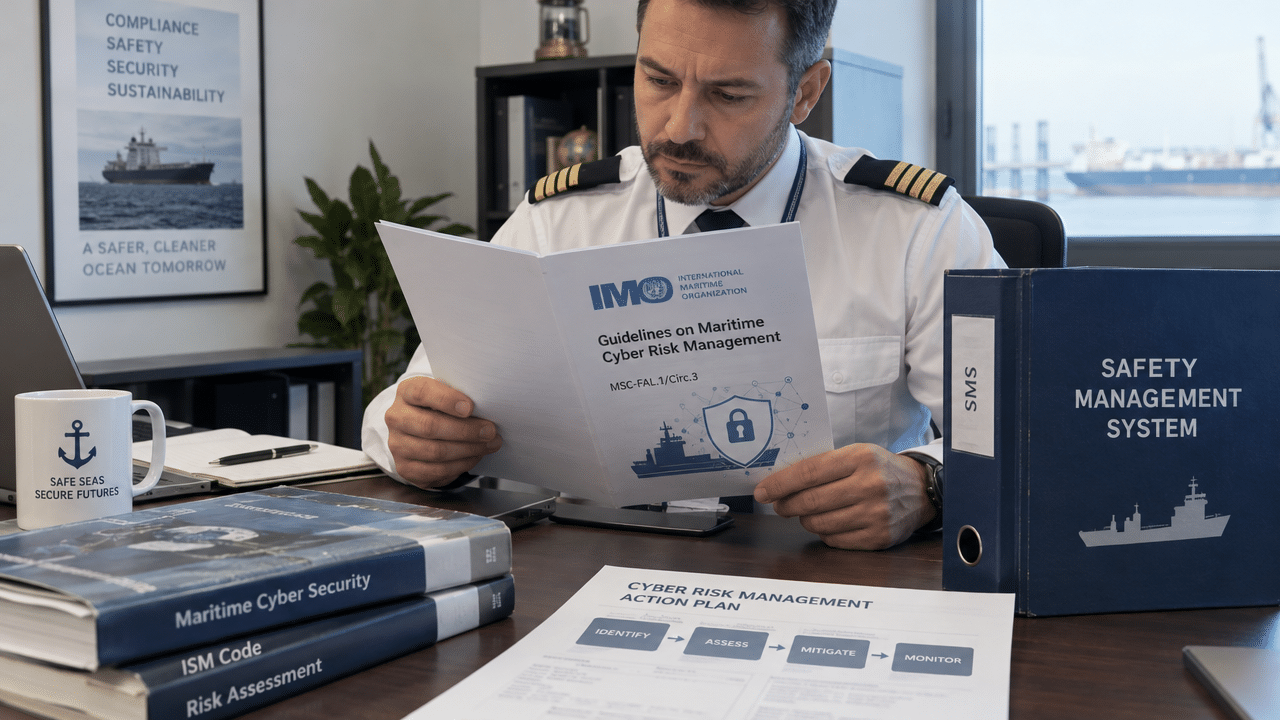
When the International Maritime Organization adopted Resolution MSC.428(98) in June 2017, it did not create a new certificate to hang in the chart room or a standalone cyber security code to bolt onto existing paperwork. It took a narrower, more lasting approach: it confirmed that an approved Safety Management System already has to address cyber risks, because IMO maritime cyber risk management falls squarely within the risk management obligations already written into the ISM Code. For any company running ISM-certified ships, this stopped being a theoretical talking point on 1 January 2021, the date by which flag states and recognized organizations began confirming, at the first annual or intermediate verification of the Document of Compliance after that date, that cyber risks were being addressed within the SMS. There was no separate cyber endorsement to earn and no new form to file. It simply became one more thing an auditor looks for when the SMS manuals come out.
What MSC.428(98) Actually Requires
The resolution itself is short, and that brevity trips people up. It does not list required controls, mandate a specific framework, or specify how often a penetration test should run. What it does is state, in effect, that cyber risks meet the definition of a risk that a Safety Management System must manage under ISM Code Section 1.2.2.2, alongside fire, flooding, mechanical failure, and every other hazard a company already assesses. The IMO’s supporting guidelines, MSC-FAL.1/Circ.3, flesh this out with a five-function structure borrowed loosely from the NIST Cybersecurity Framework: identify, protect, detect, respond, and recover. Those guidelines are recommendatory rather than mandatory, but in practice they have become the reference point every flag state and class society audits against, because there is no competing standard that carries the same weight.
This matters because it changes where the obligation lives. A company cannot satisfy MSC.428(98) by buying a firewall and calling it done, and it cannot satisfy it by issuing a memo telling crew not to click suspicious links. The requirement sits inside the management system itself, which means it has to show up in risk assessments, in procedures, in training records, and in the documents an auditor pulls during a DOC verification.
Why IMO Maritime Cyber Risk Management Belongs Inside Your SMS
For a company’s SMS, this requirement does not ask for a cyber security policy filed away as a separate binder. It asks for cyber risk to be treated the way the SMS already treats every other operational hazard, which means running it through the same risk assessment methodology the company uses for everything else. That typically means identifying the critical systems on board, both information technology such as email and administrative networks, and operational technology such as ECDIS, GPS, AIS, ballast control, and engine monitoring systems, then assessing what happens if each one is compromised, degraded, or taken offline.
Auditors reviewing a Document of Compliance verification are now looking for evidence that this assessment actually happened and that it feeds the rest of the system. That evidence usually takes the form of a cyber risk register tied into the existing risk assessment procedure, references to cyber risk in the company’s overall SMS risk assessment documentation, a defined response plan for cyber incidents that sits alongside the emergency response procedures for fire or collision, and management review minutes that show cyber risk was actually discussed rather than rubber stamped. Companies that treat this as paperwork rather than substance tend to get found out quickly, because an auditor only has to ask one or two pointed questions about a specific shipboard system to see whether the risk assessment reflects the actual vessel or was copied from a template.
Best Practices for Meeting the Requirements
Several practices separate companies that pass this part of an audit comfortably from companies that scramble every year to patch together evidence after the fact.
- Build a real asset inventory. You cannot assess risk to systems you have not catalogued. List every networked IT and OT system on each vessel class, who has access to it, and how it connects to anything else.
- Separate IT and OT networks where possible. Many of the serious shipboard incidents on record involved malware that moved from an administrative network into navigation or propulsion systems because the two were never properly segmented.
- Write a cyber incident response plan that names names. Generic language about “notifying relevant parties” does not help a master at 0300 hours. The plan needs specific contacts, specific steps, and a clear line to the company’s emergency response procedure.
- Review third-party and vendor access. Chart update providers, remote diagnostics vendors, and port agents routinely connect to shipboard systems, and each connection is a door someone else controls.
- Test the plan, not just the document. A tabletop exercise or a scheduled drill involving a simulated cyber incident surfaces gaps that a policy review on paper never will.
- Keep the risk assessment current. Systems change, vendors change, and a cyber risk register last updated two audit cycles ago is a finding waiting to happen.
None of this requires a dedicated information security department. Most companies fold it into existing roles: the designated person ashore, the technical superintendent, and whoever already owns the SMS document control process typically share the work between them.
Connecting the Framework to Crew-Level Awareness
All the policy work in the previous section accomplishes very little if the people operating the ship every day cannot recognize a phishing email, do not know what to do with an unfamiliar USB drive handed over in port, or share login credentials across the crew because it is faster. Regulators understand this, which is why the guidelines behind MSC.428(98) tie the “protect” function directly to personnel awareness and training, not only to technical controls.
Crew who understand why a particular procedure exists follow it more consistently than crew who are simply told to follow it. A seafarer who knows how a single compromised laptop took down a major shipping line’s booking systems for days, or how GPS manipulation has been used to mask a vessel’s real position, has a concrete reason to pause before plugging in an unverified device or trusting an unexpected email attachment. This is also where the SMS requirement and the training requirement meet: training records documenting that crew received cyber awareness instruction are themselves part of the evidence an auditor expects to see, closing the loop between policy and practice.
Where to Get Trained
Building IMO maritime cyber risk management compliance into an SMS is ultimately a combination of two things: a management-level risk assessment process that satisfies auditors, and a crew that has actually internalized the behaviors the policy describes. Virtual Maritime Academy offers courses that address both halves, giving shore staff and designated persons ashore a working understanding of the regulatory framework while giving seafarers the practical, scenario-based awareness training that auditors and company management both want to see documented. Courses are self-paced and DNV-certified, which means the completion record itself becomes usable evidence the next time a Document of Compliance verification asks the question every auditor now asks: can you show me how you manage this risk?
Ready to build cyber risk awareness across your crew? Explore the Maritime Cyber Security Awareness Course at Virtual Maritime Academy.
Explore the full range of maritime courses at Virtual Maritime Academy.
About Virtual Maritime Academy
Virtual Maritime Academy is a global leader in online maritime education and training, offering courses designed to meet the evolving needs of the shipping industry. As a DNV Certified Maritime Training Provider with CPD accreditation, we deliver cutting-edge programs that prepare seafarers and maritime professionals for today’s and tomorrow’s challenges. 🌊⚓