How to Become a Company Security Officer (CSO) in the Maritime Industry
Maritime Security · Careers
How to Become a Company Security Officer (CSO) in the Maritime Industry
Virtual Maritime Academy · November 5, 2026
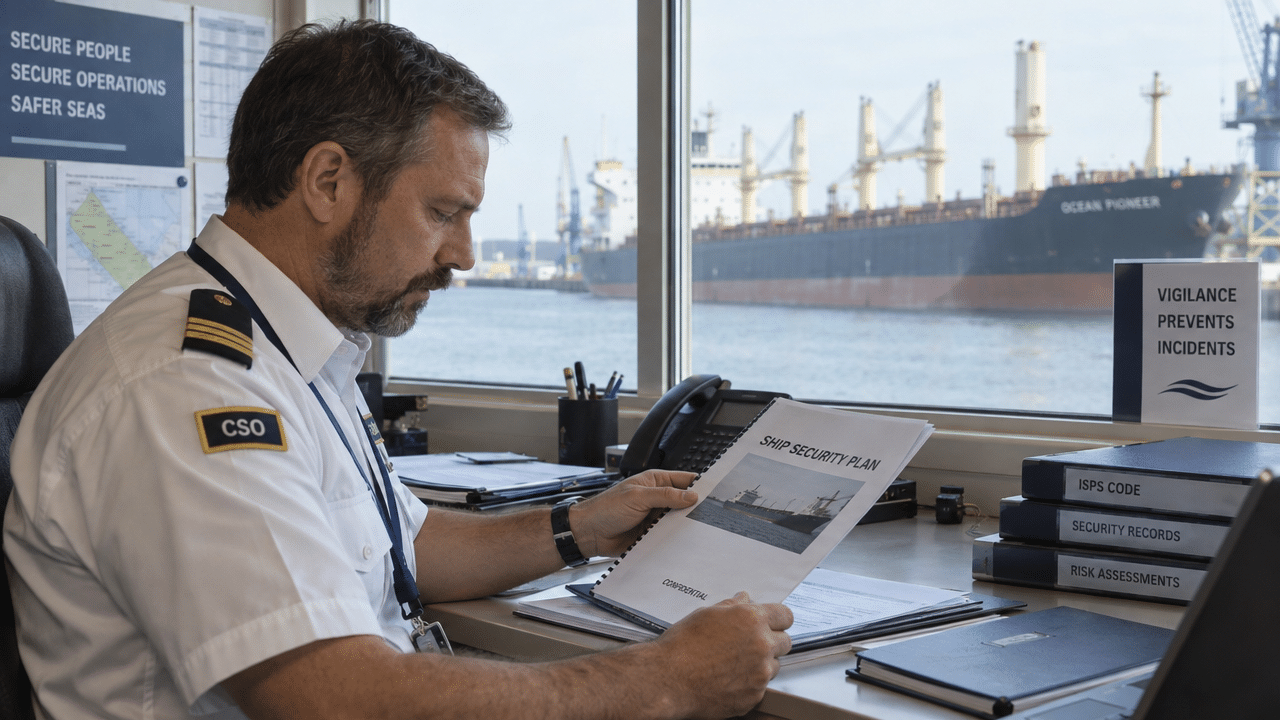
Every shipping company operating under the ISPS Code needs one named person who owns security decisions at the company level, and that person is the Company Security Officer, or CSO. Deck officers and shore-side staff ask about this role constantly, usually after a few years at sea or in a QHSE department, once they start wondering whether a company security officer career is a realistic next step or just a job title buried in the SSP manual. It is realistic, and it tends to attract people who already understand vessel operations and want to move into a position with broader influence over how a fleet handles risk. This guide walks through what the role actually involves, the backgrounds that tend to produce strong CSOs, the training path that gets you certified, and the gaps that most often stall an application before it gets taken seriously.
What the ISPS Code Requires of a Company Security Officer
The International Ship and Port Facility Security (ISPS) Code was written after 9/11 to close an obvious gap in maritime regulation: ships and ports had safety management systems, but no equivalent framework for deliberate security threats. Part of that framework is a chain of named responsibility. Every company that operates ISPS-regulated ships must designate a CSO, and every ship must have a Ship Security Officer (SSO) who reports security matters up to that person. The CSO sits above the vessel level, which is what makes the job different from an SSO posting on board.
A CSO’s duties typically include developing and maintaining the Ship Security Plan (SSP) for each vessel in the fleet, arranging internal audits and security assessments, acting as the point of contact with port facility security officers and flag state authorities, and making sure the company’s security measures actually get funded and implemented rather than just documented. When a security incident happens, whether it is a stowaway, a piracy attempt, or a cyber intrusion affecting navigation systems, the CSO is usually the person coordinating the company’s response and reporting to the flag administration. None of this is paperwork for its own sake; a weak SSP or a CSO who cannot get resources approved leaves real vessels exposed in real waters.
Backgrounds That Typically Lead Into the Role
Three backgrounds show up most often among working CSOs. The first is deck and engine officers who have sailed as Master, Chief Officer, or Chief Engineer and understand vessel operations from direct experience. They know how an SSP actually gets used on board, which makes it easier to write one that masters and crews will follow rather than quietly ignore. The second is QHSE professionals who already manage safety management systems, internal audits, and regulatory compliance ashore. Their skill set overlaps heavily with CSO work, since a large part of the job is audit scheduling, documentation control, and liaising with certifying bodies. The third is shore-side security specialists, sometimes with a background in port facility security, law enforcement, or corporate risk management, who bring threat assessment skills but usually need to build up maritime-specific regulatory knowledge.
None of these paths is automatically better than the others. A company evaluating candidates for a CSO opening is looking for a mix of operational credibility, familiarity with the regulatory environment, and the administrative discipline to keep plans current across a fleet that might include ships of different ages, flags, and trading patterns. Sailing experience earns a shipowner’s trust faster, but a QHSE background often means the audit and documentation side of the job needs less of a learning curve.
Training and Certification: The DNV-Certified CSO Route
The ISPS Code sets out specific knowledge requirements for anyone performing CSO duties, covering security administration, risk assessment methodology, recognition of weapons and dangerous substances, drills and exercises, and the content of Ship and Company Security Plans. Completing a recognized CSO course demonstrates that a candidate meets those requirements rather than just claiming familiarity with them on a resume.
A DNV-certified CSO training course gives employers and flag administrations a recognizable mark of quality, since DNV is one of the classification societies and certification bodies that shipping companies already deal with for ISM and ISPS audits. Coursework generally runs through the regulatory background of the ISPS Code, the structure and content of the SSP, methods for conducting ship and facility security assessments, incident response and reporting procedures, and the coordination required between the CSO, SSOs, and port facility security officers. Most candidates complete the course online, which suits working officers and shore staff who cannot step away for an in-person session of several days.
- Confirm the course you choose maps directly to the ISPS Code knowledge requirements for CSOs, not just a general maritime security overview.
- Favor a provider whose certificate is recognized by classification societies and flag states you expect to deal with.
- Keep your certificate and training records organized, since a company will ask for proof during hiring and auditors will ask again later.
Mapping Out a Company Security Officer Career Path
Most people reach this position through a sequence rather than a single application, so it helps to think of a company security officer career as something built in stages over several years.
- Build sea time or shore-side QHSE experience to a senior level, since companies want someone who already understands how operations run before handing them fleet-wide security authority.
- Take on SSO duties on board, if your background is seagoing, to get hands-on exposure to the SSP, drills, and audits from the ship’s side.
- Complete a recognized CSO training course, such as a DNV-certified program, once you are ready to formalize your qualification.
- Move into a shore-based security, QHSE, or operations role where you can support an existing CSO, draft or review SSPs, and sit in on audits.
- Apply for CSO or deputy CSO positions once you can show both the certificate and documented experience handling security assessments or incident response.
Smaller companies sometimes combine the CSO role with another shore-side position, such as QHSE manager or operations manager, which can be a faster entry point than waiting for a dedicated CSO vacancy at a larger operator. Larger fleets, by contrast, tend to want a full-time CSO with deputies, so the path there usually runs through a deputy or assistant CSO posting first.
Common Qualification Gaps That Hold Candidates Back
Hiring managers reject strong-looking candidates more often over gaps than over outright lack of qualification. The most frequent one is a certificate that exists but has never been applied, meaning the candidate finished a CSO course years ago with no subsequent involvement in an SSP review, an audit, or an incident report. Experience keeps a certificate meaningful, and a long gap raises doubts about whether the knowledge is current.
A second gap shows up among candidates with strong shore-side security backgrounds but limited exposure to how a ship’s crew actually operates day to day. Writing a usable SSP requires knowing what a watchkeeping officer can realistically do during a port call, and a candidate who has never served or spent meaningful time on board often writes plans that look correct on paper but do not survive contact with actual operations. A third gap is weaker-than-expected familiarity with related regulatory frameworks, particularly the ISM Code and flag state requirements, since a CSO regularly has to reconcile security obligations with the rest of the company’s management system rather than treat them as a separate silo. Candidates who address these three gaps before applying, through deliberate experience, a recognized certificate, and broad regulatory literacy, tend to move through the hiring process far faster than those who rely on sea time or shore experience alone.
Ready to build the training record a CSO appointment needs? Explore the ISPS & Company Security Officer (CSO) Course at Virtual Maritime Academy.
Explore the full range of maritime courses at Virtual Maritime Academy.
About Virtual Maritime Academy
Virtual Maritime Academy is a global leader in online maritime education and training, offering courses designed to meet the evolving needs of the shipping industry. As a DNV Certified Maritime Training Provider with CPD accreditation, we deliver cutting-edge programs that prepare seafarers and maritime professionals for today’s and tomorrow’s challenges. 🌊⚓