MLC 2006 Training Online: Who Should Take a Maritime Labour Compliance Course?
Seafarer Welfare · Training
MLC 2006 Training Online: Who Should Take a Maritime Labour Compliance Course?
Virtual Maritime Academy · November 19, 2026
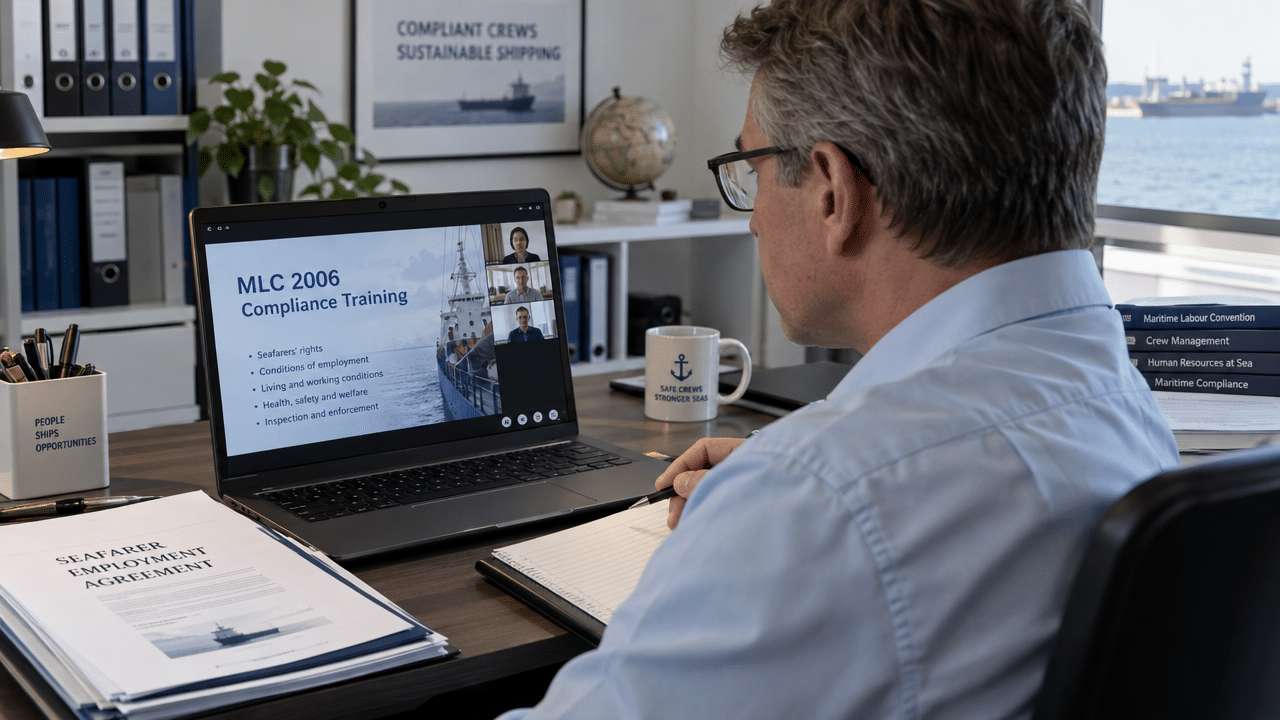
Every port state control officer who boards a vessel today will, at some point in the inspection, ask to see crew employment agreements, hours of rest records, and evidence of a functioning onboard complaint procedure. Those checks exist because of the Maritime Labour Convention, 2006, and getting them wrong has real consequences: detentions, fines, and reputational damage that follows a company for years. That is why demand for MLC 2006 training online has grown steadily across the industry, from small ship management offices to large third-party crewing agencies. The convention did not appear out of nowhere. It consolidated more than sixty older ILO instruments into one coherent framework covering minimum age, recruitment practices, accommodation, food, medical care, and social security protections for seafarers. Compliance is not optional, and the people responsible for it need more than a passing familiarity with the text.
Why MLC 2006 compliance training exists in the first place
Before the convention entered into force in 2013, seafarer labour standards were scattered across dozens of conventions and recommendations, many of them ratified unevenly from country to country. A ship could technically comply with one instrument while falling well short of another, and enforcement varied wildly depending on flag and port state. The MLC fixed that by creating a single ratified standard with a certification system attached to it: ships over 500 gross tonnage engaged in international voyages must carry a Maritime Labour Certificate and a Declaration of Maritime Labour Compliance, both of which depend on documented internal systems, not just good intentions. Training grew up around this requirement because the convention’s fourteen titles touch nearly every department on a ship, and someone in the office has to translate those titles into working procedures, checklists, and audit evidence.
Who actually needs this training
Several roles overlap in MLC responsibility, and each one needs a slightly different depth of understanding.
- Crewing managers and HR staff. They draft employment agreements, manage recruitment and placement arrangements, and have to prove those arrangements meet Title 1 and Title 2 requirements before a seafarer ever steps aboard.
- Designated Persons Ashore (DPAs). Many DPAs already carry ISM responsibilities, and MLC compliance now sits alongside that role in most companies, particularly around grievance handling and welfare complaints.
- Internal and external auditors. Anyone conducting internal MLC audits or supporting a recognized organization’s certification audit needs to know what documented evidence actually satisfies each title, not just what the checklist says.
- Shipowners and superintendents. Ultimate accountability for the Declaration of Maritime Labour Compliance rests with the owner, and superintendents overseeing vessel operations are usually the ones fielding questions during a port state inspection.
- Masters and senior officers. The master is responsible for maintaining records onboard and handling onboard complaints correctly, which makes a working knowledge of the convention part of the job rather than an optional extra.
If a company handles crew of multiple nationalities working under different flag state requirements, the case for structured training becomes even stronger, since the convention leaves certain details to national implementation and a generalist HR background will not catch every variation.
What a good MLC compliance or auditor course actually covers
A course worth its tuition goes well beyond summarizing the fourteen titles. It walks through the practical documentation a company and a ship need to maintain, including Part I and Part II of the Declaration of Maritime Labour Compliance, and explains why Part II has to reflect real operational practice rather than copied boilerplate. Expect modules on seafarer employment agreements and what makes one legally sufficient, hours of work and rest record-keeping and the common errors that trigger deficiencies, onboard accommodation and recreational facility standards, food and catering requirements, health protection and medical care access, and the onboard complaint procedure from first report to resolution.
Courses aimed at auditors add a further layer: how to plan an MLC audit, how to sample records without missing systemic problems, how to word a finding so it holds up under scrutiny, and how to distinguish a minor nonconformity from something serious enough to affect certification. A well-built course also covers the relationship between MLC and other frameworks seafarers encounter, such as STCW and ISM, since inspectors frequently look at how these systems interact rather than treating each one in isolation.
How MLC 2006 training online is typically delivered and assessed
Most MLC 2006 training online programs are built around self-paced modules that combine short video or narrated lessons with reading material drawn directly from the convention text and its guidelines. This structure suits the audience well, since crewing managers, DPAs, and superintendents rarely have a free week to sit in a classroom, and a course that can be worked through in evening sessions or between port calls gets finished rather than abandoned. Good programs break the material into chapters aligned with the convention’s titles, each followed by a short knowledge check before moving on, so gaps get caught early rather than at the final exam.
Assessment generally combines chapter quizzes with a longer final examination, often timed and proctored to some degree, that tests whether the learner can apply the convention to a scenario rather than just recall a definition. A case-based question about handling an onboard complaint, for instance, reveals far more about readiness than a multiple-choice question asking someone to recite Title 5’s structure. On successful completion, reputable providers issue a certificate that names the specific standard covered and the date of completion, which matters when a company has to demonstrate to a flag state or classification society that its shore staff received documented training.
How to get started
Getting started does not require clearing a calendar. The first step is figuring out which course level fits the role: a crewing manager or DPA generally needs a compliance-focused course covering documentation and procedures, while someone who will conduct or support audits needs the auditor-track version with its added emphasis on evidence gathering and finding-writing. From there, a short list of practical steps keeps the process moving.
- Confirm whether the course provider’s certificate is accepted by the flag states and classification societies your fleet works with, since recognition varies by provider.
- Check that the syllabus maps directly to the convention’s titles rather than offering a generic labour-law overview.
- Look for a course that includes real documentation examples, such as sample Declarations of Maritime Labour Compliance, rather than text summaries alone.
- Set a realistic completion window, given that most programs run between eight and twenty hours depending on depth and whether the auditor module is included.
- Register directly through the provider’s website and keep the completion certificate on file alongside other shore staff training records.
Companies managing several roles at once often enroll a cohort together so that crewing staff, DPAs, and junior superintendents work through the same material and arrive at a shared understanding of what inspectors and auditors will actually ask for. That shared baseline tends to pay off the first time a port state control officer asks a question nobody in the office expected.
Ready to get trained on MLC 2006 compliance? Explore the MLC Lead Internal Auditor Course at Virtual Maritime Academy.
Explore the full range of maritime courses at Virtual Maritime Academy.
About Virtual Maritime Academy
Virtual Maritime Academy is a global leader in online maritime education and training, offering courses designed to meet the evolving needs of the shipping industry. As a DNV Certified Maritime Training Provider with CPD accreditation, we deliver cutting-edge programs that prepare seafarers and maritime professionals for today’s and tomorrow’s challenges. 🌊⚓