Maritime Cybersecurity Training: Why Every Seafarer Needs Cyber Awareness
Cybersecurity · Seafarer Training
Maritime Cybersecurity Training: Why Every Seafarer Needs Cyber Awareness
Virtual Maritime Academy · November 13, 2026
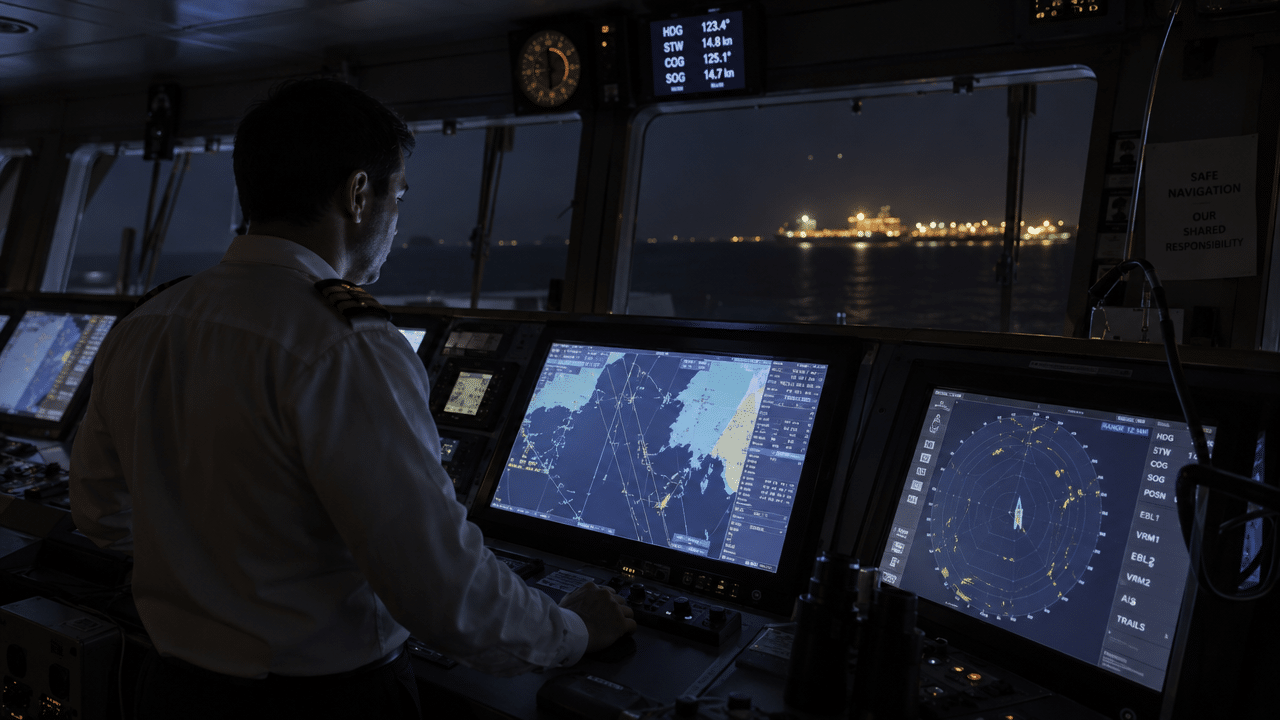
Ask a bridge officer who is responsible for cybersecurity aboard their ship, and many will point toward the IT department ashore, or shrug and say it belongs to someone else. That assumption is quietly dangerous. Every seafarer who touches a keyboard, plugs in a USB drive, or logs into a port’s cargo booking system is now a working part of the vessel’s cyber defenses, whether they signed up for that role or not. This is exactly why maritime cybersecurity awareness training has moved from a nice-to-have for shore staff to a standard expectation for crew at every level, from cadets to masters.
Why Cyber Risk Now Reaches Every Seafarer
A generation ago, a ship’s most sensitive systems were mechanically isolated from the outside world. Steering, propulsion monitoring, and cargo control ran on closed loops that nobody outside the engine room could reach without physically being there. That isolation has largely disappeared. Modern vessels run on integrated networks where the electronic chart system, satellite communications, crew Wi-Fi, and even refrigeration monitoring often share the same backbone. A compromised laptop in the officers’ mess can, in the wrong circumstances, end up talking to the same network segment as the ECDIS.
That connectivity brings real operational benefits: remote diagnostics, weather routing, faster port clearance, and better fleet oversight. It also means a single careless click by a deck cadet checking personal email on a shared terminal can open a door that an attacker has been waiting for. Cybersecurity used to be a shore-side IT concern because the systems that mattered were ashore. Now the systems that matter are underway, twelve time zones from the nearest help desk, and the person standing in front of them is almost always a crew member, not a specialist.
The Real-World Vectors Crew Encounter Every Watch
It helps to be specific about where risk actually shows up on board, because “cyber threat” can sound abstract until you name the exact screen a crew member is looking at. These are the points of contact seafarers deal with on a normal rotation, not hypothetical scenarios from a conference slide.
- Navigation and bridge systems: GPS spoofing or jamming, corrupted chart updates loaded from an unverified source, and ECDIS software that has not been patched in months because nobody on board owns that task.
- Email and messaging: phishing attempts dressed up as agent instructions, bunker invoices, or port authority notices, often timed to arrive right before a busy port call when an officer is least likely to check carefully.
- USB devices and removable media: contractors, surveyors, and pilots who plug personal drives into shipboard terminals for chart updates or software patches, sometimes without anyone asking what else is on that drive.
- Port system interfaces: cargo manifests, terminal operating systems, and single-window customs portals that crew must log into using credentials that are shared, reused, or written on a sticky note by the chart table.
None of these require a crew member to be technically skilled to cause a problem. They require only that the crew member not recognize the warning signs, which is a training gap rather than a character flaw.
What IMO’s Maritime Cyber Risk Guidelines Expect From Crew
The International Maritime Organization addressed this directly through MSC-FAL.1/Circ.3 and the related guidelines on maritime cyber risk management, which pushed companies to fold cyber risk into their existing Safety Management System under the ISM Code rather than treating it as a separate IT policy sitting in a drawer somewhere. That shift matters for crew because it means cyber risk is now audited, documented, and tied to the same accountability structure as fire drills or lifeboat musters.
In practical terms, the guidelines expect officers and crew to be able to identify suspicious activity on shipboard systems, follow defined procedures for reporting an incident rather than quietly trying to fix it themselves, understand which systems on board are considered critical, and know their own role in the ship’s cyber risk management plan. A master is expected to treat a cyber incident the way they would treat a mechanical casualty: contain it, report it, and document it, rather than hoping it resolves on its own before the next port.
Flag states and port state control officers are increasingly asking to see evidence that this expectation has been met. A company can write an excellent cyber risk policy, but if the crew on a given vessel cannot explain what they would do if the ECDIS started behaving oddly mid-passage, that policy has not actually reached the people who need it.
What a Maritime Cybersecurity Awareness Training Course Actually Covers
A well-built course aimed at seafarers does not try to turn a deck officer into a network administrator, and it should not. The goal is recognition and response, built around the same systems and situations covered above. A solid program typically walks through:
- The difference between IT systems (email, administration, crew welfare) and OT systems (navigation, propulsion, cargo control), and why each carries different risks.
- How to spot a phishing attempt before clicking, including the specific red flags common in maritime-themed scams such as fake agent emails and spoofed port authority notices.
- Safe handling of USB drives and removable media, including when to decline a device outright.
- Password discipline and account hygiene for shared shipboard systems and port portal logins.
- What the IMO guidelines and the company’s own Safety Management System actually require of the person on watch.
- A clear, rehearsed reporting chain so that a suspected incident gets escalated in minutes rather than discovered weeks later during an audit.
Courses that stop at generic internet safety advice miss most of what makes maritime cybersecurity awareness training useful in the first place: the scenarios have to be set on a bridge, in a cargo office, or at a terminal gate, not in a generic office cubicle, because that is where the decisions actually get made.
How to Get Trained, From Awareness Level to Advanced
Most seafarers should start at the awareness level, which is designed to be completed without any IT background and focuses on recognition, reporting, and basic good habits. This level suits every rank and department, since the person most likely to open a malicious attachment is just as likely to be the chief cook checking a supply order as it is an officer on the bridge.
From there, officers who hold responsibility for the ship’s Safety Management System, or who are designated as the vessel’s cyber security point of contact, benefit from a deeper course that covers incident response planning, risk assessment methods, and how to work with a Company Security Officer or shore-side IT team during an active incident. Shore staff and those pursuing designated security officer roles can go further still, into courses that address governance, vendor risk, and the technical side of network segmentation on board.
The practical path looks like this: complete an awareness-level course as part of onboarding or your next certificate renewal cycle, confirm with your company whether cyber awareness is already built into your SMS familiarization requirements, and if you hold or are working toward a security-related role on board, ask your training department about the advanced modules that build on the awareness course rather than duplicating it. Training that stacks this way, each level building on real knowledge from the one before it, tends to stick far better than a single long seminar crammed in before sign-on.
Ready to take your maritime cybersecurity skills further? Explore the Maritime Cyber Security – Advanced Course at Virtual Maritime Academy.
Explore the full range of maritime courses at Virtual Maritime Academy.
About Virtual Maritime Academy
Virtual Maritime Academy is a global leader in online maritime education and training, offering courses designed to meet the evolving needs of the shipping industry. As a DNV Certified Maritime Training Provider with CPD accreditation, we deliver cutting-edge programs that prepare seafarers and maritime professionals for today’s and tomorrow’s challenges. 🌊⚓